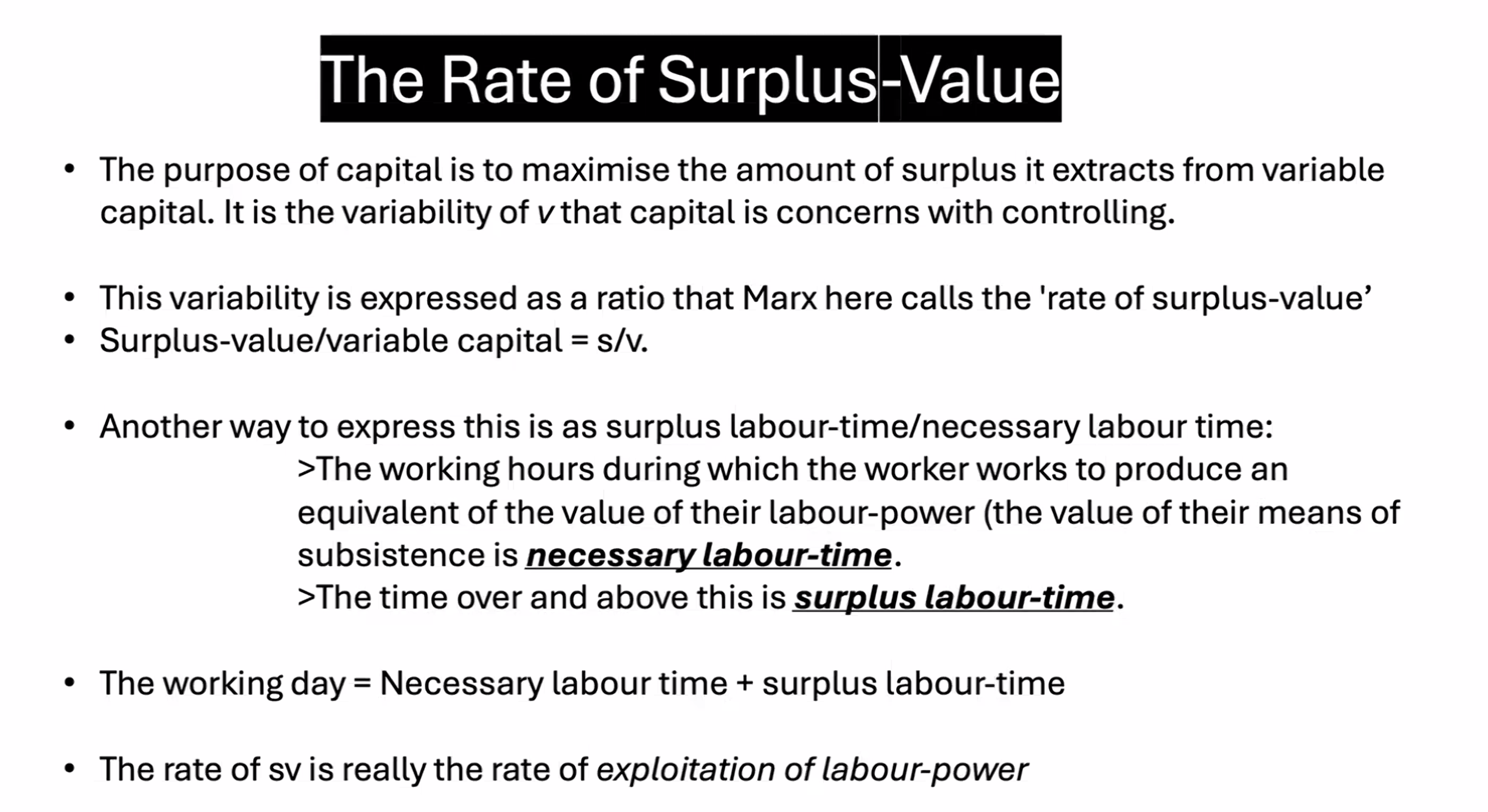
Capital Vol. 1, Ch. 9 — mind map
Text version — the same content in reading order
Economic Manuscripts: Capital Vol. I - Chapter Nine — marxists.org
Capital Vol. I : Chapter Nine (The Rate of Surplus-Value)
Ch. 9 — The Rate of Surplus-Value
Ch.8 split capital into c and v and found that only v grows. Ch.9 asks how much — and finds the right measure is not profit on the whole capital but surplus-value against the variable part alone: the degree of exploitation of labour-power.
1. The Degree of Exploitation of Labour-Power
The capital advanced, C, is c + v. The product is worth c + v + s. The surplus-value, s, arises from a change in v alone — c is merely reproduced in the product.
So, for the purpose of understanding how s is created, set c = 0. This is not to say raw materials and machinery are unimportant; it is the ordinary abstraction of leaving aside what does not change. The constant capital is present only as the material in which living labour is embodied.
The rate of surplus-value is therefore s / v — surplus-value measured against the variable capital that produced it.
Measured against the whole capital, s / (c + v), it becomes the rate of profit — a different magnitude, obeying different laws, and one that hides the source of the surplus. Marx defers it to Vol. III and insists that s/v is the correct measure here.
Looked at from the side of the worker, the working day divides in two.
Necessary labour-time: the part of the day in which he produces a value equal to the value of his own labour-power — the wage. Necessary to him, because it maintains him; necessary to capital, because his continued existence is its basis.
Surplus labour-time: the rest of the day, in which he creates surplus-value — which has all the charms of a creation out of nothing for the capitalist. Its expenditure is labour, but it forms no value for the worker.
Hence s / v = surplus labour / necessary labour. Two expressions of the same ratio — one in objectified labour (values), the other in living labour (time).
The rate of surplus-value is therefore an exact expression for the degree of exploitation of labour-power by capital.
And: what distinguishes economic formations of society — slavery, serfdom, wage-labour — is not whether surplus labour is extracted from the direct producer, but the form in which it is pumped out of him.
The method of calculation: take the value of the product, subtract the constant capital (which merely reappears), and what remains is the new value, v + s. Subtract v — the wages actually paid — and the rest is s. Divide by v.
Marx’s worked example is a Manchester spinning mill of 10,000 spindles, 1871: weekly product £510, of which c £378, v £52, s £80. Rate of surplus-value ≈ 153 %. On a ten-hour day the spinner works for himself just under four hours and for the capitalist just over six.
2. The Value of the Product as Proportional Parts of the Product
The value composition of the product can be pictured as a division of the product itself. Twenty pounds of yarn worth 30 shillings: 24s of it is c (cotton 20s, spindle-wear 4s), 6s is new value (3s v, 3s s). So 16 lb of yarn represents the constant capital, 2 lb the wage, and 2 lb the surplus-value.
A useful device, and Marx uses it often — but it invites a mistake.
The mistake: to read the proportional parts as stretches of time. On a twelve-hour day it then looks as if the spinner spends the first 8 hours “producing” the cotton, the next 1⅗ replacing the spindle, then 1⅕ hours earning his wage — and only in the last 1⅕ hours produces surplus-value.
But every hour of the twelve contains all four parts in the same proportion. The spinner adds new value continuously and transfers old value continuously. The last hour is like any other.
3. Senior’s “Last Hour”
In 1836 Nassau Senior, Oxford professor of political economy, was summoned to Manchester to argue against the Ten Hours Bill. His claim: on an 11½-hour day in a cotton mill, the whole net profit is produced in the last hour. Shorten the day by one hour and net profit vanishes; by an hour and a half, and gross profit goes too.
The argument turns on adding up the mill’s whole outlay — buildings, machinery, cotton, wages — and asking how many hours it takes to “replace” it.
Marx’s reply. Senior has confused the transfer of constant capital with the addition of new value, and made the worker “produce” the cotton and the building in the first hours of the day. Set that aside, and the position is simple: the worker adds new value in every hour, roughly half of it wages and half surplus. Cut one hour from 11½ and surplus labour falls from about 5¾ hours to about 4¾ — the rate of surplus-value drops, but profit does not disappear. It would take cutting the day to the necessary labour-time to abolish it.
And the Professor calls this an analysis! The Ten Hours Act passed in 1847. The mills stayed in profit.
4. The Surplus Product
The part of the product that represents the surplus-value is the surplus product. Its rate, too, is measured against the necessary product — the part representing v — not against the total.
Since the working day is the sum of necessary labour and surplus labour, the whole of Part Three now turns on one quantity: the length of the working day. That is Ch.10.
Senior vs. Marx on an 11½-hour day
Senior hours 1–10½: replace outlay (buildings, machines, cotton, wages) hour 11: gross profit hour 11½: net profit → lose the last hour, lose the profit
Marx c is transferred, not produced, in every hour alike new value per day ≈ 11½ h, of which ≈ 5¾ h wages, ≈ 5¾ h surplus → day cut to 10½ h: surplus ≈ 4¾ h. Rate falls from 100 % to about 83 %. Profit remains.
Two ways to read 20 lb of yarn (30s)
As proportional parts — correct 16 lb ↔ c (13⅓ lb cotton, 2⅔ lb spindle) 2 lb ↔ v · 2 lb ↔ s
As stretches of the day — wrong hours 1–8: “making” cotton hours 8–9⅗: “making” spindle hours 9⅗–10⅘: wage hours 10⅘–12: surplus
Every hour contains ⅔ c, ⅙ v, ⅙ s. There is no “surplus hour”.
The Manchester mill, weekly
c = £378 cotton £342 · machinery wear £20 · coal, gas, oil £16 v = £52 s = £80
product = £510 · capital advanced = £430
s / v = 80 / 52 ≈ 153 %
Ten-hour day → necessary labour ≈ 3 h 57 min, surplus labour ≈ 6 h 3 min.
Rate of profit would be 80 / 430 ≈ 19 % — same facts, different picture.
c = 0 is a methodological move, not an empirical claim. The same gesture as Ch.1’s abstraction from use-value: set aside what does not vary for the question being asked. Later — Ch.15, and the organic composition — c comes back with a vengeance.
s/v vs. s/(c+v). The capitalist sees only the second — profit on total outlay — and so sees the surplus as coming from all his capital equally. The rate of profit is the form in which the source of surplus-value is hidden. Marx insists on s/v because it is the ratio that reveals.
“Necessary” is double-edged: necessary to the worker and to capital. And surplus labour is older than capital — the corvée peasant and the slave perform it too. Capital did not invent it; what it invented is a form in which the surplus is extracted invisibly, through a fair exchange.
“Exploitation” here is a ratio, not a complaint. A well-paid worker in a highly productive mill can be more exploited (higher s/v) than a badly paid one whose necessary labour takes most of the day. Keep the technical sense and the moral sense apart when the word comes up.
Marx builds the proportional-parts picture before demolishing its misuse, because it is exactly how the value of the product presents itself to the manufacturer — as a sum of costs to be “covered” in sequence. The illusion is not stupidity; it is how things look from inside the counting-house.
Political economy in the service of the manufacturers against the Factory Acts. Note Marx’s method: not denunciation but taking the argument seriously and showing it cannot add up. Senior’s claim implies that the whole surplus is produced in one hour — which would make the rate of surplus-value about 1,000 %.
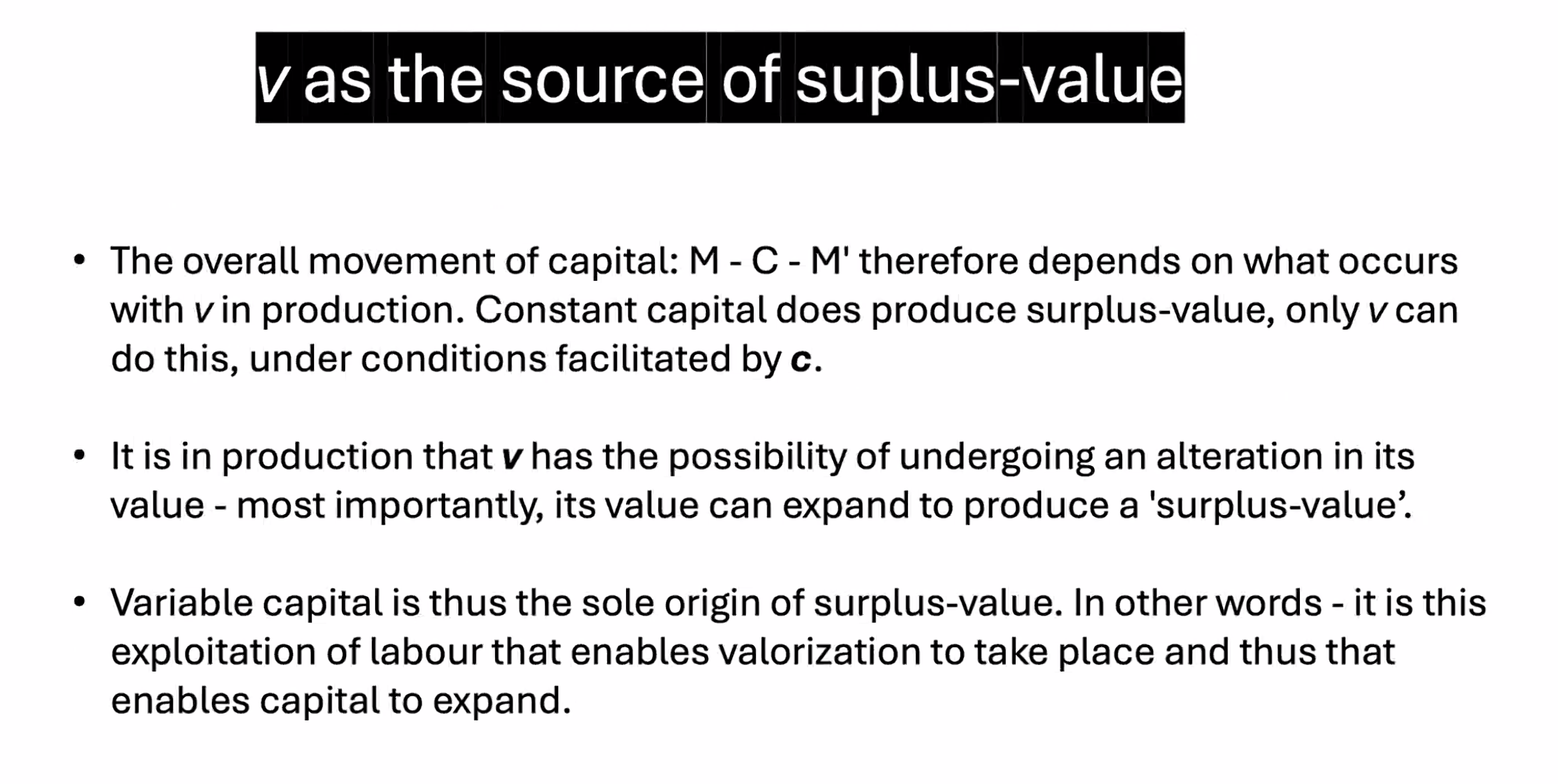
does not produce surplus valiue