Capital Vol. 1, Ch. 8 — mind map
Text version — the same content in reading order
Economic Manuscripts: Capital Vol. I - Chapter Eight — marxists.org
Capital Vol. I : Chapter Eight (Constant Capital and Variable Capital)
Ch. 8 — Constant Capital and Variable Capital
Ch.7 showed that living labour adds new value. But what happens to the value already in the cotton and the spindle? Ch.8 answers, and in doing so splits capital into two parts that behave differently in production.
The various factors of the labour process play different parts in forming the value of the product.
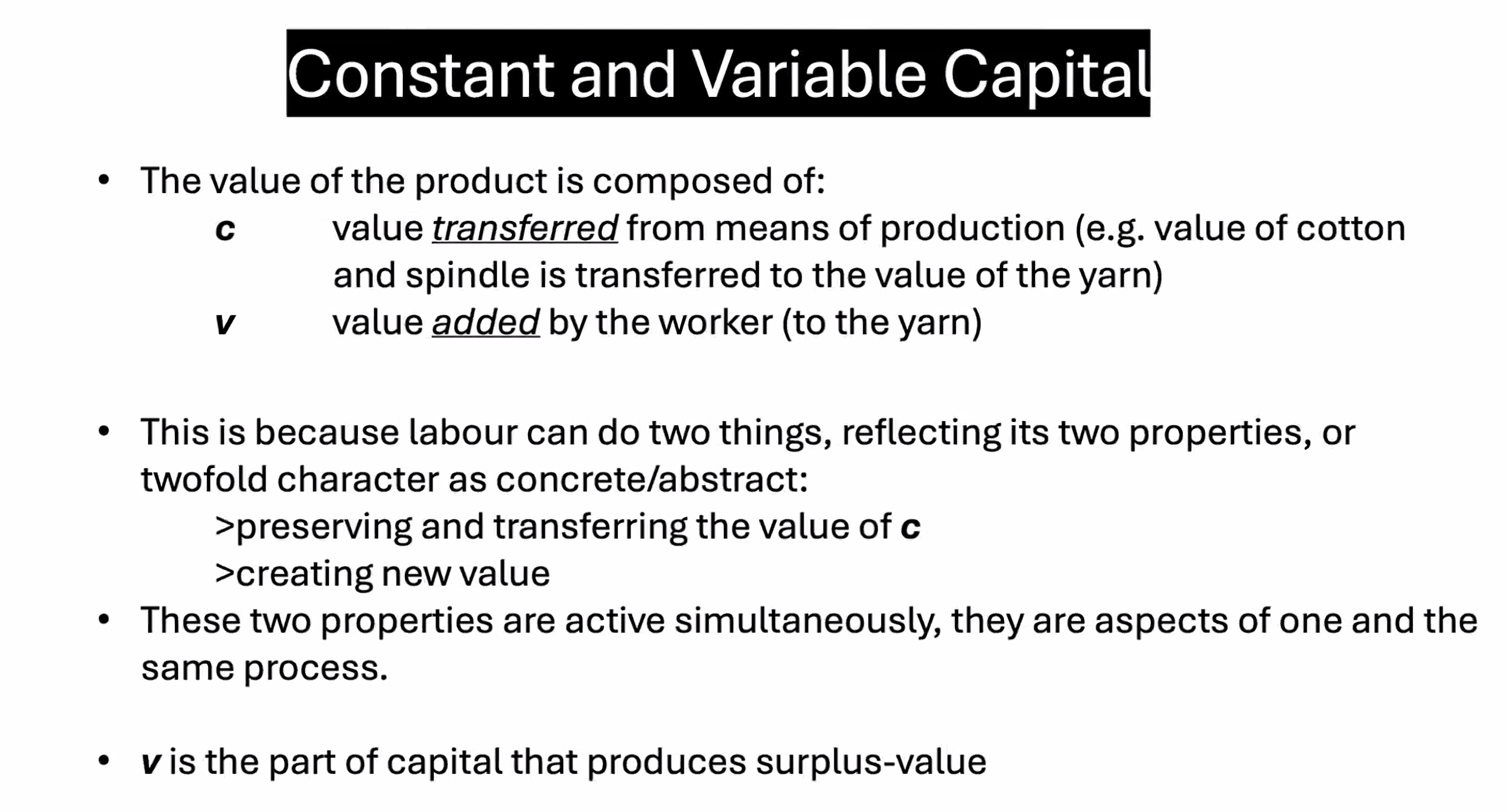
The worker adds new value to the object of labour by adding a definite quantity of labour, whatever its content. The values of the means of production consumed, on the other hand, reappear in the product — they are preserved by being transferred. The spindle and the cotton do not vanish; their value passes over into the yarn.
How can the same labour both add and preserve value at once? Through the two-fold character of labour (Ch.1 §2).
As abstract labour — the expenditure of human labour-power in general — spinning adds new value to the cotton. As concrete, useful labour — spinning in particular — it transfers the value of the cotton and the spindle into the yarn. The worker preserves the values of the consumed means of production … not by his additional labour as such, but by the particular useful character of that labour.
The two effects come apart when productivity changes. Let the spinner’s productivity double: in six hours he now works up twice as much cotton, so twice as much value is transferred — but only the same new value is added, because six hours of abstract labour is six hours regardless.
Conversely, if the spindle or cotton changes in value, the value transferred changes with it, while the value added by the six hours does not move.
A means of production never transfers more value to the product than it itself loses during the labour process by the destruction of its own use-value.
Raw and auxiliary materials are used up whole and transfer their whole value. An instrument of labour — a machine lasting ten years — gives up a tenth of its value each year, piecemeal, while remaining bodily entire in the workshop. It enters the labour process wholly and the valorization process only by fractions.
The value carried over is limited on both sides: the means of production cannot add more value than they possess, and they possess only what was necessary to produce them — measured not by their original cost but by the labour-time currently required to reproduce them. If a cotton harvest fails and its value rises, the old cotton in the mill transfers more value to the yarn than was paid for it.
The preservation of old value costs the worker nothing extra — it is achieved in the same act as adding new value. It is a gift of nature which costs the worker nothing, but is very advantageous to the capitalist. So long as things go on smoothly the capitalist does not notice it. He notices it in a crisis, when production stops, the labour process is interrupted, and the value of stock and machinery rots away with nothing to preserve it.
The definitions
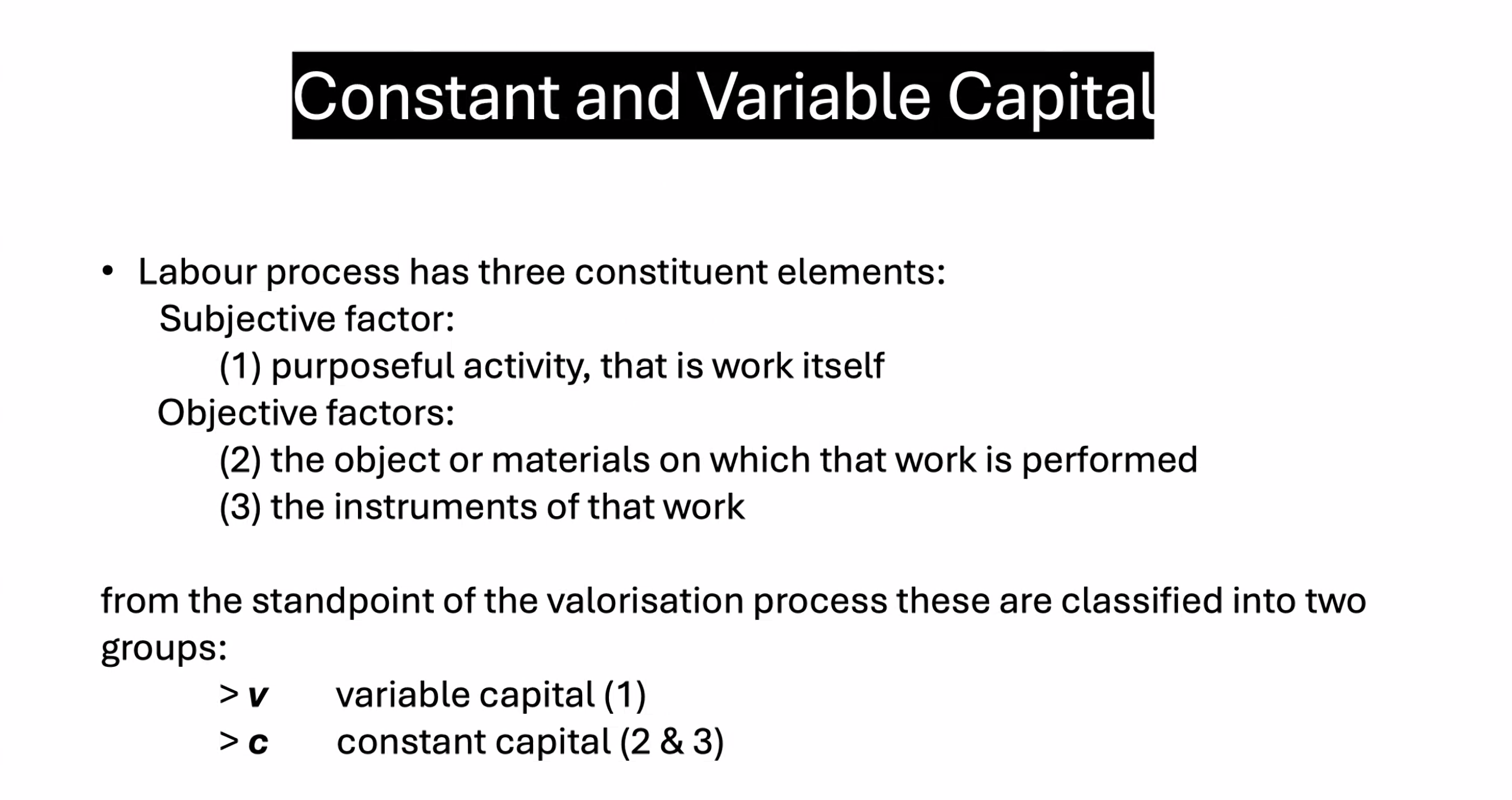
That part of capital which is turned into means of production, i.e. the raw material, the auxiliary material and the instruments of labour, does not undergo any quantitative alteration of value in the process of production. For this reason, I call it the constant part of capital, or more briefly, constant capital.
That part of capital which is turned into labour-power does undergo an alteration of value in the process of production. It both reproduces the equivalent of its own value and produces an excess, a surplus-value … I therefore call it the variable part of capital, or more briefly, variable capital.
The same elements, seen twice. From the standpoint of the labour process they are the objective and subjective factors — means of production and labour-power. From the standpoint of the valorization process they are constant and variable capital.
Same things; different names; the difference is which question is being asked.
“Constant” does not mean the value of the means of production can never change. It can — the price of cotton rises, a better machine makes old spindles cheaper. But these changes happen in the sphere of production from which the cotton or spindle emerges, and are only reflected in the process where they are consumed. Within this labour process, they hand on what they have and no more. That is all the constancy means.
Likewise the proportion between the two parts can change. As industry develops, the same amount of labour sets in motion ever more raw material and machinery: the constant part grows relative to the variable. But whatever the proportion, the distinction stands — only the variable part valorizes.
The value of the product is therefore c + v + s. The new value created by the living labour is v + s. And surplus-value is measured against v alone.
Worked figures (Marx’s own scale)
c = £410 (cotton £312, spindles £44, coal etc. £54) v = £90 (labour-power for the period) s = £90 (the surplus)
value of product = £590 capital advanced = £500
The £410 reappears; the £90 of labour-power returns as £180. Everything that grew, grew from v.
The same capital, two ways of looking
| labour process | valorization process |
|---|---|
| means of production (objective factor) | constant capital, c — value transferred, unchanged in magnitude |
| labour-power (subjective factor) | variable capital, v — value reproduced plus surplus, s |
value of product = c + v + s new value created = v + s
The spinner, twice
Normal day — 6 hours cotton + spindle-wear: value transferred 6 hrs spinning: value added = 6 hrs
Productivity doubled — 6 hours twice the cotton worked up → transferred value ×2 6 hrs spinning: value added still = 6 hrs
The transferred part tracks the quantity of use-values handled. The added part tracks time only.
Two questions the classical economists ran together: where does new value come from, and what happens to the old value already in the inputs? Marx keeps them apart. Living labour answers both, but by different properties of the same act.
The two-fold character of labour doing real work again. Ch.1 introduced it as a property of the commodity; here it becomes the mechanism of the whole value composition of the product. Marx thought this his most important theoretical point.
Dead labour cannot create value; it can only pass on what it has. A machine transfers value, it does not add it — however productive it is, it makes the worker’s labour more fruitful in use-values without adding a minute of abstract labour. This is the seed of the whole argument about machinery in Ch.15.
The free gift. The capitalist pays for labour-power and receives, in the bargain, the preservation of all his existing capital. He only sees this when the factory stands idle and his cotton and iron start losing value with no one to transfer it.
Constant / variable is not fixed / circulating. Fixed vs circulating (Vol. II) is about how value is transferred — piecemeal or all at once. Constant vs variable is about whether value is added at all. Raw material is constant but circulating; Smith and Ricardo muddled the two and lost the source of surplus-value.
Why the distinction matters. Only v produces surplus-value, so the true measure of exploitation is s/v, not s/(c+v) — that is Ch.9. And the growth of c relative to v (the organic composition of capital) drives the accumulation argument of Part Seven and the falling rate of profit in Vol. III.