Capital Vol. 1, Ch. 7 — mind map
Text version — the same content in reading order
Part Three: The Production of Absolute Surplus-Value
Ch. 7 — The Labour Process and the Valorization Process
The capitalist must produce a use-value, and a value, and a surplus-value.
1. The Labour Process
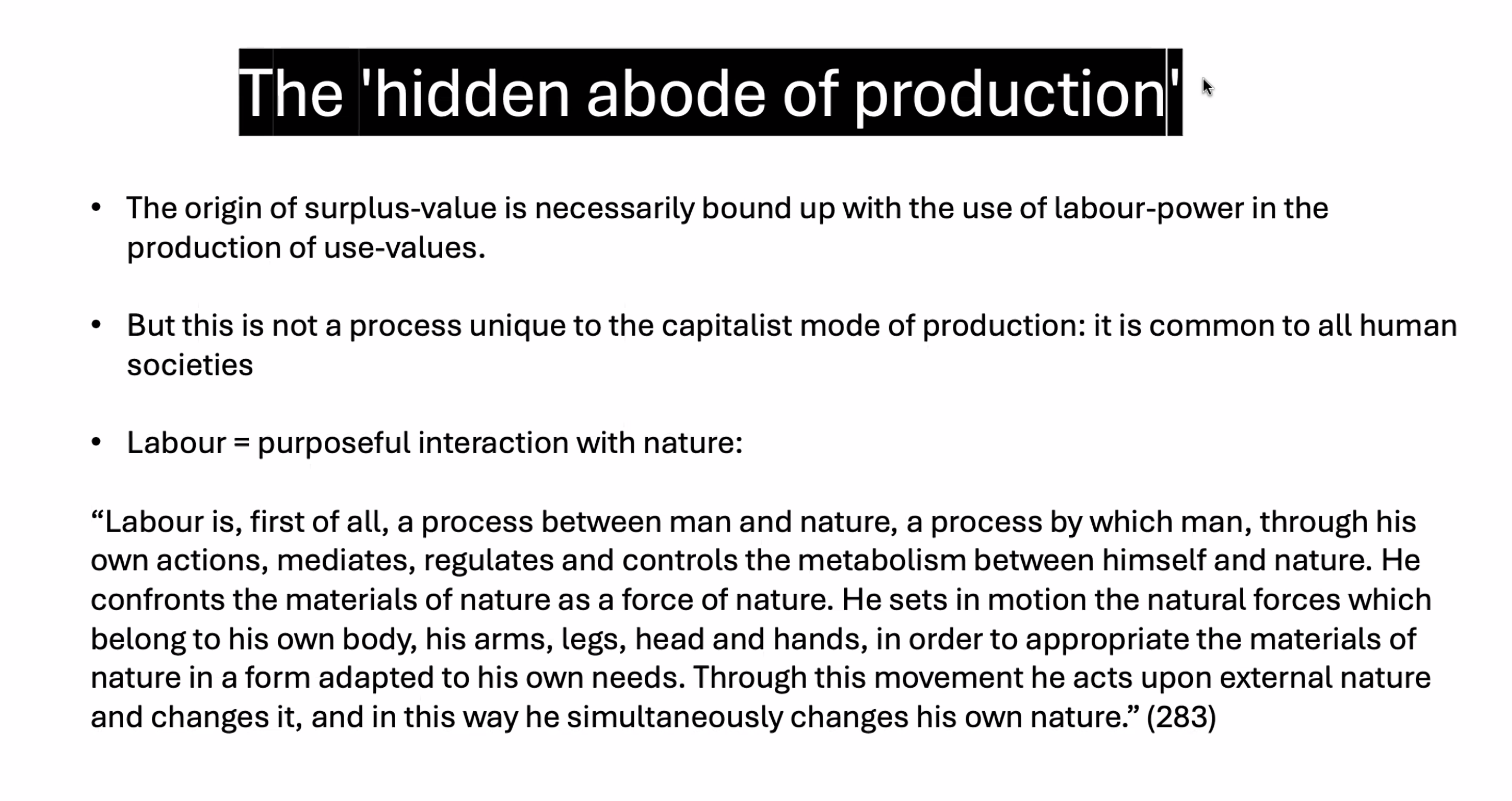
Labour is, first of all, a process between man and nature, a process by which man, through his own actions, mediates, regulates and controls the metabolism between himself and nature. He confronts the materials of nature as a force of nature. He sets in motion the natural forces which belong to his own body, in order to appropriate the materials of nature in a form adapted to his own needs.
A spider conducts operations which resemble those of a weaver, and a bee would put many a human architect to shame by the construction of its honeycomb cells. But what distinguishes the worst architect from the best of bees is that the architect builds the cell in his mind before he constructs it in wax. At the end of every labour process, a result emerges which had already been conceived by the worker at the beginning, hence already existed ideally.
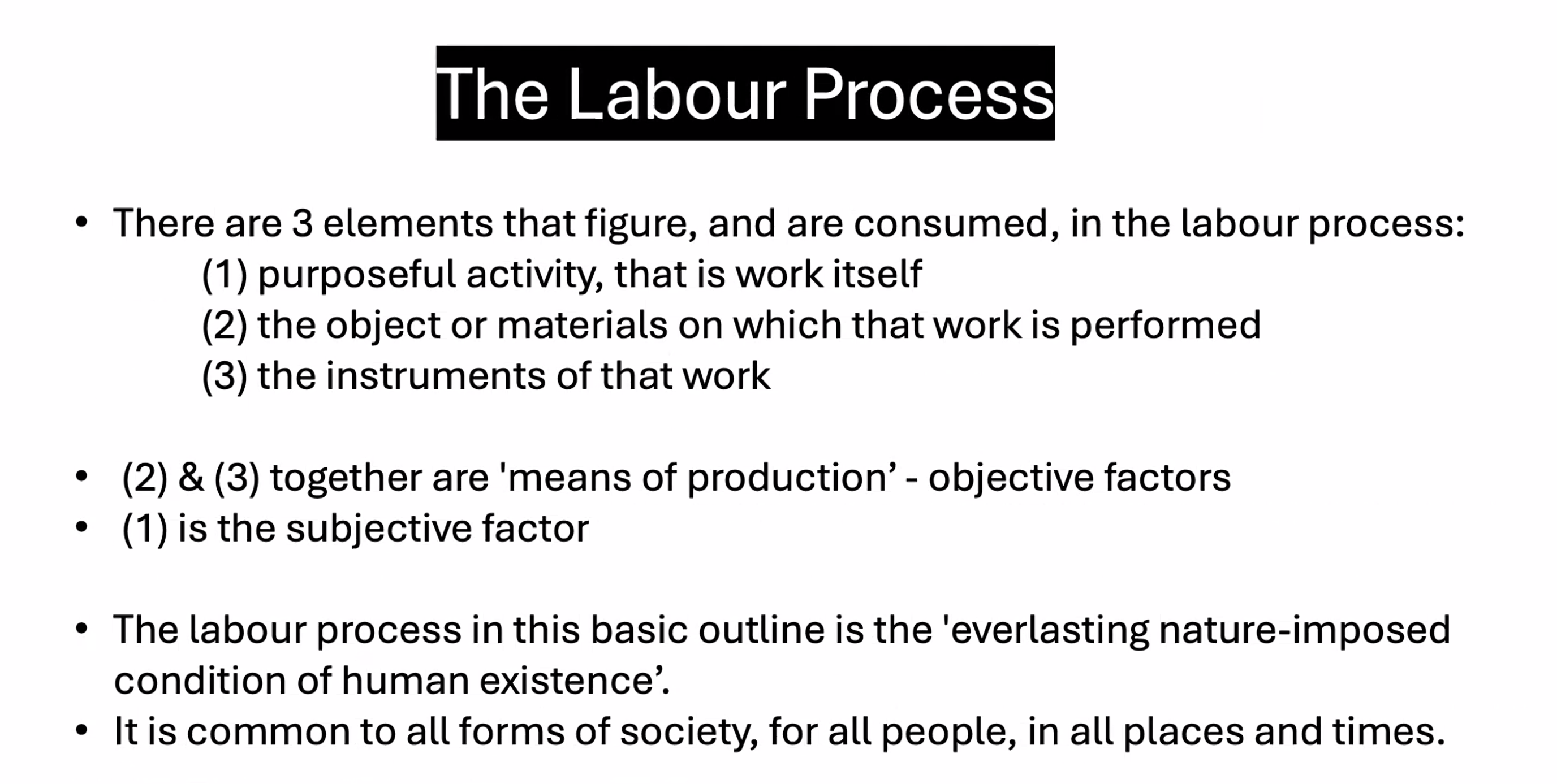
The simple elements of the labour process are (1) purposeful activity, that is work itself, (2) the object on which that work is performed, and (3) the instruments of that work.
All raw material is an object of labour, but not every object of labour is raw material. The object of labour counts as raw material only when it has already undergone some alteration by means of labour.
An instrument of labour is a thing, or a complex of things, which the worker interposes between himself and the object of his labour and which serves as a conductor, directing his activity onto that object.
It is not what is made but how, and by what instruments of labour, that distinguishes different economic epochs.
Living labour must seize on these things, awaken them from the dead, change them from merely possible into real and effective use-values. Bathed in the fire of labour, appropriated as part of its organism, and infused with vital energy for the performance of the functions appropriate to their concept and to their vocation in the process, they are indeed consumed, but they are consumed with a purpose.
Labour uses up its material elements, its objects and its instruments. It consumes them, and is therefore a process of consumption.
The labour process, as we have just presented it in its simple and abstract elements, is purposeful activity aimed at the production of use-values. It is an appropriation of what exists in nature for the requirements of man. It is the universal condition for the metabolic interaction between man and nature, the everlasting nature-imposed condition of human existence, and it is therefore independent of every form of that existence, or rather it is common to all forms of society in which human beings live.
The labour process under capital
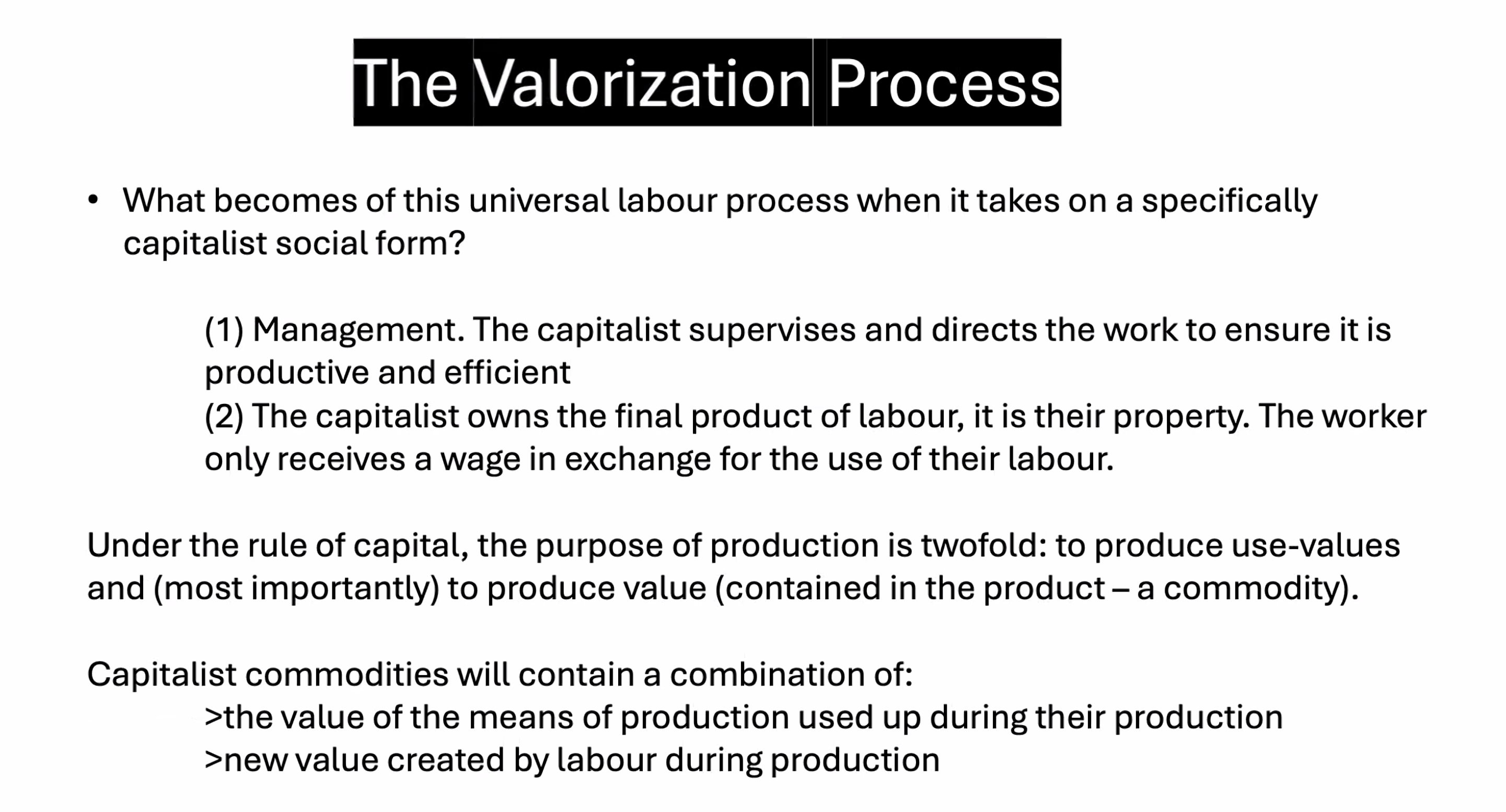
First, the worker works under the control of the capitalist to whom his labour belongs; the capitalist takes good care that the work is done in a proper manner, and the means of production are applied directly to the purpose.
Secondly, the product is the property of the capitalist and not that of the worker, its immediate producer.
2. The Valorization Process
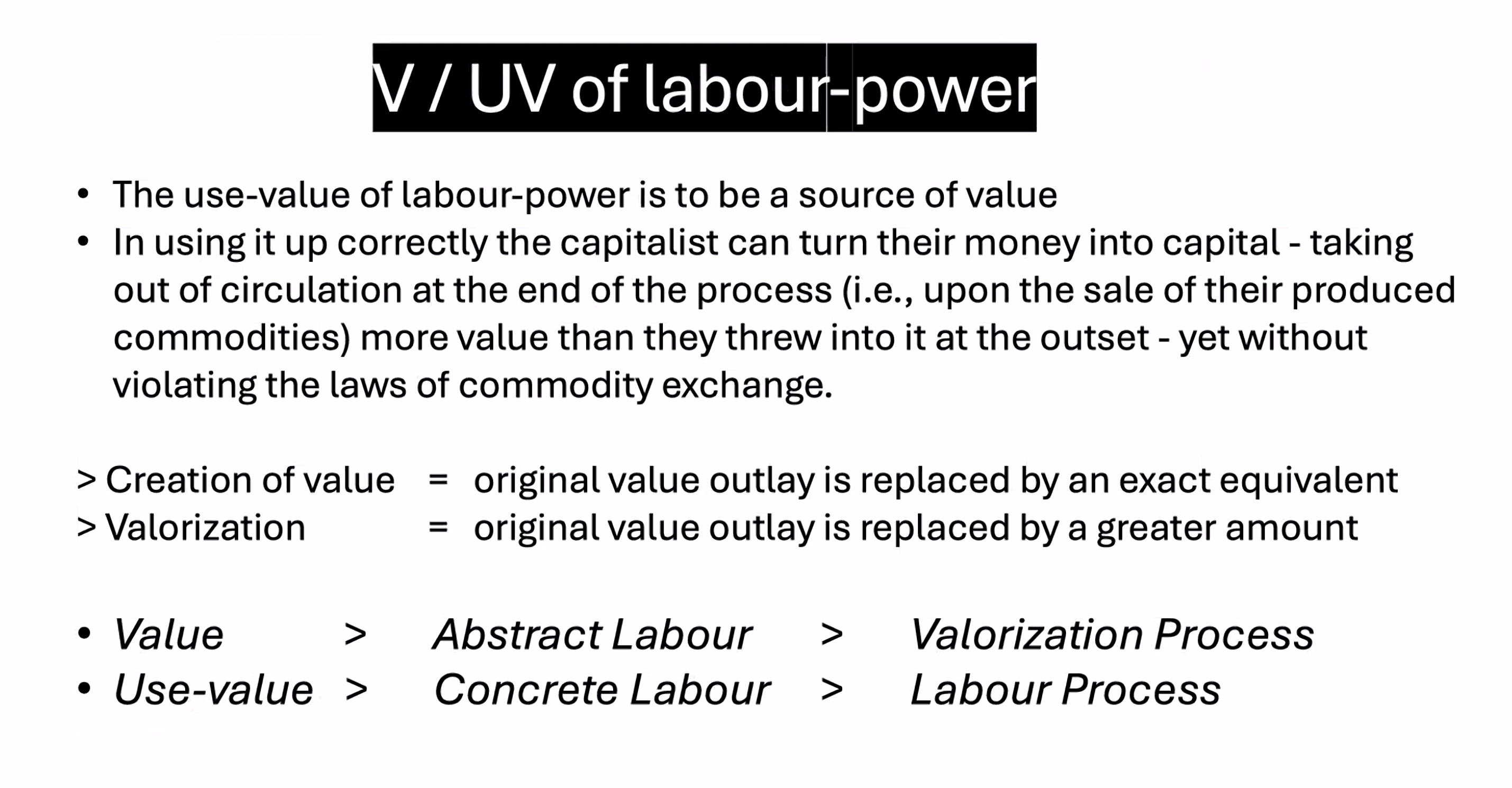
Our capitalist has two objectives: in the first place, he wants to produce a use-value which has exchange-value, i.e. an article destined to be sold, a commodity; and secondly he wants to produce a commodity greater in value than the sum of the values of the commodities used to produce it, namely the means of production and the labour-power he purchased with his good money on the open market. His aim is to produce not only a use-value, but a commodity; not only use-value, but value; and not just value, but also surplus-value.
The value of a commodity is determined by the total labour-time contained in it, both past and living. The past labour embodied in the labour-power and the living labour it can perform … are two totally different things. The former determines the exchange-value of the labour-power, the latter is its use-value.
The fact that half a day’s labour is necessary to keep the worker alive during 24 hours does not in any way prevent him from working a whole day. Therefore the value of labour-power, and the value which that labour-power valorizes in the labour-process, are two entirely different magnitudes; and this difference was what the capitalist had in mind when he was purchasing the labour-power.
Every condition of the problem is satisfied, while the laws governing the exchange of commodities have not been violated in any way. Equivalent has been exchanged for equivalent.
The trick has at last worked: money has been transformed into capital.
If we compare the process of creating value with the process of valorization, we see that the latter is nothing but the continuation of the former beyond a definite point. If the process is not carried beyond the point where the value paid by the capitalist for the labour-power is replaced by an exact equivalent, it is simply a process of creating value; but if it is continued beyond that point, it becomes a process of valorization.
By turning his money into commodities which serve as the building materials for a new product, and as factors in the labour process, by incorporating living labour into their lifeless objectivity, the capitalist simultaneously transforms value, i.e. past, objectified and dead labour, into capital, self-valorizing value, a live monster that is fruitful and multiplies.
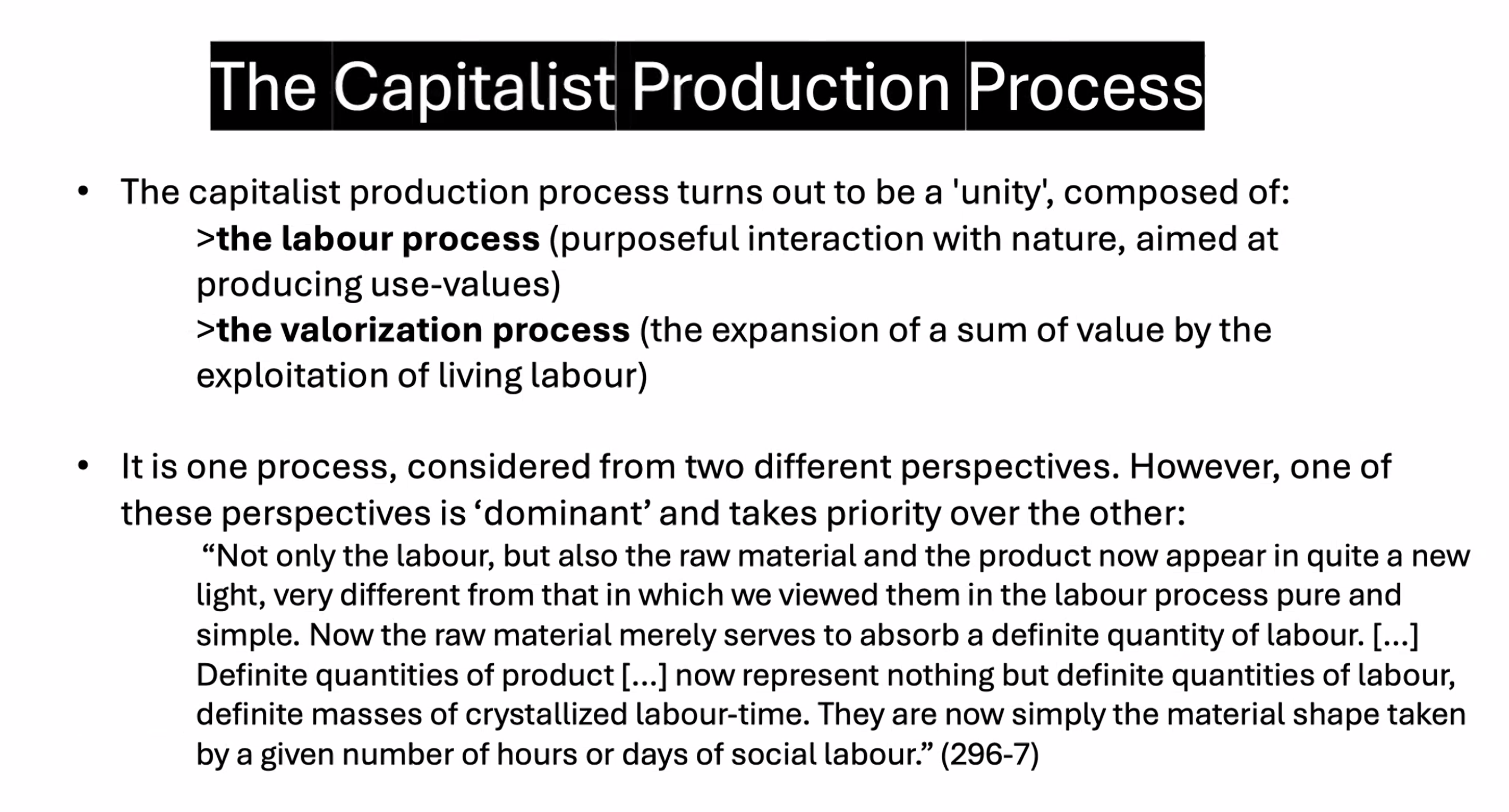
As the unity of the labour process and the process of creating value, the production process is a process of production of commodities; as the unity of the labour process and the process of valorization, it is the capitalist process of production, the capitalist form of the production of commodities.
Skilled and simple labour — the closing assumption
Throughout, the spinner’s labour has been taken as simple average labour. Marx now lifts the assumption to show it changes nothing. Skilled (“complicated”) labour is the expenditure of a more costly labour-power — one whose production took more time and training, and which therefore has a higher value — and it creates, in equal times, proportionally higher values. Skilled labour counts as multiplied simple labour, and the reduction of one to the other is unavoidable in every process of creating value.
But the gap between what the labour-power costs and what its use creates is there just the same. The jeweller’s labour-power is dearer than the spinner’s, and the jeweller’s hour adds more value — yet still more than its own price. So Marx keeps the simplifying assumption: the worker employed by the capitalist performs unskilled average labour.
Spinner and jeweller
value of labour-power — spinner: low (little training) · jeweller: high (years of training)
value created per hour — spinner: 1 hr simple · jeweller: 1 hr = several hrs simple
surplus — in both cases, value created > value of labour-power. Same structure, larger numbers.
Critics later called this the reduction problem: if skilled labour is measured by its wage, and wages presuppose value, the argument looks circular. Marx’s answer here is not a formula but an assumption made for the purpose of the analysis.
The working day splits in two
necessary labour — reproduces the value of labour-power (the wage).
surplus labour — performed gratis for the capitalist.
Lengthening the day lengthens only the second part. That is absolute surplus-value; shortening the first part instead gives relative surplus-value.
The capitalist pleads his case (§2, after the first run of the yarn example)
First pass: the spinner works half a day — the 6 hours that replace his 3s wage. Cotton 10s + spindle-wear 2s + labour 3s = 15s of yarn. Capital advanced: 15s. Our capitalist stares in astonishment. No surplus; money has not become capital.
His defences, in order:
- Abstinence — he could have blown the 15s on pleasure; instead he abstained and consumed it productively. Reply: he has been paid for that already — with 10 lb of yarn.
- Service — he furnished the spinner with cotton and spindle; did he not do him a favour? Reply: a service is only the useful effect of a use-value, and the spinner did him one in return.
- His own labour — Have I not worked myself? Superintended, overseen the spinner? His overseer and manager try to hide their smiles.
Then, having recited the whole creed of the economists, he bursts out laughing, declares he would not give a brass farthing for any of it, and leaves such tricks to the professors who are paid for them. He is a practical man — and in his business he knows what he is about. Next Marx lets him do what he was always going to do: keep the spinner at the wheel for the second half of the day.
The yarn example
means of production (cotton + spindle worn away) → value simply transferred into the product by concrete labour.
labour-power → paid for at its daily value, but adds new value for as long as it is set to work.
Stop at half a day and value is merely reproduced. Carry on to a full day and the second half is surplus-value, costing the capitalist nothing.
Marx first treats the labour process independently of any specific social formation — as it is common to all societies. Only then does he let capital in. The trick of the chapter is that the two halves are the same process described twice.
The bee/architect passage is the answer to Ch.1’s abstract labour: concrete useful labour is purposive and imagined in advance. Labour is not merely expenditure of muscle.
The three elements: activity, object, instrument. Instruments and raw materials are themselves the products of past labour — dead labour waiting to be reanimated.
Nothing specifically capitalist has happened yet. This is the eternal, nature-imposed condition of human existence — the useful labour of Ch.1, section 2.
Capital’s two changes are not technical but relations of control and ownership: the labour belongs to the capitalist while it is being performed, and the product belongs to him when it is finished. The worker sells the activity, not the thing.
The whole secret of surplus-value. Labour-power is bought at its value — the labour-time needed to reproduce the worker. Its use creates more value than it costs. No swindle in exchange is required; the puzzle of Ch.5 is solved in production, not circulation.
Absolute surplus-value: the surplus produced by prolonging the working day beyond the necessary labour-time. Its magnitude is a question of duration — hence the struggle over the working day in Ch.10, and the length-vs-intensity distinction from relative surplus-value in Part Four.
Why this closes the section: absolute surplus-value is indifferent to skill. Whatever the grade of labour-power, the mechanism is the same — bought at its value, used beyond it. The reduction of skilled to simple labour was already introduced in Ch.1 as a social process that goes on behind the backs of the producers; here Marx simply relies on it rather than explaining it.
The famous footnote: the skilled/unskilled distinction rests partly on illusion or on differences “long since ceased to be real”, and partly on the helpless condition of sections of the working class who cannot exact the full value of their labour-power. Skill differentials are as much about bargaining power as about training.
Economic Manuscripts: Capital Vol. I - Chapter Seven — marxists.org
Capital Vol. I : Chapter Seven (The Labour-Process and the Process of Producing Surplus-Value)
About — Andres Saenz de Sicilia — andressaenzdesicilia.com
Dr Andrés Saenz de Sicilia (b. 1985) is a British-Mexican philosopher, researcher and artist. He teaches at Goldsmiths, Univesity of London; Northeastern…