Capital Vol. 1, Ch. 16–18 — mind map
Text version — the same content in reading order
Economic Manuscripts: Capital Vol. I — Chapter Sixteen — marxists.org
Capital Vol. I : Chapter Sixteen (Absolute and Relative Surplus-Value)
Part Five: The Production of Absolute and Relative Surplus-Value
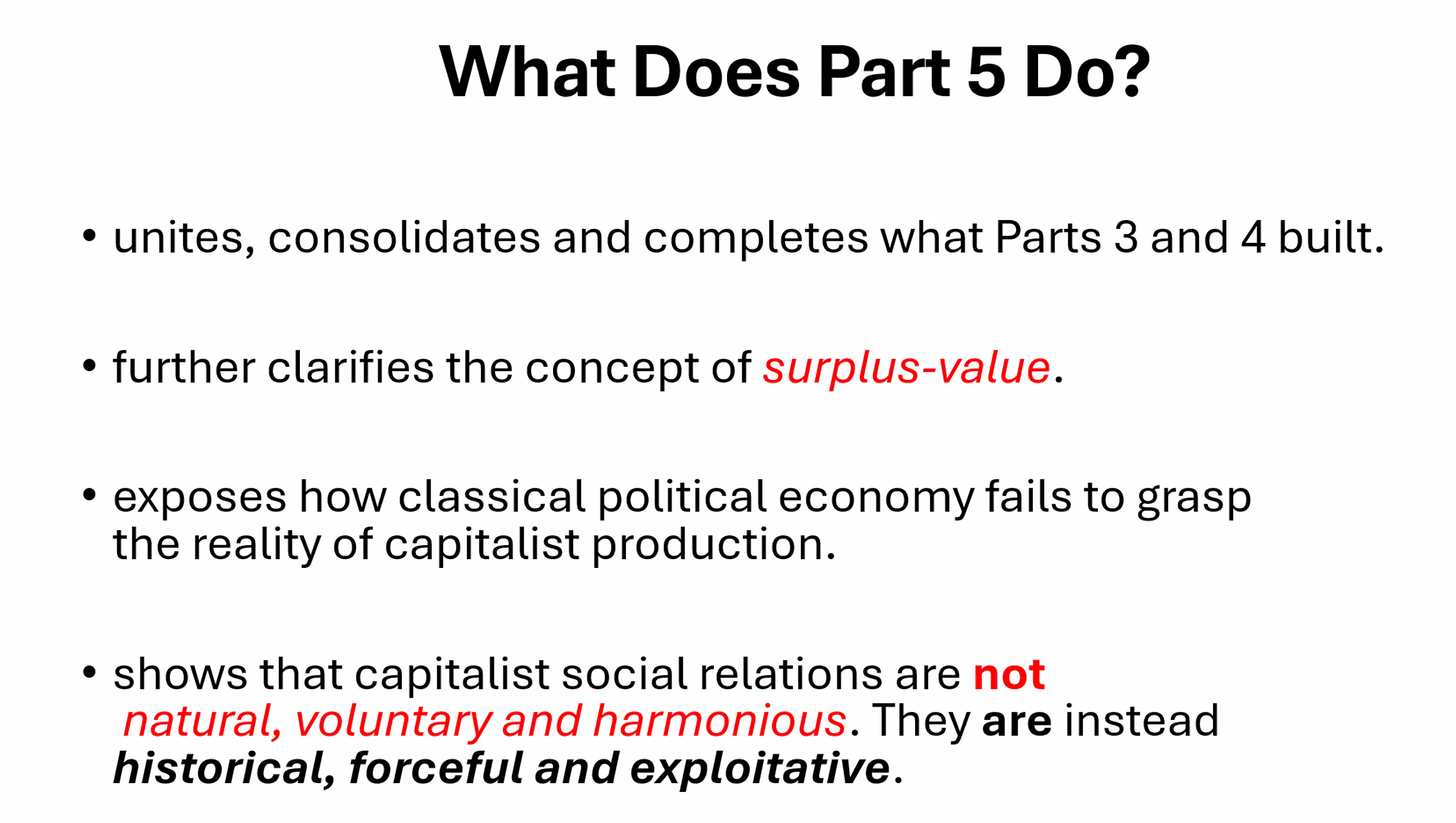
Chs. 16 – 18
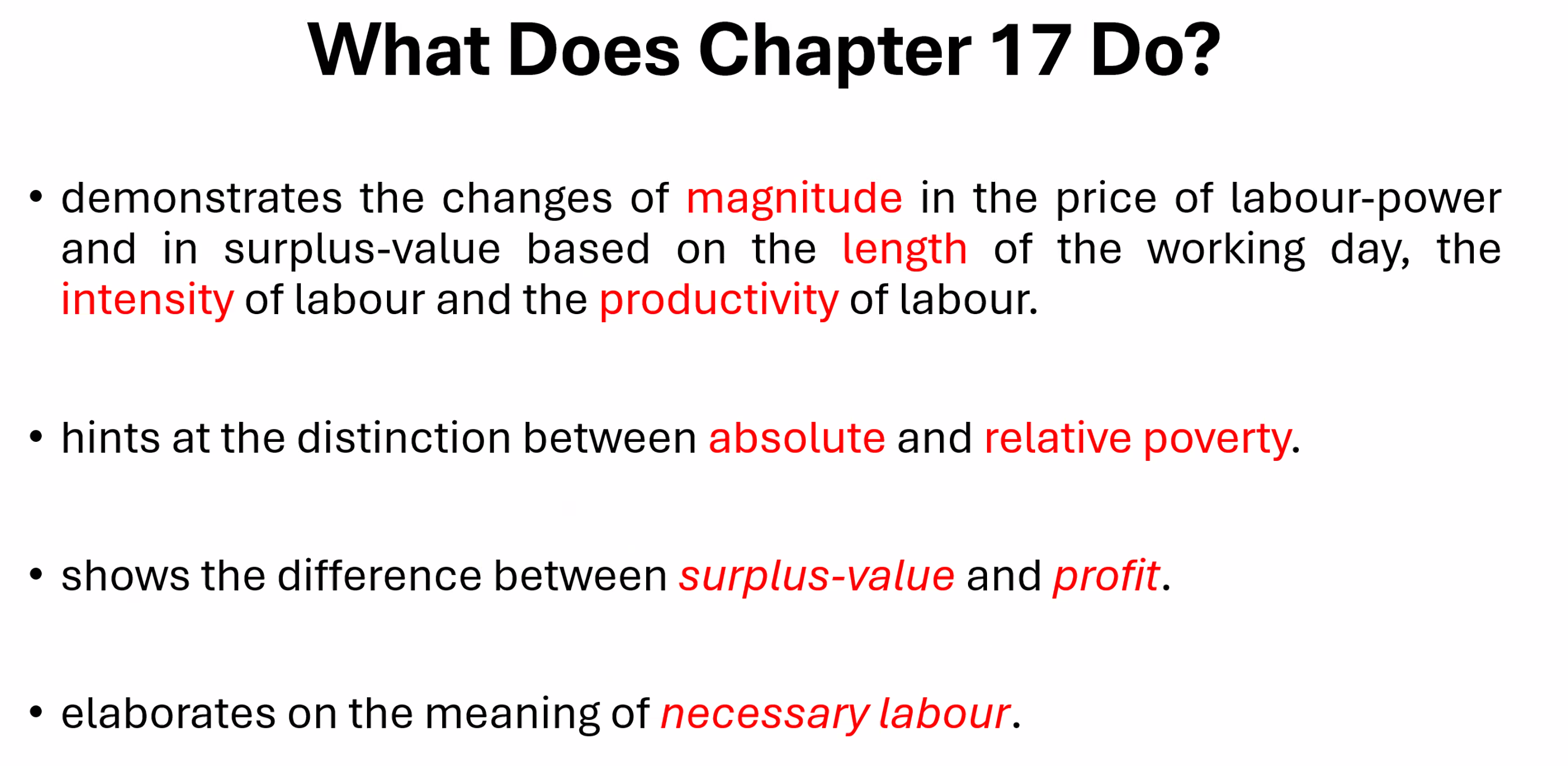
Three short chapters that gather up Parts Three and Four. Ch.16 asks what productive now means and how the two kinds of surplus-value stand to each other. Ch.17 works through what happens to wages and surplus when the day, the intensity and the productivity of labour change. Ch.18 shows how the formula you choose can hide the whole thing.
Ch. 16 — Productive labour, redefined twice
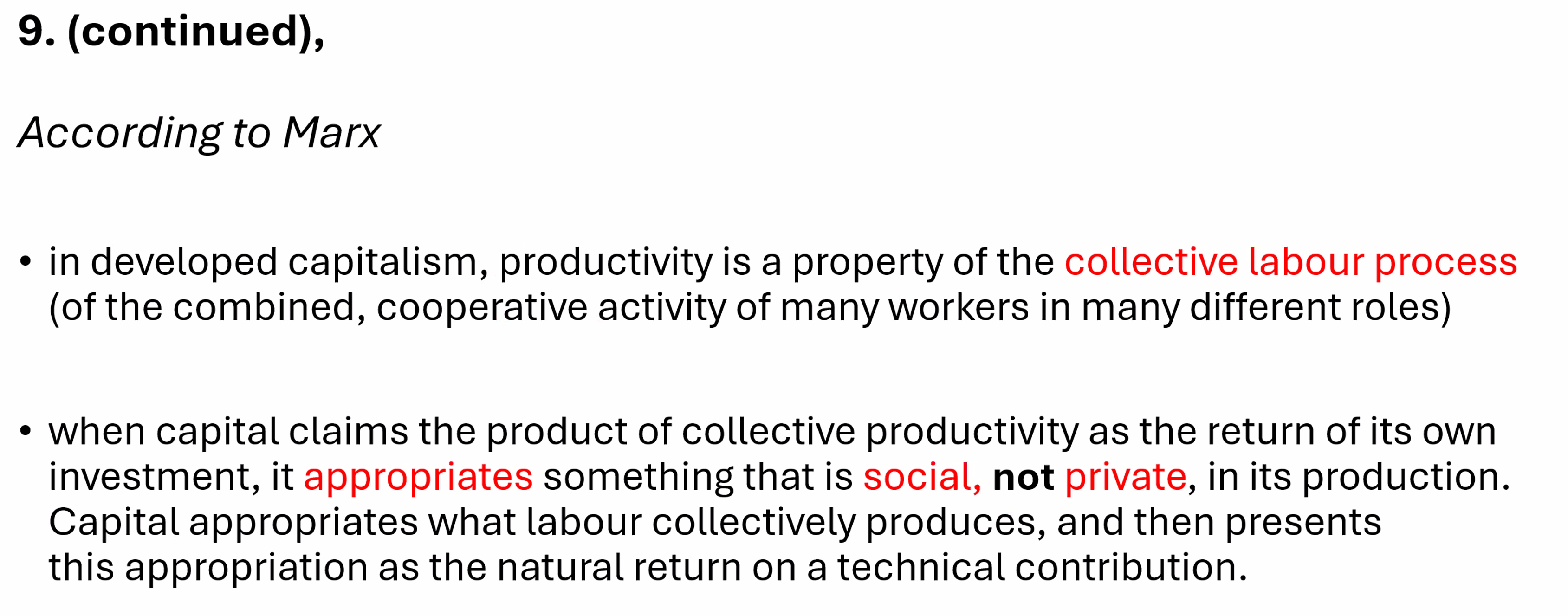
In Ch.7 productive labour meant labour that produces a use-value. Capital changes the definition in two opposite directions at once.
Widened. Now that the real producer is the collective worker, it is no longer necessary for the individual himself to put his hand to the object; it is sufficient for him to be an organ of the collective labourer. The engineer and the overseer are productive alongside the spinner.
Narrowed. That worker alone is productive who produces surplus-value for the capitalist, or in other words contributes towards the self-valorization of capital. A schoolmaster is a productive worker when, besides working on the heads of his pupils, he works to enrich the proprietor of the school — because the proprietor has invested in a teaching-factory rather than a sausage-factory. Productive labour is a social relation, not a kind of work. To be a productive worker is therefore not a piece of luck, but a misfortune.
Absolute and relative, side by side
The production of absolute surplus-value turns exclusively on the length of the working day, whereas the production of relative surplus-value completely revolutionizes the technical processes of labour and the groupings into which society is divided. The first is the general basis of the system and the starting-point of relative surplus-value — formal subsumption. The second presupposes a specifically capitalist mode of production — real subsumption.
From one angle the distinction is illusory: relative surplus-value is absolute, since the day must exceed necessary labour; absolute surplus-value is relative, since productivity must already confine necessary labour to part of the day. But once the capitalist mode is established and the rate of surplus-value is to be raised, the distinction becomes palpable. With the value of labour-power given, the rate can be moved only by lengthening the day or by shortening necessary labour — and those are different acts, with different histories.
The natural basis — and its limits
Surplus labour needs a certain productivity: one person’s labour must be able to keep more than one person. Nature sets conditions. Where it is too stingy there is no surplus; where it is too lavish — the tropics, where bread grows on trees — she keeps man in hand, like a child in leading-strings, and there is no spur to develop his powers. The temperate zone, and the need to master a natural force — the Nile, the irrigation works of India — is where social labour on a large scale first became necessary.
But favourable natural conditions alone give us only the possibility, never the reality, of surplus labour. The economists credit the capitalist with the productivity of nature — Mill supposes capital yields a profit because food lasts longer than the time it took to grow. Marx: on a level plain, simple mounds look like hills; and the insipid flatness of our present bourgeoisie is to be measured by the altitude of its great intellects.
Ch. 17 — Three variables, four cases
Assume commodities sell at their value, and the price of labour-power may rise above its value but never fall below it. Then the relative magnitudes of the price of labour-power and of surplus-value — how the new value of a day is split — depend on three things: the length of the working day, the intensity of labour, and its productivity.
Marx takes them one at a time, holding the other two constant, and then together.
Case I — productivity varies
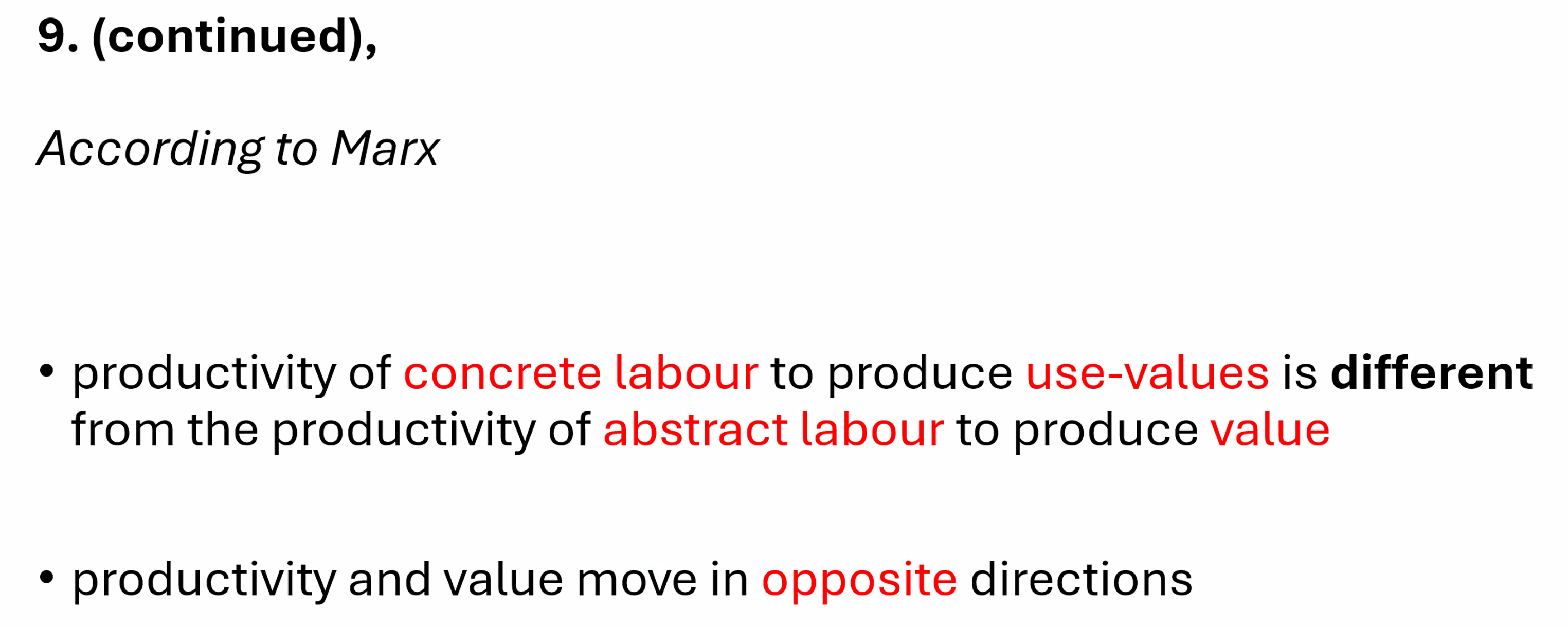
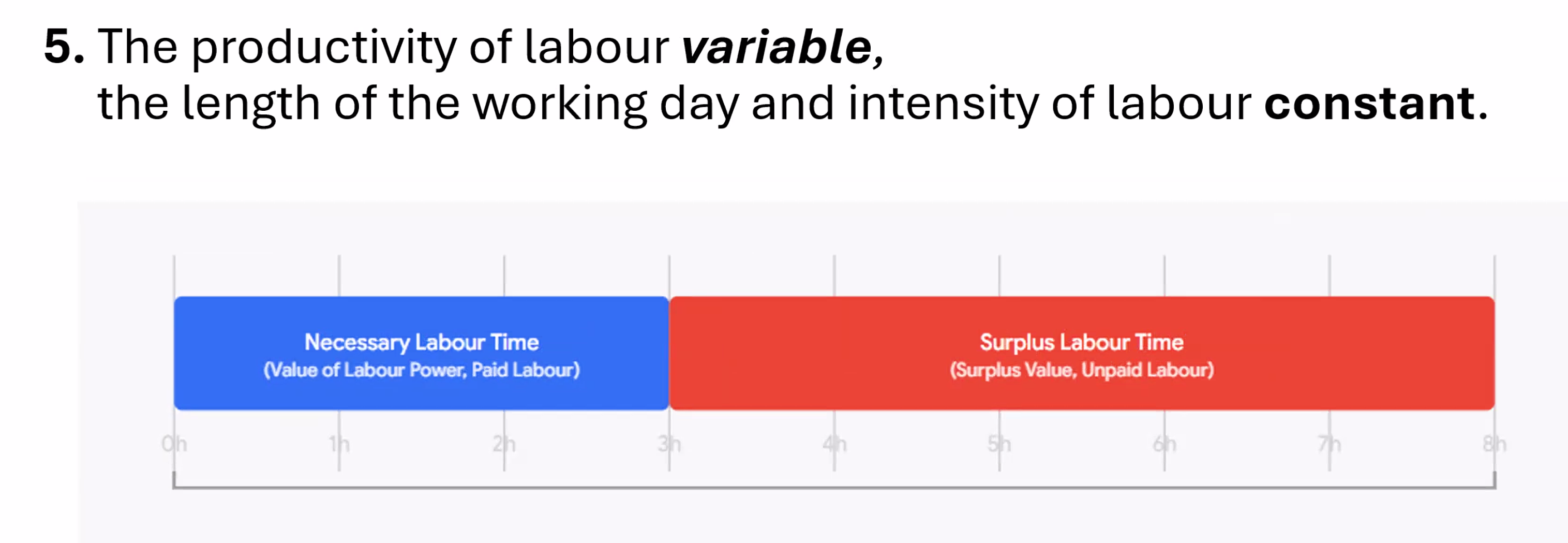
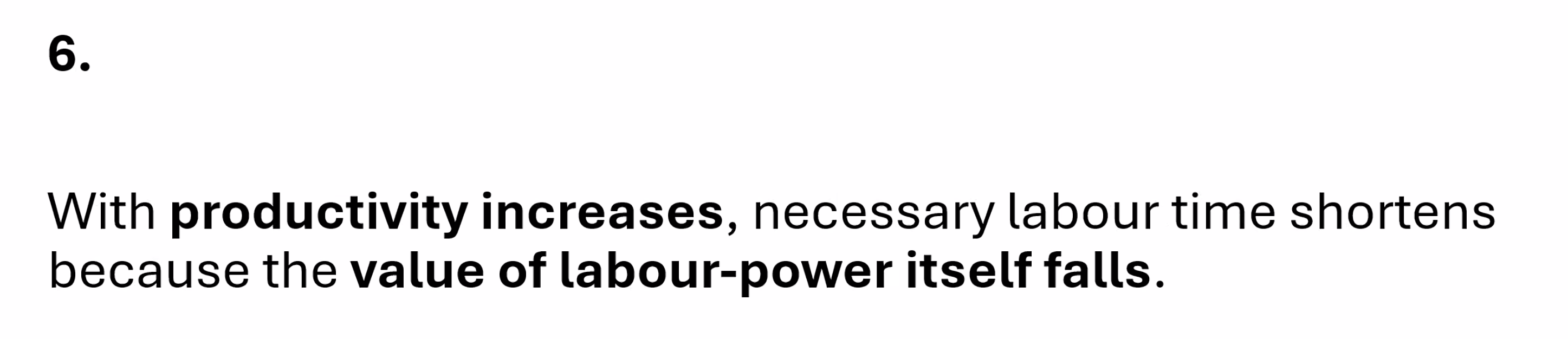
Three laws. First, a working day of given length always creates the same amount of value, no matter how the productivity of labour varies: twelve hours is twelve hours, whether it yields twelve articles or twenty-four. Second, since the new value is fixed, the value of labour-power and surplus-value move in opposite directions — one can rise only as the other falls. Third, the change in surplus-value is always the consequence of the change in the value of labour-power, never its cause.
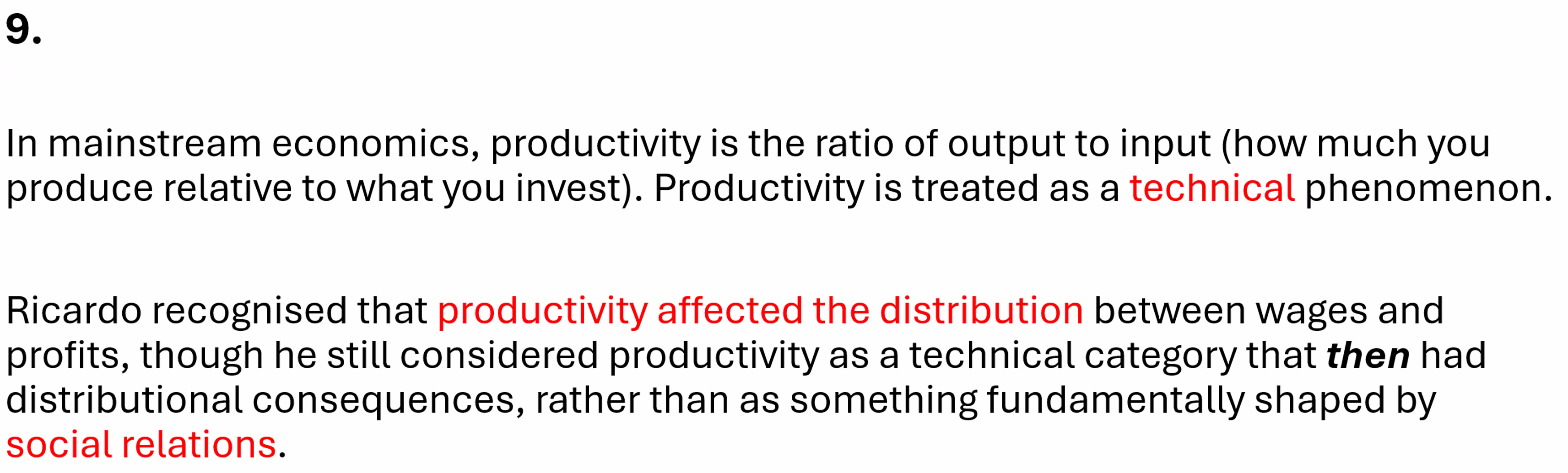
And the price of labour-power can fall in value while rising in use-values: cheaper bread means the same wage buys more and yet represents less labour-time. The worker is better off in goods and worse off in share, at once. Ricardo had it backwards — he thought surplus could rise only if wages fell, and missed that both the wage and the surplus are moved by productivity first.
Case II — intensity varies
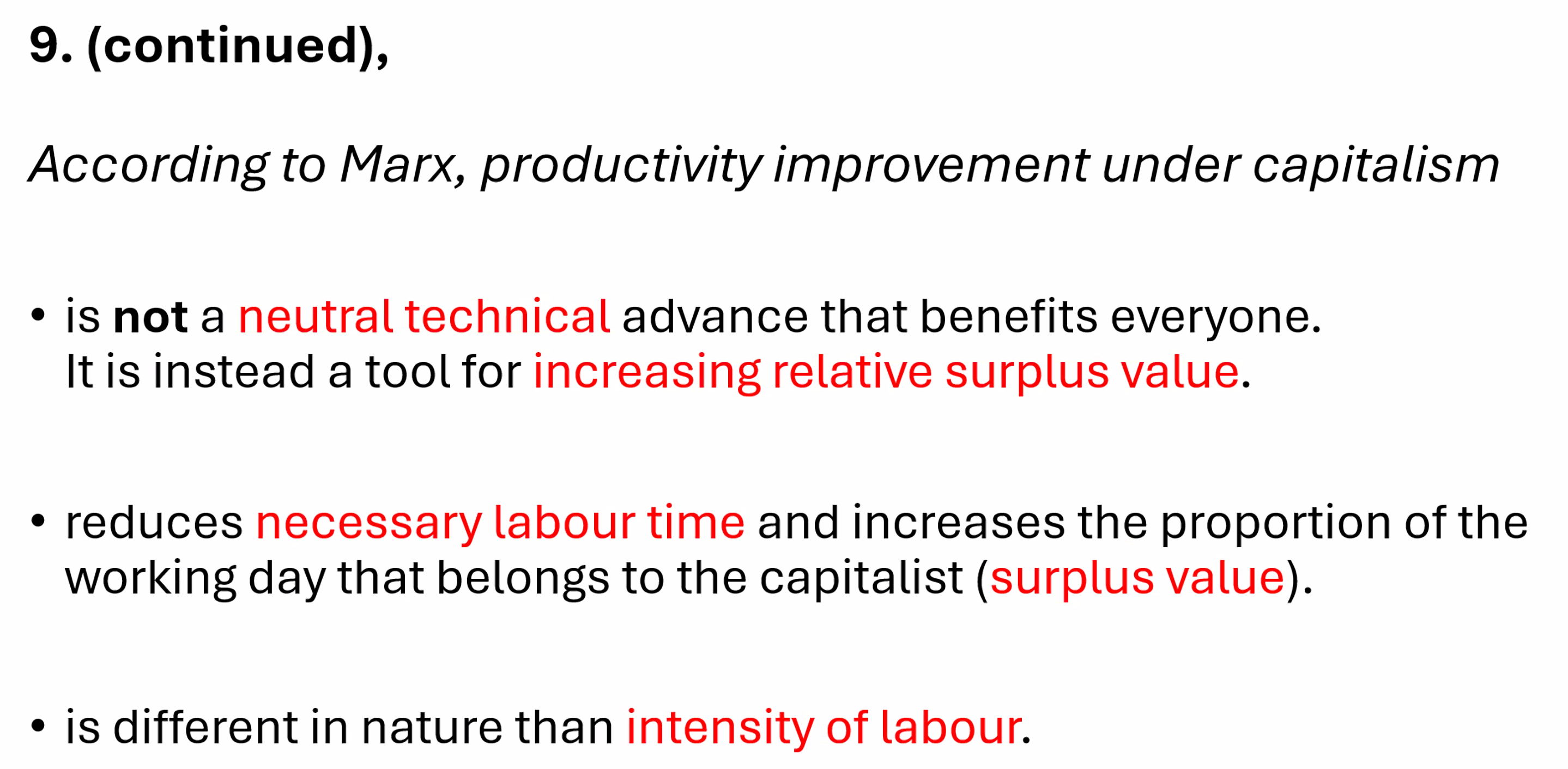
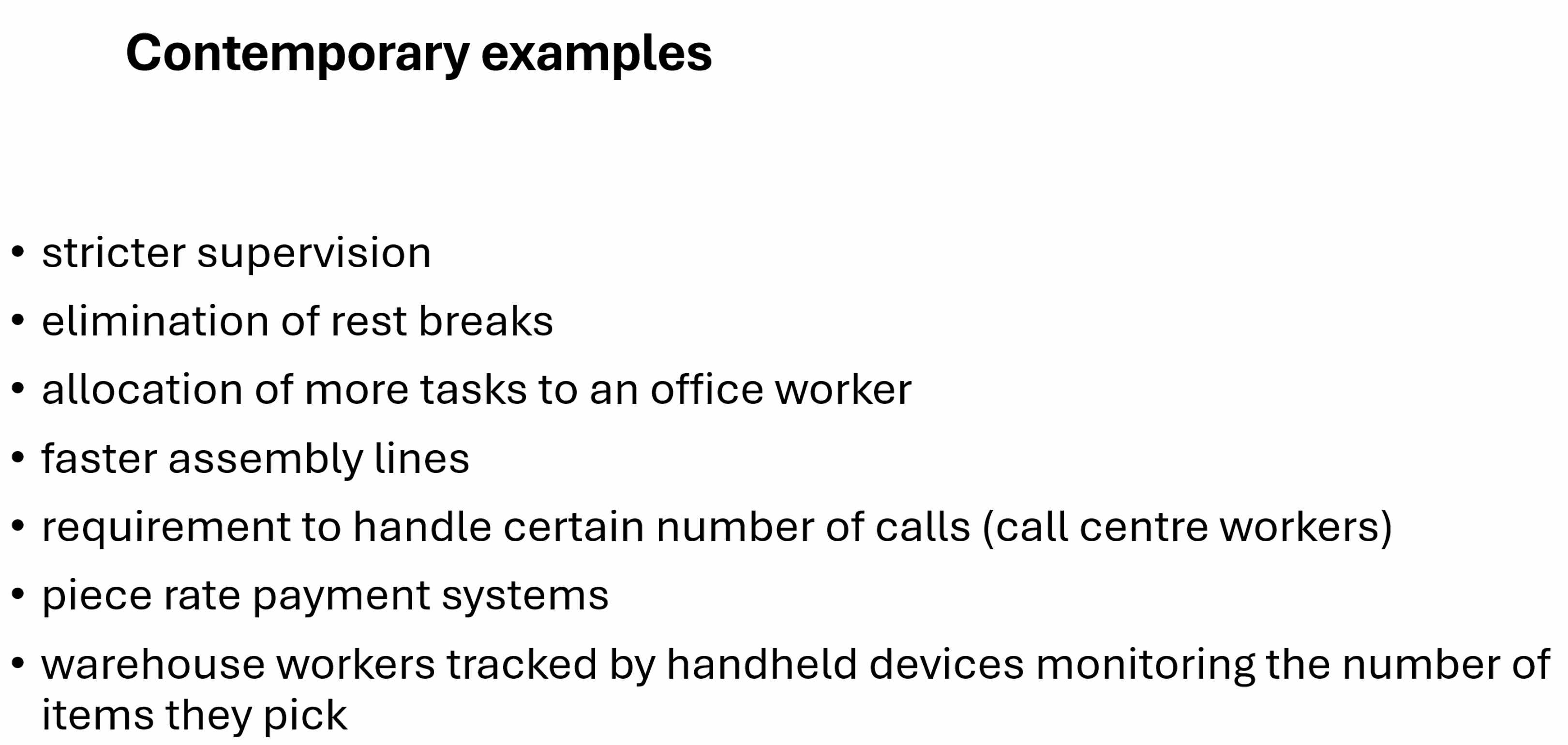
A more intense day creates more value in the same time. So here both wage and surplus can rise together — the day’s product has grown. But more intense labour wears the worker faster, so the price of labour-power may rise and still fall below its value, if the extra wage does not cover the extra wear.
Once a higher intensity becomes general it is the new normal degree, and ceases to count as extra. Between nations the difference remains: the more intense national working day counts as more value — an English hour is not an Indian hour on the world market.
Case III — length varies
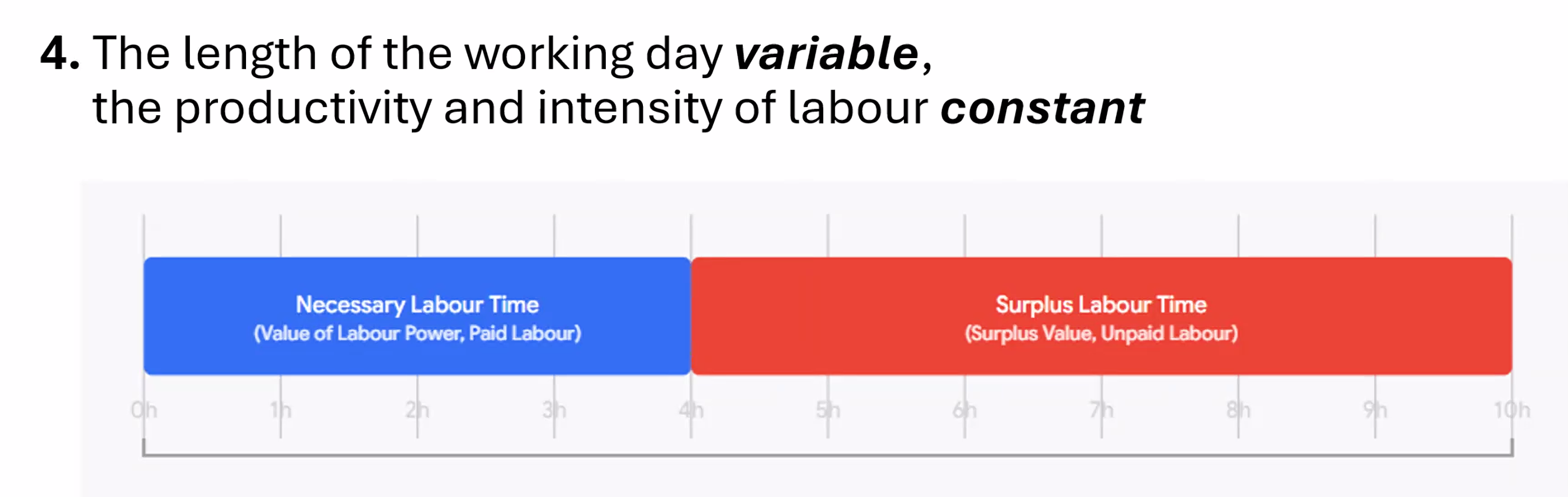
Shorten the day with productivity and intensity fixed, and the value of labour-power is unchanged while the surplus shrinks by the hours removed — the Ten Hours Act case. Capital’s only escape is to push wages below value, which the assumption forbids and the Factory Acts, in practice, did not.
Lengthen it, and surplus-value rises absolutely and relatively. Here too the price of labour-power may rise — the sixteen-hour day paid better than the twelve — and still fall below value, because a day that uses the worker up in half the years must, to pay for the labour-power at its value, pay for the years it destroys.
Case IV — all three together, and the horizon
(a) Productivity falls while the day lengthens — England in the Corn Law years, 1799 to 1815, when dear bread and long hours combined and the economists mistook the result for a law of nature.
(b) Productivity and intensity rise while the day shortens. Pushed to the limit this would reduce the day to necessary labour and abolish surplus-value — impossible under capital. In a society without class antagonism, necessary labour itself would widen: the worker’s wants would grow, and a fund for reserve and accumulation would become part of it. The day would then be as short as productivity allows, shared among everyone.
In capitalist society, spare time is acquired for one class by converting the whole life-time of the masses into labour-time. The shortening of the working day finds its final limit in the generalization of labour.
Ch. 18 — Formula I: the true measure
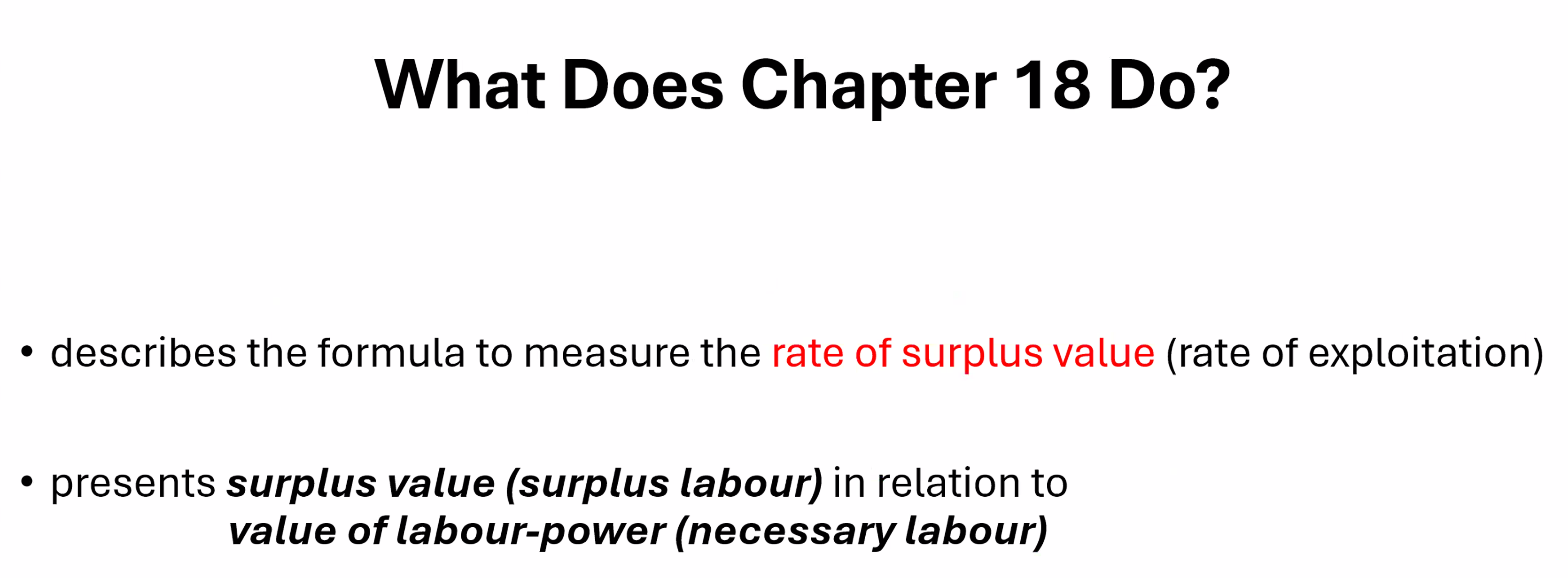
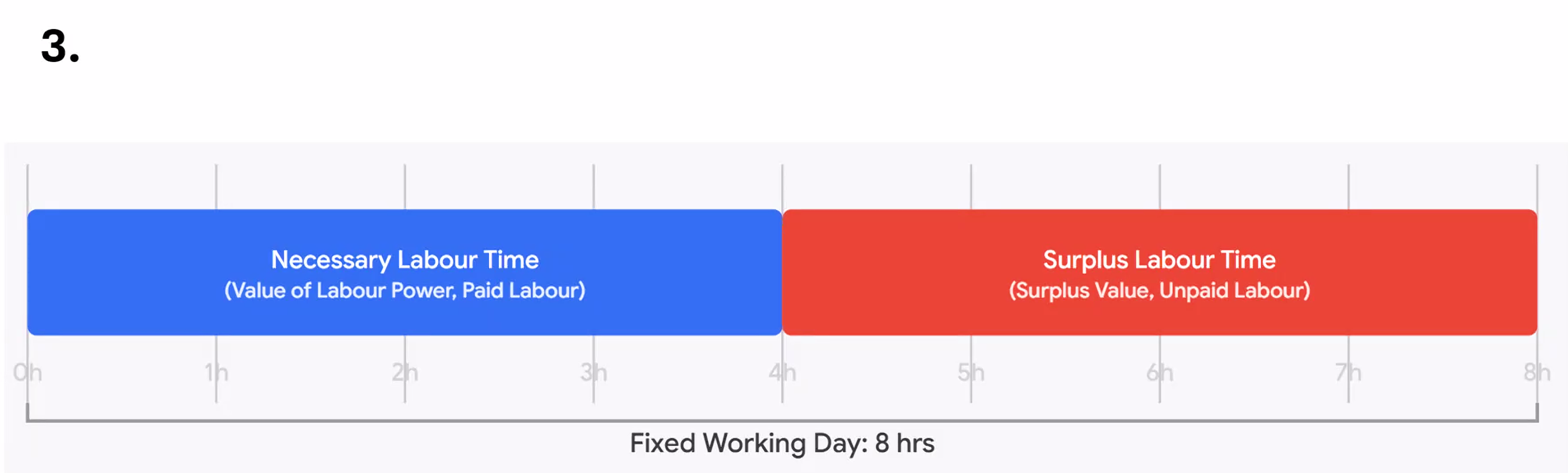
s / v = surplus-value / variable capital = surplus labour / necessary labour = unpaid labour / paid labour.
This is the rate of surplus-value as the book has used it since Ch.9: the surplus measured against the part of capital that produced it, which is also the surplus part of the day measured against the necessary part. It can rise without limit, and it states what it measures.
Formula II — the classical measure, and what it hides
Classical political economy measures the surplus against the whole: surplus labour / working day = surplus-value / value of the product = surplus product / total product.
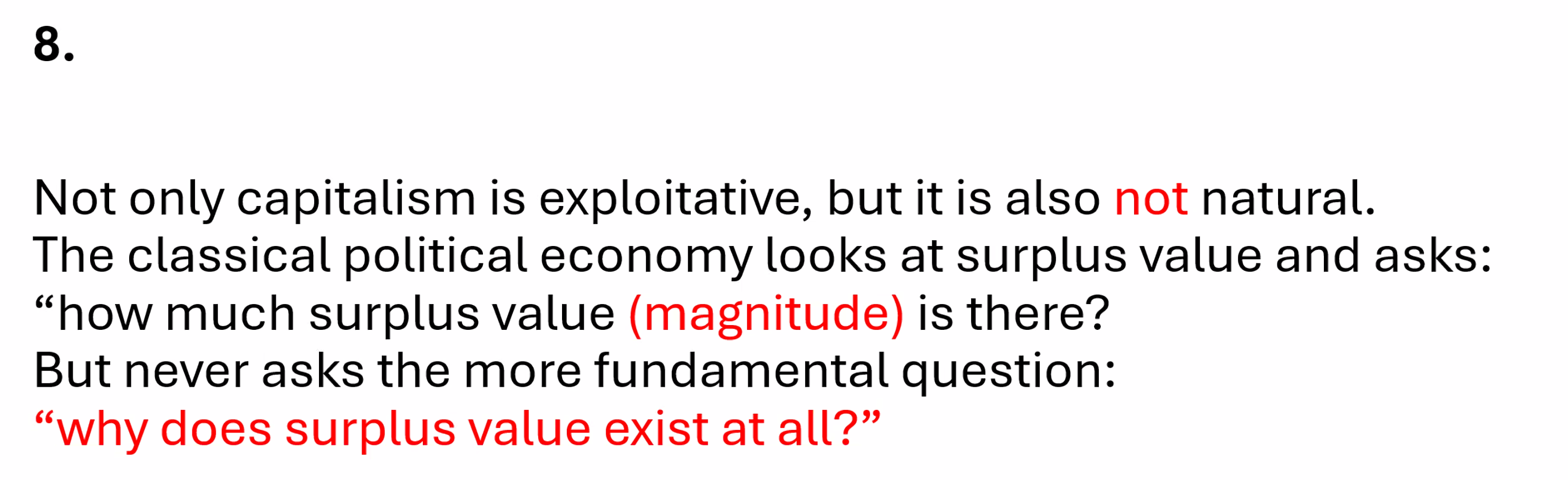
Two faults. The number is wrong: a rate of 100 % on Formula I appears as 50 % here, and Formula II can never reach 100 % however far exploitation goes — it always understates. And the picture is wrong: dividing by the whole product makes capitalist and worker look like partners sharing a joint output in proportions set by their contributions. The capital relation is represented as a relation of association. The surplus is no longer something taken; it is something shared out.
Formula III — unpaid labour, and the sentence that closes Part Five
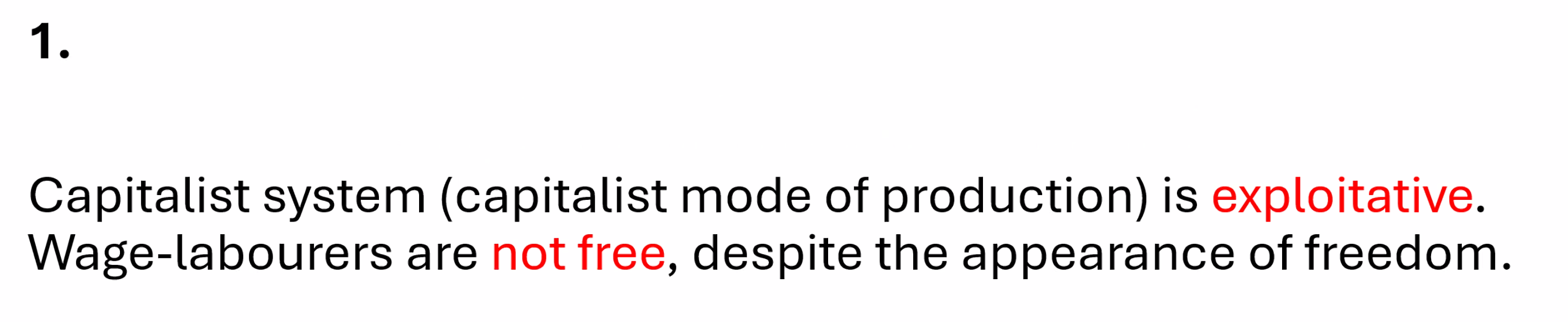
Marx’s own popular expression: surplus-value = unpaid labour; the rate = unpaid labour / paid labour. It is only a popular expression — the capitalist pays for labour-power, not for labour — but it names the fact that the day divides into a part that is paid for and a part that is not, and that the wage-form conceals the division. Part Six will take up that concealment.
Capital is therefore not only the command over labour, as Adam Smith thought. It is essentially the command over unpaid labour. All surplus-value, whatever particular form — profit, interest, or rent — it may subsequently crystallize into, is in substance the materialization of unpaid labour-time. The secret of the self-valorization of capital resolves itself into the fact that it has at its disposal a definite quantity of the unpaid labour of other people.
Three formulae for one rate
| numerator / denominator | with s = v | ceiling | shows | |
|---|---|---|---|---|
| I | s / v · surplus labour / necessary labour | 100 % | none | extraction, measured against its source |
| II | s / (v + s) · surplus labour / whole day · surplus product / total product | 50 % | < 100 %, always | a partnership sharing a product |
| III | unpaid labour / paid labour | 100 % | none | the same as I, in plain words |
Classical economy used II and so could not see what it had measured. The wage-form (Part Six) is what makes III invisible in practice.
The four cases of Ch.17
| case | held constant | varies | value of the day | wage | surplus |
|---|---|---|---|---|---|
| I | length, intensity | productivity ↑ | same | ↓ in value, ↑ in goods | ↑ |
| II | length, productivity | intensity ↑ | more | can ↑ | can ↑ |
| III | productivity, intensity | length ↓ / ↑ | less / more | same (may ↑ yet fall below value) | ↓ / ↑ |
| IV | — | all three | the Corn Law years; and the horizon beyond capital |
Law I.1: a day of given length creates the same value whatever its productivity. Law I.3: the surplus changes as a consequence of the wage’s value, never as cause.
Productive labour — two definitions
| Ch.7, the labour process | Ch.16, for capital | |
|---|---|---|
| criterion | produces a use-value | produces surplus-value |
| who counts | whoever works on the object | any organ of the collective worker — wider |
| who is excluded | nobody useful | anyone not valorizing capital — narrower |
| the schoolmaster | productive: he teaches | productive only if the school is run for profit |
| the verdict | a fact about work | a fact about a relation |
Not a piece of luck, but a misfortune.
Productive is a verdict on a relation, not on a task. The same lesson, song or stitch is productive if someone makes surplus-value from it and unproductive if not. Two things follow. Much of the later argument about services, the state sector and housework turns on this page. And misfortune: to be productive for capital is to be exploited, so the word is not a compliment.
Against naturalism. Nature supplies the possibility of surplus; only a social relation makes it real, and only a specific one makes it capital’s. The tropics-and-leading-strings passage is Marx at his most nineteenth-century — hold the point and let the climate go. The target is the economists who make profit a gift of fertile soil, which is a way of making it nobody’s doing.
Ricardo reversed. For Ricardo, profit rises only if wages fall, so the two classes are locked in a zero-sum over a fixed cake. Marx agrees the cake of a day is fixed — law one — but shows that productivity moves the value of the wage first, and the surplus follows. Hence the result that still startles: real wages up, share down, both at once. That is relative immiseration in its strict sense, and the only sense Marx commits to here.
Intensity is the hidden variable in every wage statistic. An hour is not an hour; a rising wage can go with a body used up faster. Ch.15’s denser hour returns as a law. And the national point — the more intense day counts as more value on the world market — is the seed of the later arguments about unequal exchange.
The utopian horizon, stated as arithmetic. Shorten the day to the limit and surplus-value vanishes — so under capital the limit can never be reached. Beyond capital, necessary labour would mean something larger (wants, reserves, growth) and the day would be whatever productivity allows, shared by all. The limit of shortening is that everyone works. This is Vol. I’s clearest glance past capitalism before Part Eight.
A formula is an ideology. Divide by v and you see extraction; divide by the whole day and you see a partnership. Classical economy chose the second and could not say what it had found. Formula III is the bridge to Part Six: unpaid labour is what the wage-form exists to make invisible.
The Smith correction sits here, at the close of Ch.18 — not at the end of Ch.11, where an earlier canvas placed it.


Marx does not see labour as just another input
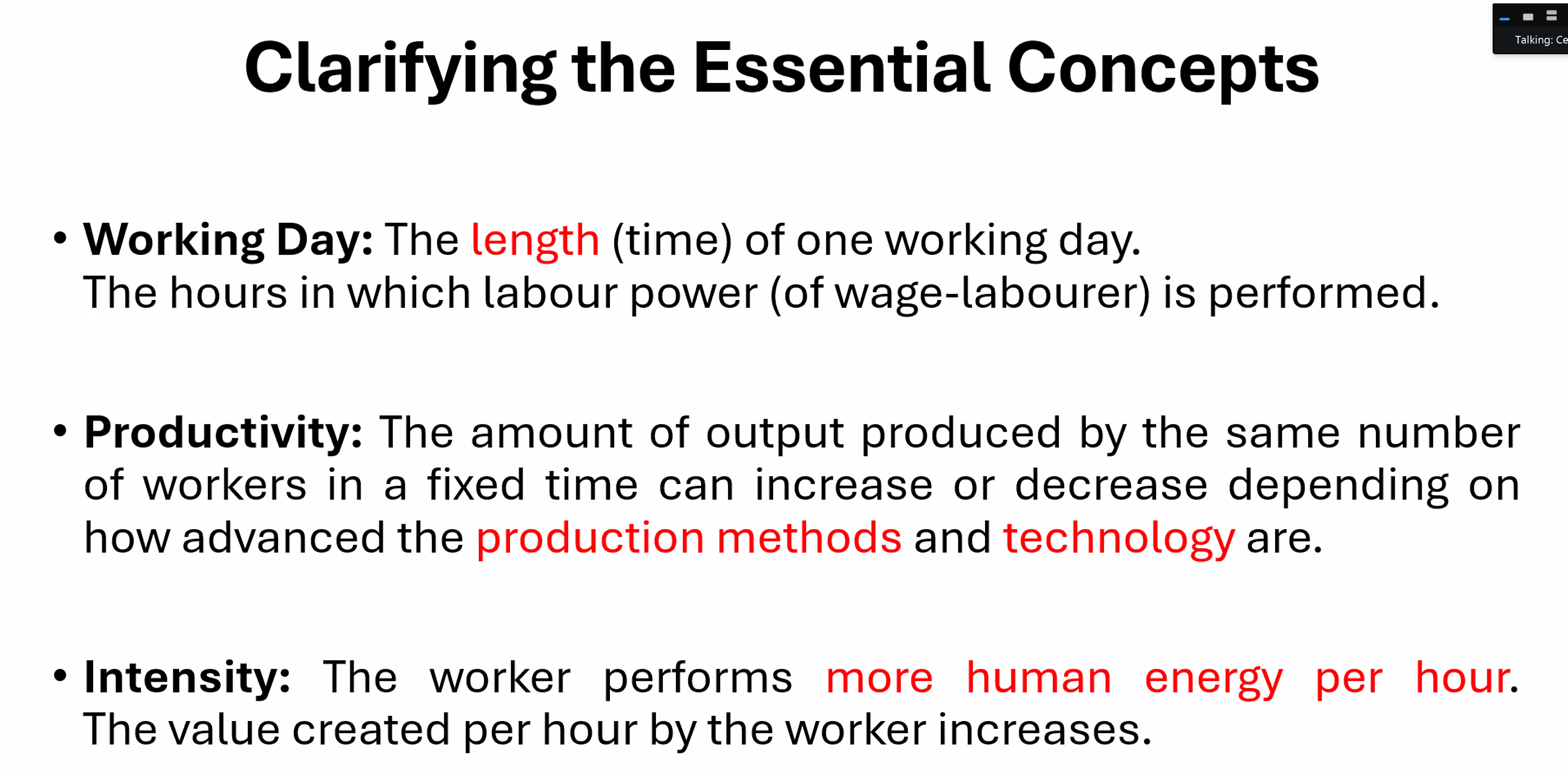
explains his productiity which is not the common usage
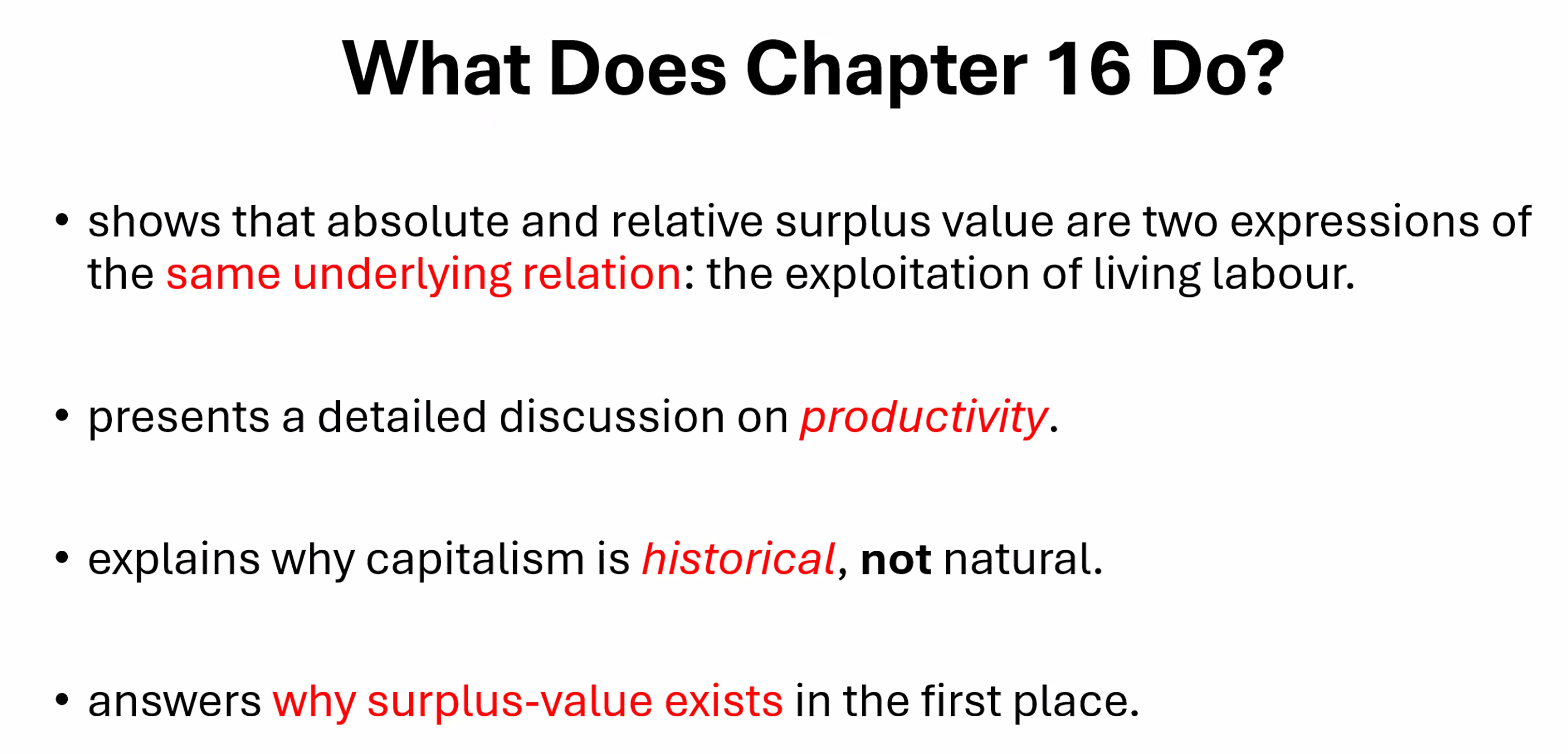
better production techniques = increase of output

intensity means that amount of value increases but the amount transmitted per item does not decrease