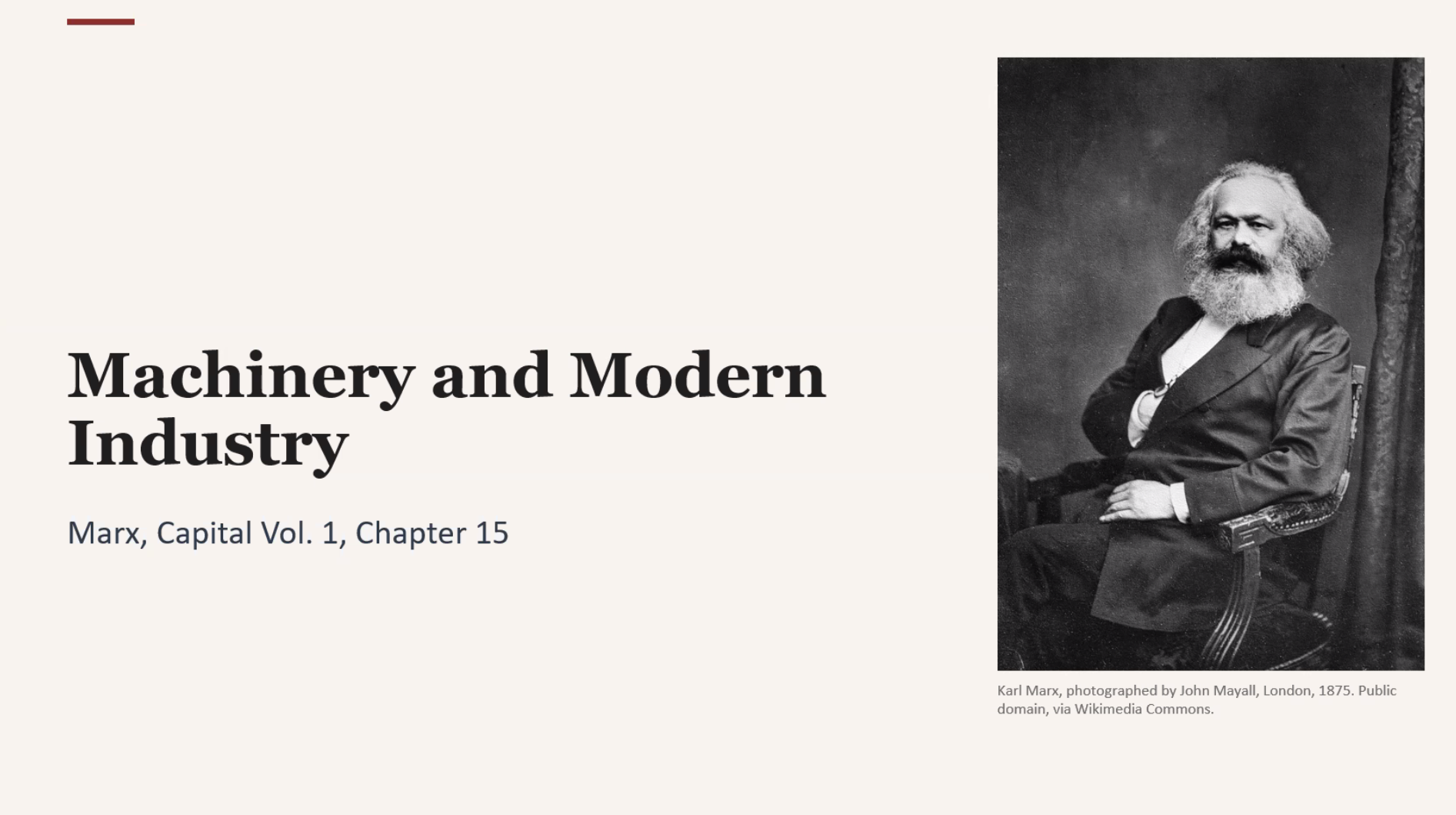
Capital Vol. 1, Ch. 15, part 2 — mind map
Text version — the same content in reading order
Economic Manuscripts: Capital Vol. I — Chapter Fifteen — marxists.org
Capital Vol. I : Chapter Fifteen (Machinery and Modern Industry)
Ch. 15 — Machinery and Large-Scale Industry
Part 2 · sections 6–10
Part 1 showed what machinery does inside the factory. Sections 6–10 follow it outward: to the workers it throws out and the economists who explain them away, to the boom-and-crisis rhythm it imposes, to the sweated trades it breeds in its shadow, to the legislation it provokes, and finally to the land.
6. The compensation theory
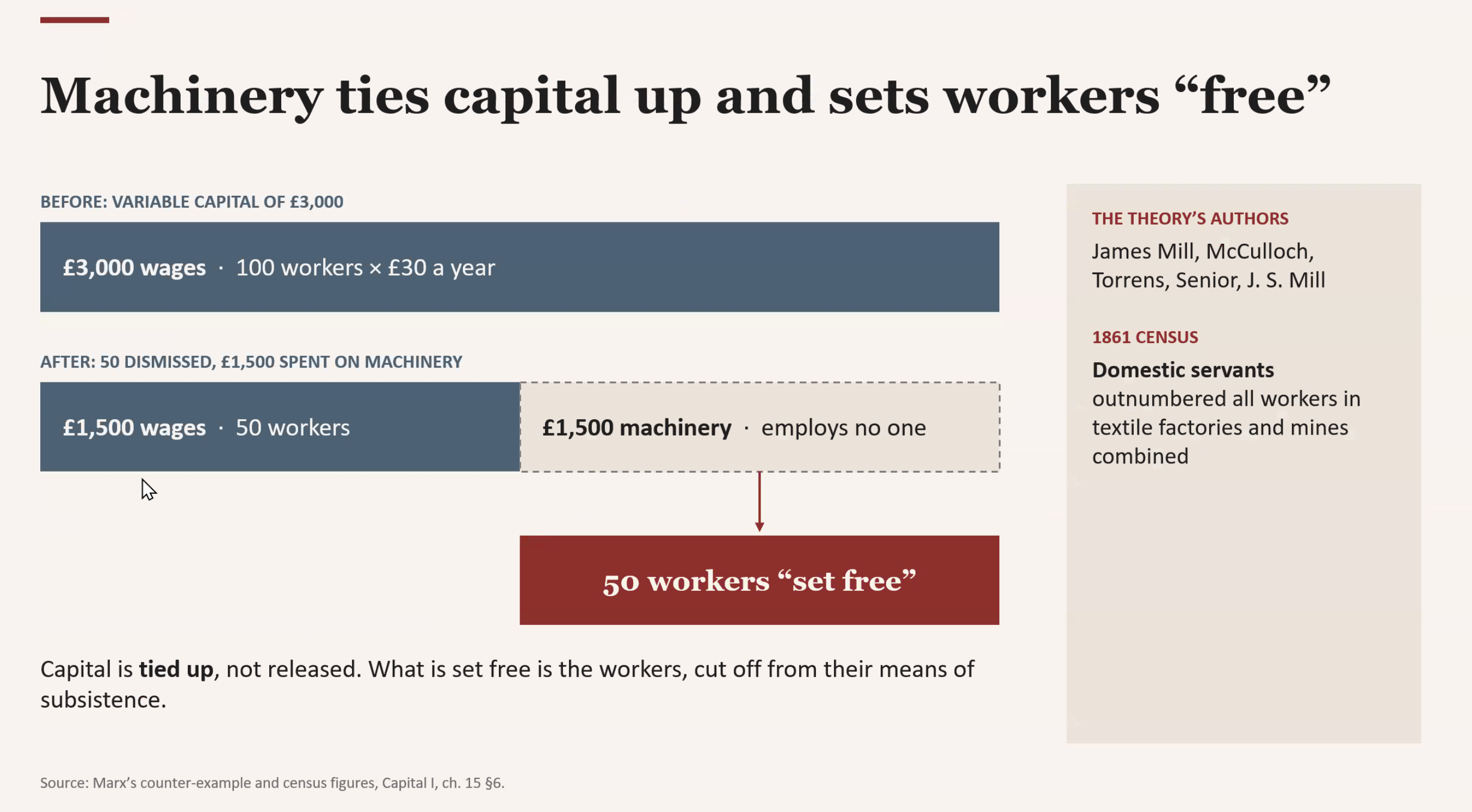
James Mill, MacCulloch, Torrens, Senior, John Stuart Mill: machinery that displaces workers sets free a capital which must then re-employ them. Marx takes the arithmetic seriously. A carpet manufacturer employs 100 workers at £30 — £3,000 in wages. He buys machinery for £1,500 and dismisses 50. Has £1,500 been set free? No: it has been converted into machinery, and is now bound in the mill more tightly than before.
What is set free is the £1,500 of bread and clothing the fifty used to buy, now without a buyer — and the fifty workers themselves. The economists’ freed capital exists in the form of the workers’ hunger. If they find work again it will be by new capital, not by the capital that dismissed them.
Where compensation really comes from
Machinery does raise employment elsewhere: in machine-making, in the raw-material trades, in new branches of production, in luxury goods for the enlarged surplus — and above all in domestic service. The census of 1861 counts 1.2 million servants in England and Wales against 1.1 million in all textile factories and mines together. The modern domestic slaves.
But the real course of events is not what the economists describe. The workers, when driven out of the workshop by the machinery, are thrown onto the labour market, and move — if they move — into lower trades, after an interval of misery. And the apologists’ trick is to answer every charge against machinery’s capitalist use by pointing to machinery as such: the contradictions do not exist, they say, because they arise not from the machine but from its capitalist application — which is exactly the point.
7. Repulsion and attraction of workers
Over the long run factory employment grows absolutely while it shrinks relative to the capital employed: each worker sets more machinery in motion. Expansion absorbs the hands that improvement expelled, and then improvement expels them again.
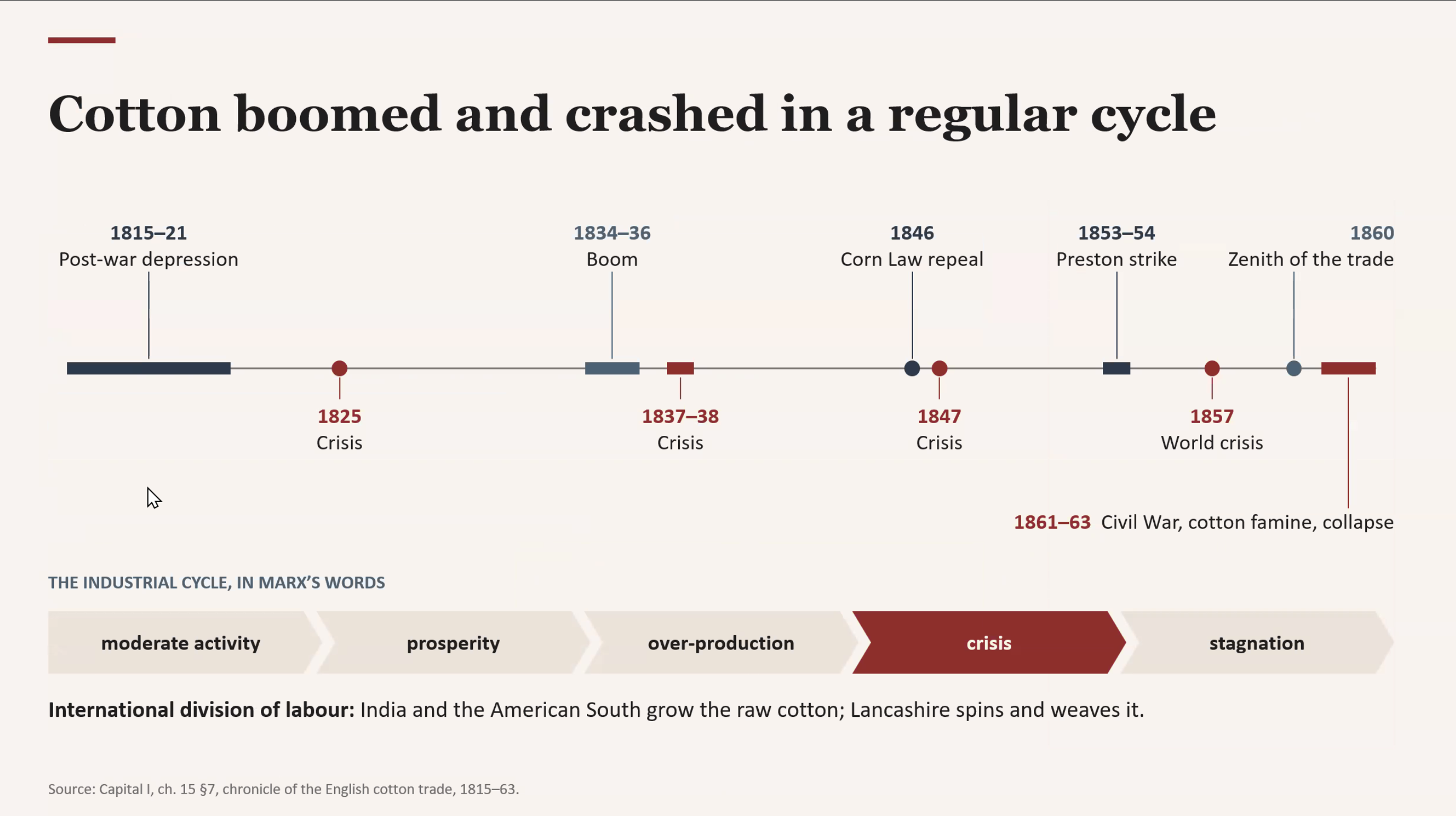
And the expansion comes by fits and starts. Large-scale industry, producing for the world market, moves through periods of moderate activity, prosperity, over-production, crisis and stagnation — the industrial cycle, stated here for the first time in Capital. The workers’ condition alternates with it: attracted in the boom, repelled in the crisis, held in reserve between.
The cotton industry, and the world market
Marx gives the chronology — 1770 to 1865, boom to crash to boom — because cotton is the industry that lived on exports. Large-scale industry creates a new and international division of labour, converting one part of the globe into a field of agricultural production for the other, which is chiefly industrial. Lancashire spun slave-grown cotton for Indian and Chinese markets it had itself destroyed.
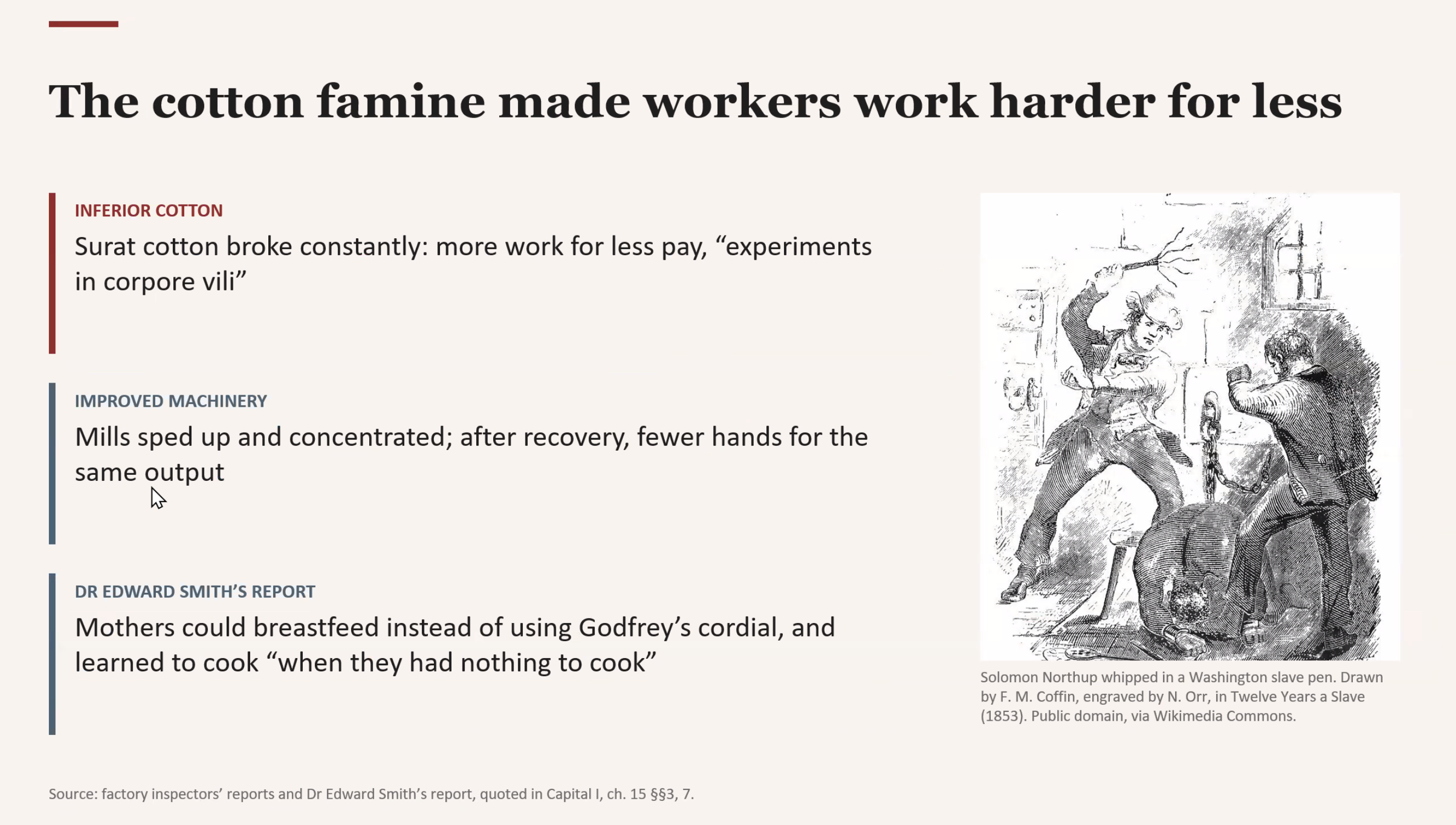
So when the American Civil War cut the supply, the Cotton Famine of 1861–65 put Lancashire on short time and relief. The operatives asked to emigrate; the manufacturers, in the person of Mr Potter in The Times, objected — the labour force was the machinery of the trade, and must be kept in the country for when cotton returned. Marx’s comment: the spinners were to be stored like the spindles.
8. The revolution in manufacture, handicrafts and domestic industry
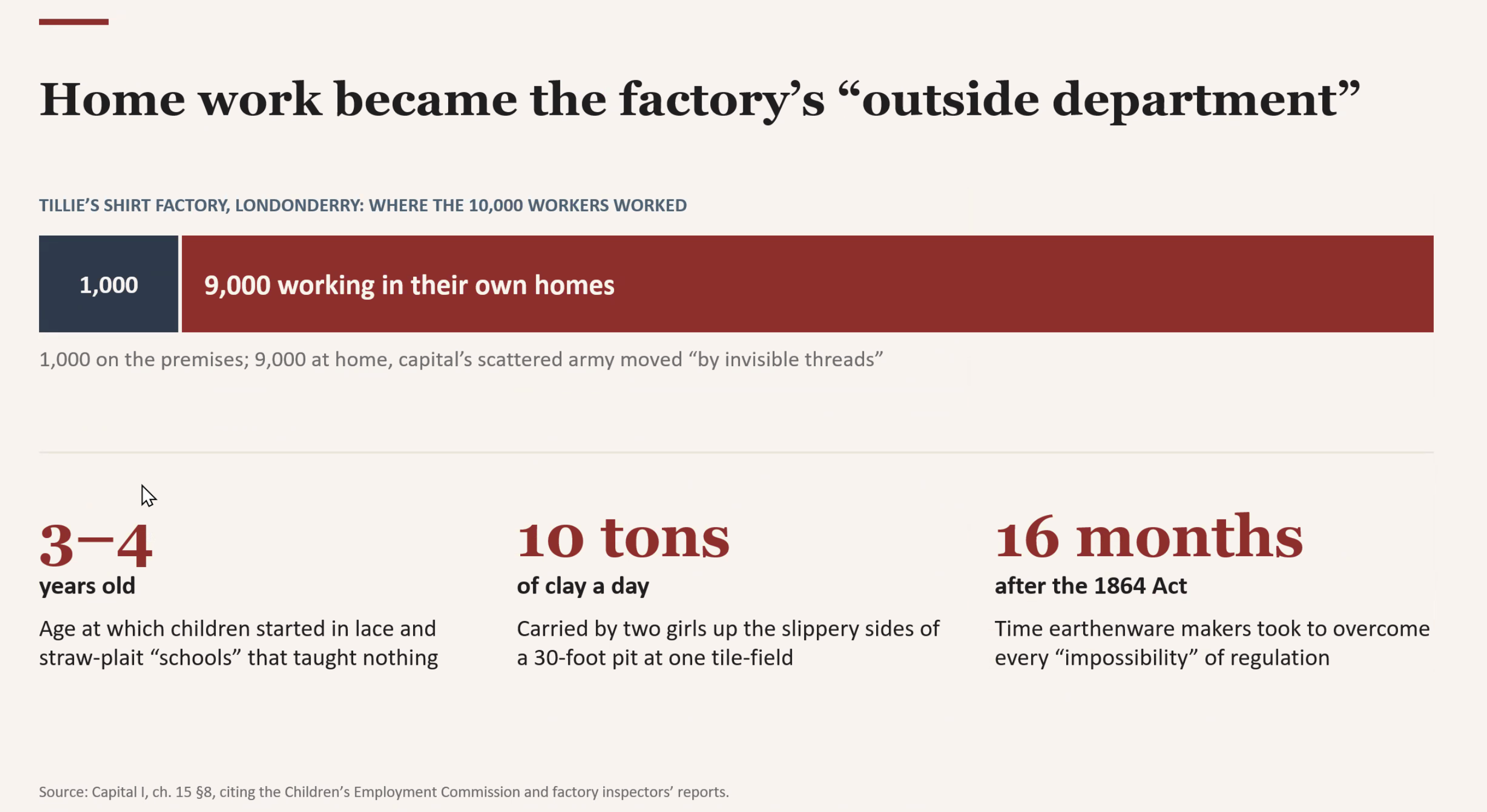
(a) The factory kills the handicraft outright where it competes with it, and overthrows co-operation based on the hand — the handloom weavers again. (b) But it also does something stranger. Its cheap products and the reserve of workers it has created let capital organise the old forms of outwork on a new footing. The so-called domestic industry has now been converted into an external department of the factory, the manufactory, or the warehouse.
The cottage worker is no longer the independent producer of the past but a hand of the factory who happens to work at home, supplied and paid by the warehouse, undercut by the machine, with none of the factory’s legal protection.
(c) Modern manufacture, (d) modern domestic industry
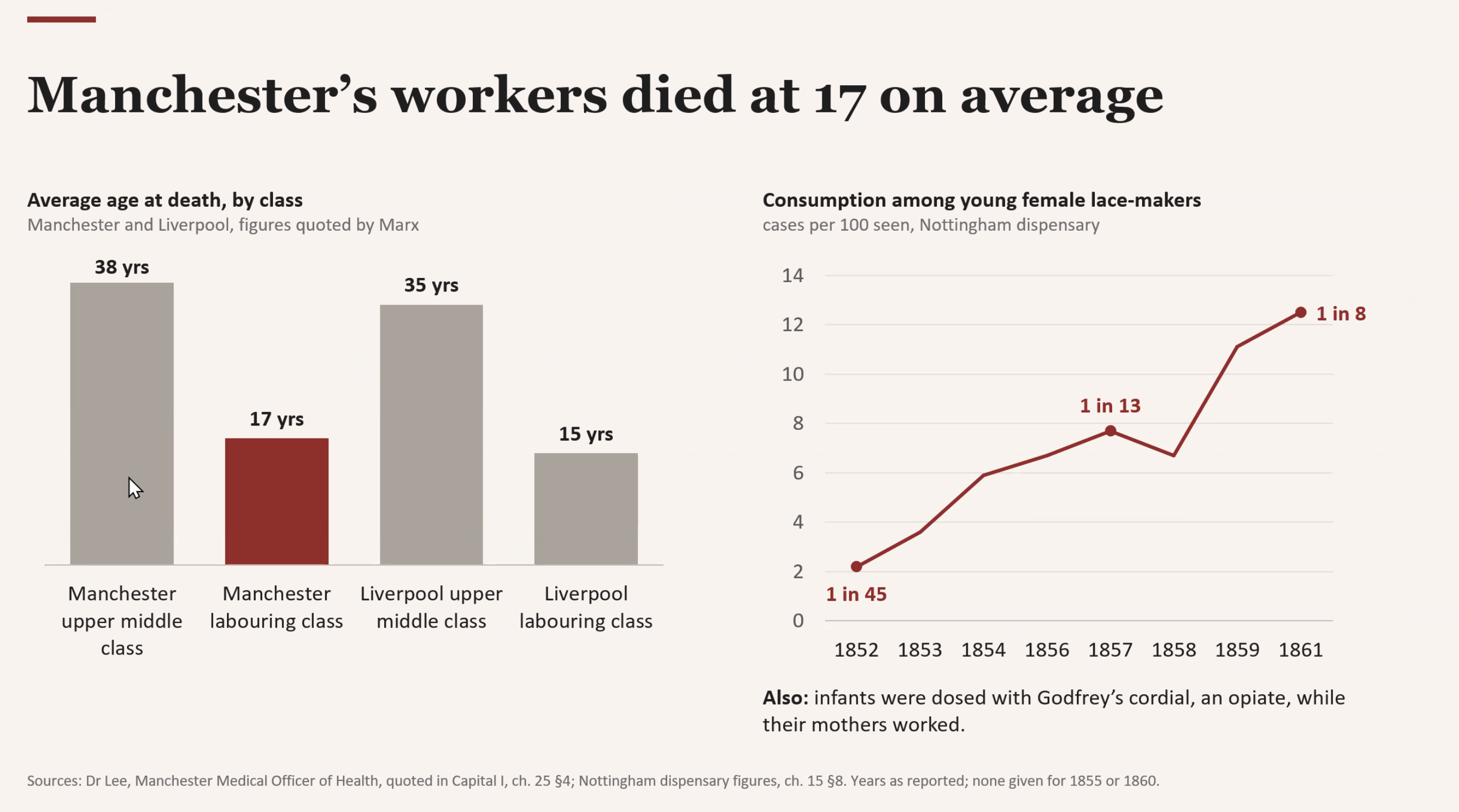
The evidence, trade by trade. London printing and bookbinding; the Birmingham metal trades; lace-finishing in Nottingham, done by children in mistresses’ houses; the straw-plait schools of Bedfordshire where children of four plait for pennies; the London wearing-apparel trade, with its seasons and its Mary Anne Walkley.
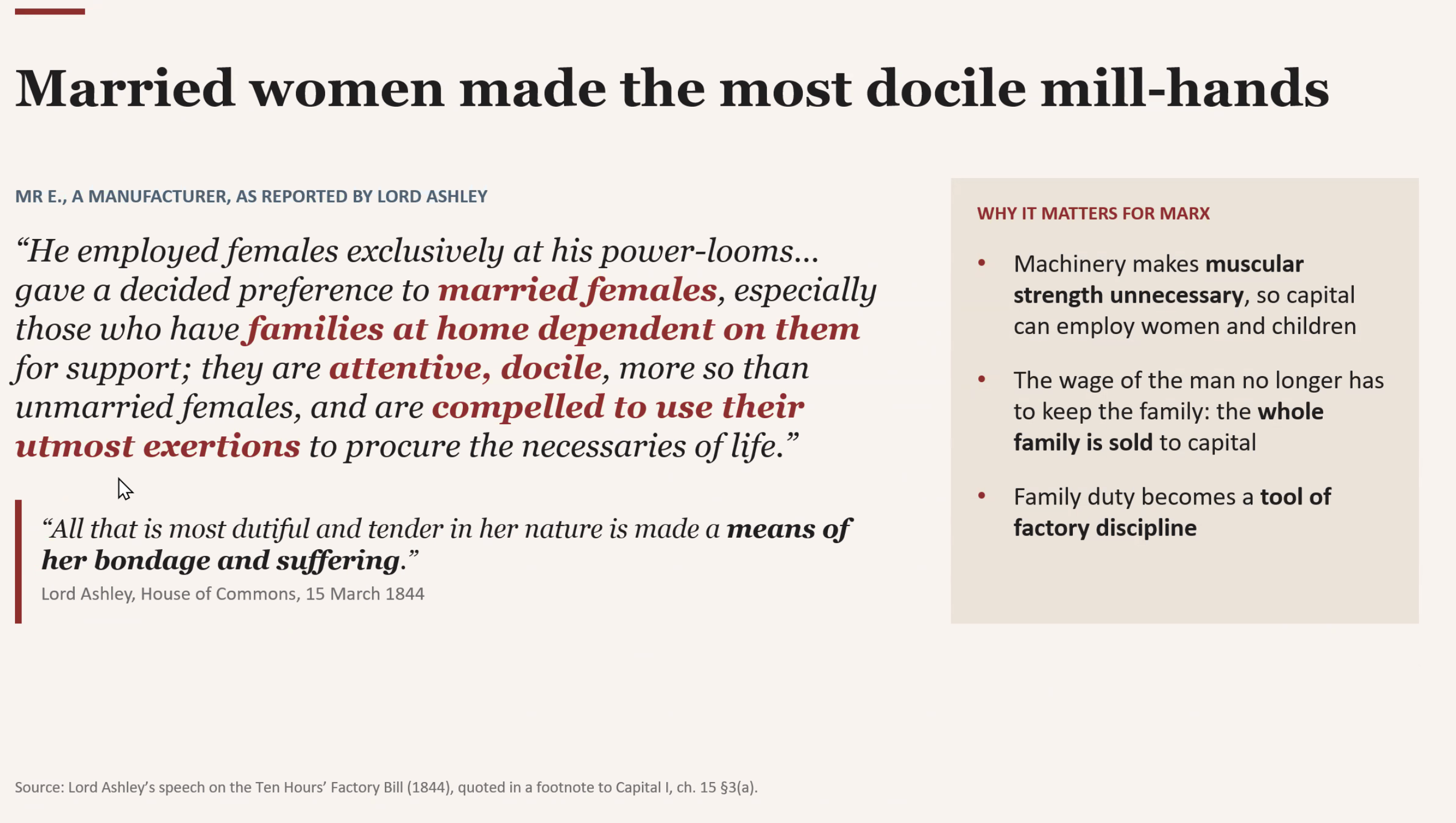
Exploitation here is more shameless than in the factory, precisely because there is no machine to set a rhythm and no Act to set a limit. The cheapness rests on sheer abuse of the labour of women and children, sheer robbery of every normal condition of working and living. This is not a survival of the old world; it is a product of the new one.
(e) The transition, accelerated by the Factory Acts
The sweated trades last only as long as they are unregulated. Bring a trade under the Factory Acts — limit its hours, bar its children — and the small master can no longer compete on sheer abuse; the machine moves in and the trade passes to the factory. The sewing-machine in the clothing trade in the 1850s and 60s is the example: once the Act touched the workshops, the slop trade mechanised within a decade.
So factory legislation artificially ripens the material elements necessary for the conversion of the manufacturing system into the factory system. The reform intended to protect the outworker ends by abolishing him.
9. The health and education clauses
The sanitary clauses are meagre — whitewash, ventilation, a guard on the shaft — and even these the manufacturers fought. What capital resists is the most modest provision.
The education clauses are more interesting. Children under the Acts work half the day and school the other half, and the inspectors report that the half-timers learn as much as, or more than, full-time pupils: the change of activity refreshes both. Marx reads in this the germ of the education of the future, which will combine productive labour with instruction and gymnastics for every child — Robert Owen’s practice, made general.
Large-scale industry is revolutionary — and contradicts itself
Unlike every earlier mode, modern industry never views or treats the existing form of a production process as the definitive one. Its technical basis is revolutionary; it constantly overturns the division of labour it has just made, and throws masses of workers and capital from one branch to another.
So it requires fluidity — workers fit for a variety of labours — and the partially developed individual, who is merely the bearer of one specialized social function, must be replaced by the totally developed individual, for whom the different social functions are different modes of activity he takes up in turn. Yet in its capitalist form it reproduces the old detail worker, and makes the variation a catastrophe for whoever lives through it. That is the absolute contradiction between the technical necessities of large-scale industry and the social character inherent in its capitalist form.
The family, the Acts extended, and what legislation ripens
Machinery has dissolved the old family by putting women and children to work. Terrible as that is, the fact that the collective worker is now composed of both sexes and all ages must … turn into a source of humane development — a higher form of the family, on a new economic foundation.
The Acts are extended — 1864, and in 1867 the Factory Acts Extension Act and the Workshops Regulation Act, reaching some 1.4 million more workers. The Workshops Act is handed to local authorities and goes largely unenforced; the hypocrisy is in the detail. But the direction is set. Factory legislation generalises the factory, and in doing so generalises its contradictions: it matures the contradictions and antagonisms of the capitalist form of that process, and thereby ripens both the elements for forming a new society and the forces tending towards the overthrow of the old one.
10. Large-scale industry and agriculture
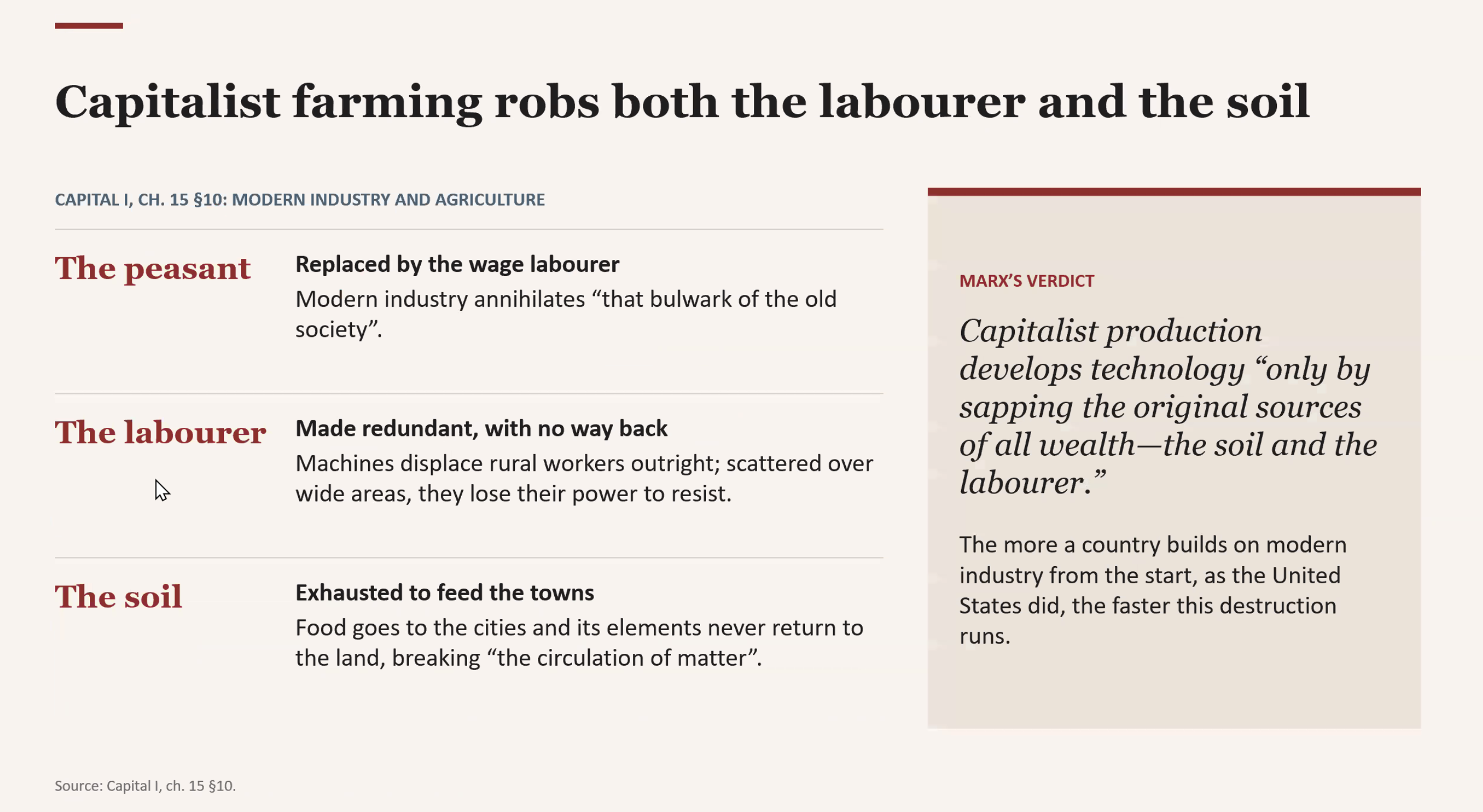
In agriculture machinery displaces workers with none of the cushion that factory expansion gives: the surplus population it creates has nowhere to go but the town. And it is here that large-scale industry acts most revolutionary — it annihilates the peasant, that bulwark of the old society, and replaces him by the wage-labourer. The country is made as capitalist as the town, and dependent on it.
The need for social transformation and the antagonism of classes are brought to the same level in the countryside as in the factory.
The rift, and the two sources of wealth
Capitalist agriculture concentrates population in the towns, and so disturbs the metabolic interaction between man and the earth, i.e. it prevents the return to the soil of its constituent elements consumed by man in the form of food and clothing; hence it hinders the operation of the eternal natural condition for the lasting fertility of the soil. Liebig had shown what English farming was doing to its own ground.
All progress in capitalist agriculture is a progress in the art, not only of robbing the worker, but of robbing the soil. And the chapter’s last line: Capitalist production, therefore, only develops the techniques and the degree of combination of the social process of production by simultaneously undermining the original sources of all wealth — the soil and the worker.
Two robberies, one progress — §10
| the worker | the soil | |
|---|---|---|
| what is taken | surplus labour | nutrients: nitrogen, phosphorus, potash |
| by what | the wage, the machine | town/country split; no return of waste to land |
| who showed it | the factory inspectors | Liebig, Agricultural Chemistry |
| the result | a shortened life | exhausted fertility |
| the word | exploitation | the metabolic rift |
Capitalist production … undermines the original sources of all wealth — the soil and the worker.
The factory’s shadow — §8
| form | what it is | regulated? |
|---|---|---|
| the factory | machine, automaton, Acts | yes |
| modern manufacture | hand-work in large shops — printing, Birmingham metal | not until 1867 |
| modern domestic industry | out-work for the warehouse — lace, straw-plait, slop clothing | no |
The unregulated forms are cheaper than the factory only by abuse — and vanish into it as soon as the Acts reach them.
(e) sewing-machine + Factory Act → the slop trade mechanises, 1850s–60s.
The industrial cycle, and cotton
moderate activity → prosperity → over-production → crisis → stagnation → …
Cotton, 1770–1865, by Marx’s reckoning 1770–1815 the great expansion 1815–21 peace, glut, depression 1822–25 boom · 1825 crash 1826–32 slow recovery 1833–37 boom · 1837–39 crisis 1842 stagnation · Chartist strikes 1844–47 railway boom · 1847 crash 1848–57 expansion · 1857 crash 1861–65 the Cotton Famine
Workers attracted, repelled, held in reserve — on the cycle’s timetable, not their own.
The carpet manufacturer’s sum
Before 100 workers × £30 = £3,000 wages
After machinery bought £1,500 50 workers dismissed · wages now £1,500
The economists say £1,500 of capital is set free → re-employs the 50
Marx says the £1,500 is now machinery — fixed, not free what is free is
- £1,500 of bread and clothes with no buyer
- 50 workers with no wage
Freed capital = the workers’ hunger.
The set free fallacy, dismantled the Senior way: take the economists’ own sum and show what it actually adds up to. Capital is not freed by machinery; it is fixed by it. What is freed is the worker and his dinner, and neither is capital. Compensation, when it comes, is a fresh accumulation — which is exactly what Part Seven is about.
Machinery as such versus its capitalist employment — the distinction of Part 1 §5, now turned against the economists who refuse it. Their defence of capital consists in blaming the machine’s victims on the machine’s social form, and then declaring the social form irrelevant.
The 1.2 million servants are the hidden half of the factory system: the surplus it created, re-employed to wait on those who hold it.
The industrial cycle appears here as the normal rhythm of large-scale industry, not a run of accidents — the first sketch in Vol. I of what Part Seven calls the reserve army. And the world market: the Cotton Famine is a lesson in dependency running both ways — Lancashire on the American South, India on Lancashire. One part of the globe an agricultural field for the other.
Domestic industry is not a leftover; it is made by the factory — its outside department, fed by the surplus population and the warehouse. Marx is describing the sweatshop before the word, and the logic of subcontracting and home-work still: push the unregulated part of the process outside the regulated building. Worse than the factory because no machine sets the pace and no Act the hours.
The positive vision inside the negative analysis. Large-scale industry needs the versatile, all-round worker — and in its capitalist form forbids him. That gap is the lever: Owen’s schools, the half-time system, polytechnic education are not reforms but the new society’s requirements showing through the old. Worth asking a room whether the gap has closed or widened.
The metabolic rift. Ch.7 defined labour as the metabolism between man and nature; here capital is shown breaking it — nutrients leave the field as food, reach the city as sewage, never return. Liebig’s soil chemistry gave Marx the science. Foster and Saito rebuilt ecological Marxism on this passage. And the last line names capital’s two victims together: the worker and the soil, robbed by the same progress.
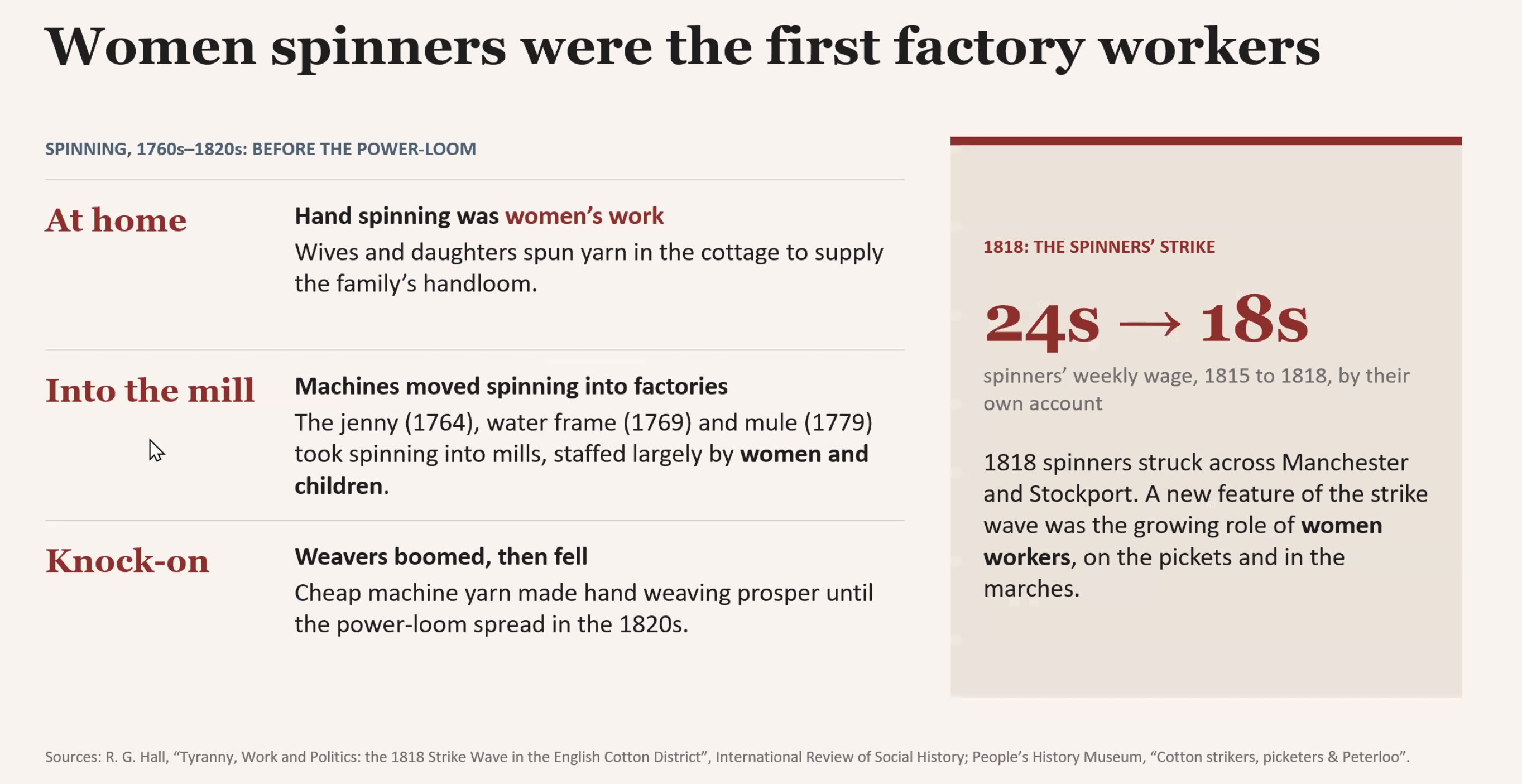
women were the first factory workers - Marx misses this
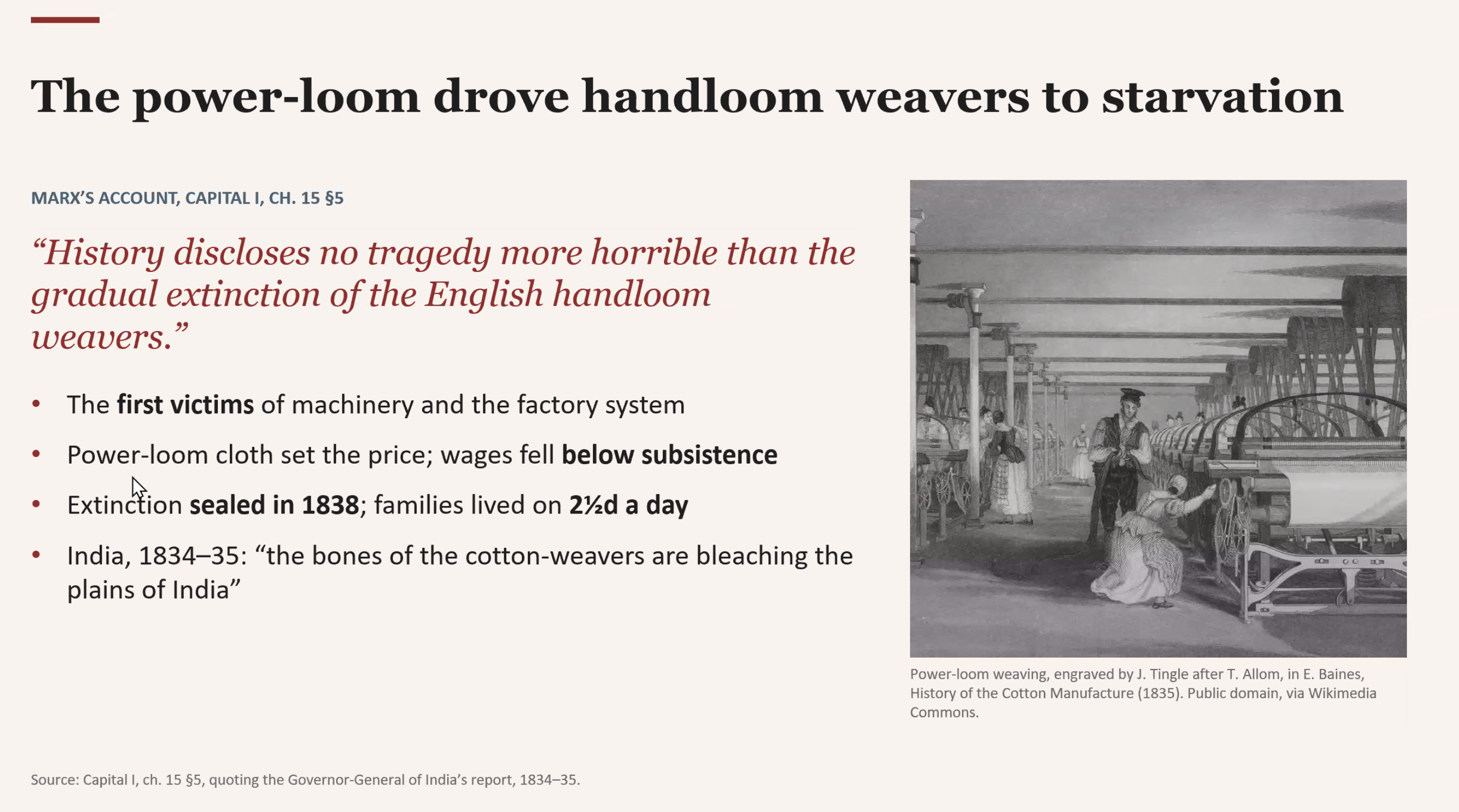
the main example of who gets the downside of mechanisation, made weavers redundant
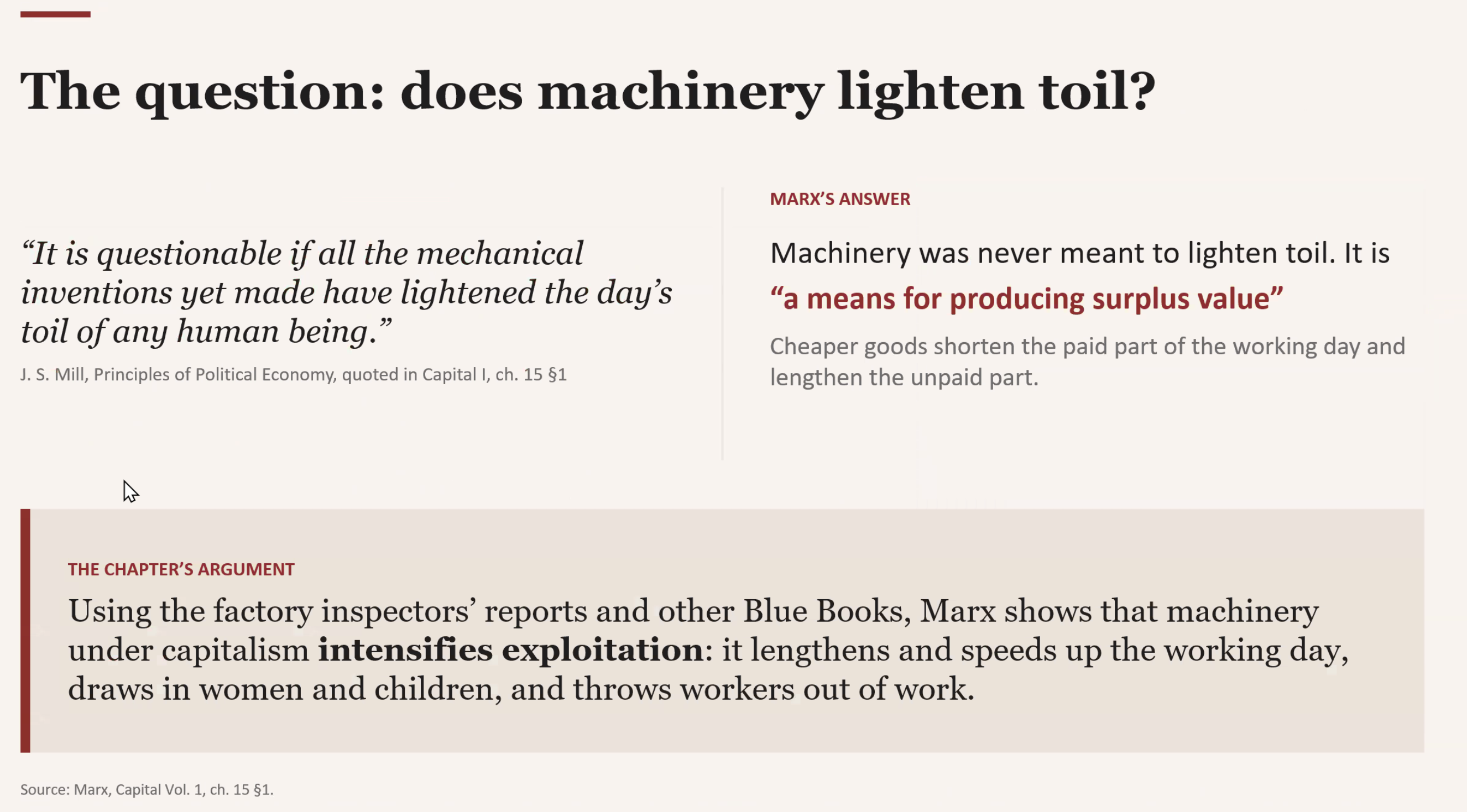
lengthens the part of the day the but given to capital
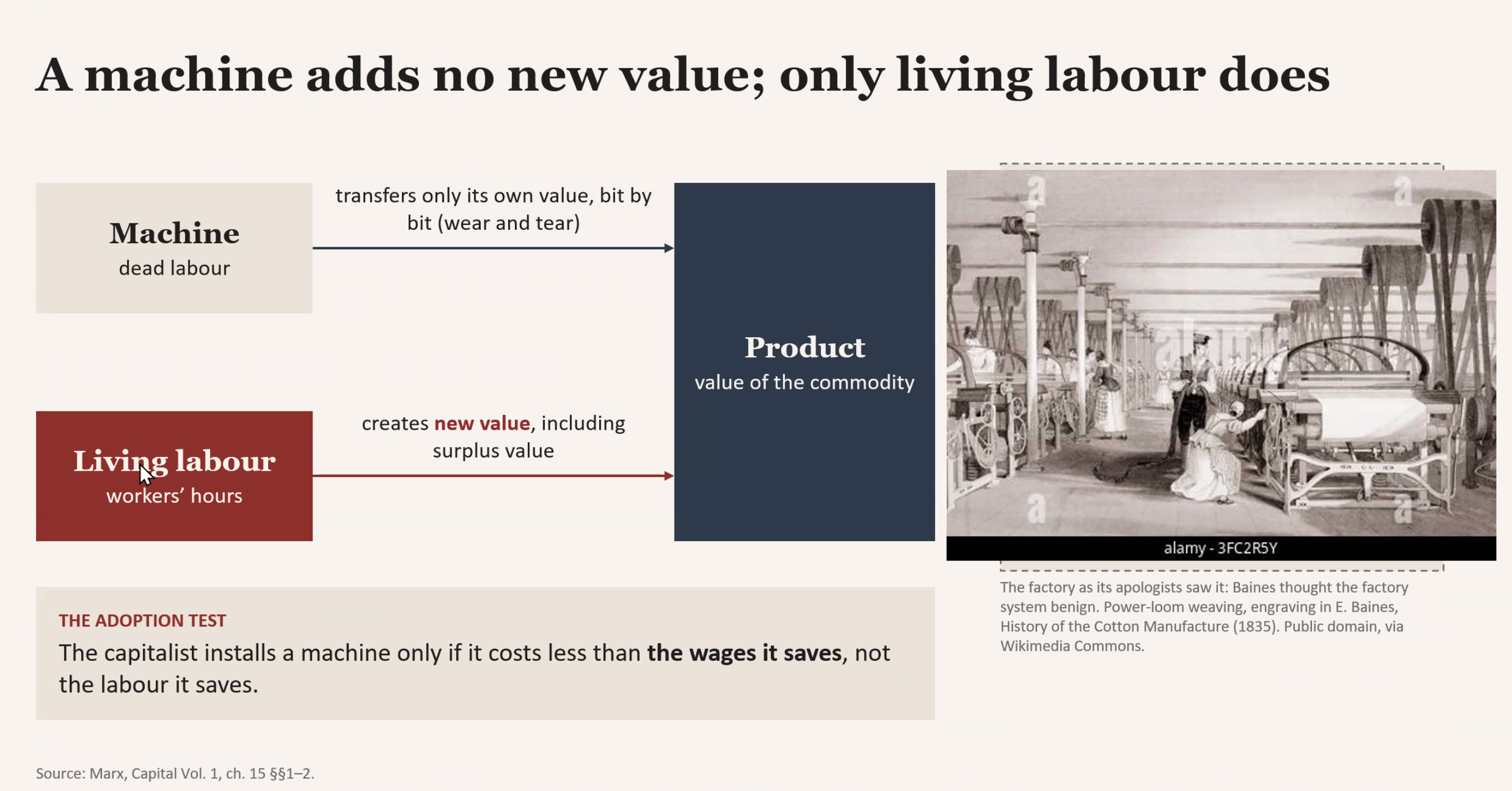
transfers its own value
the double burden of private production and social reproduction
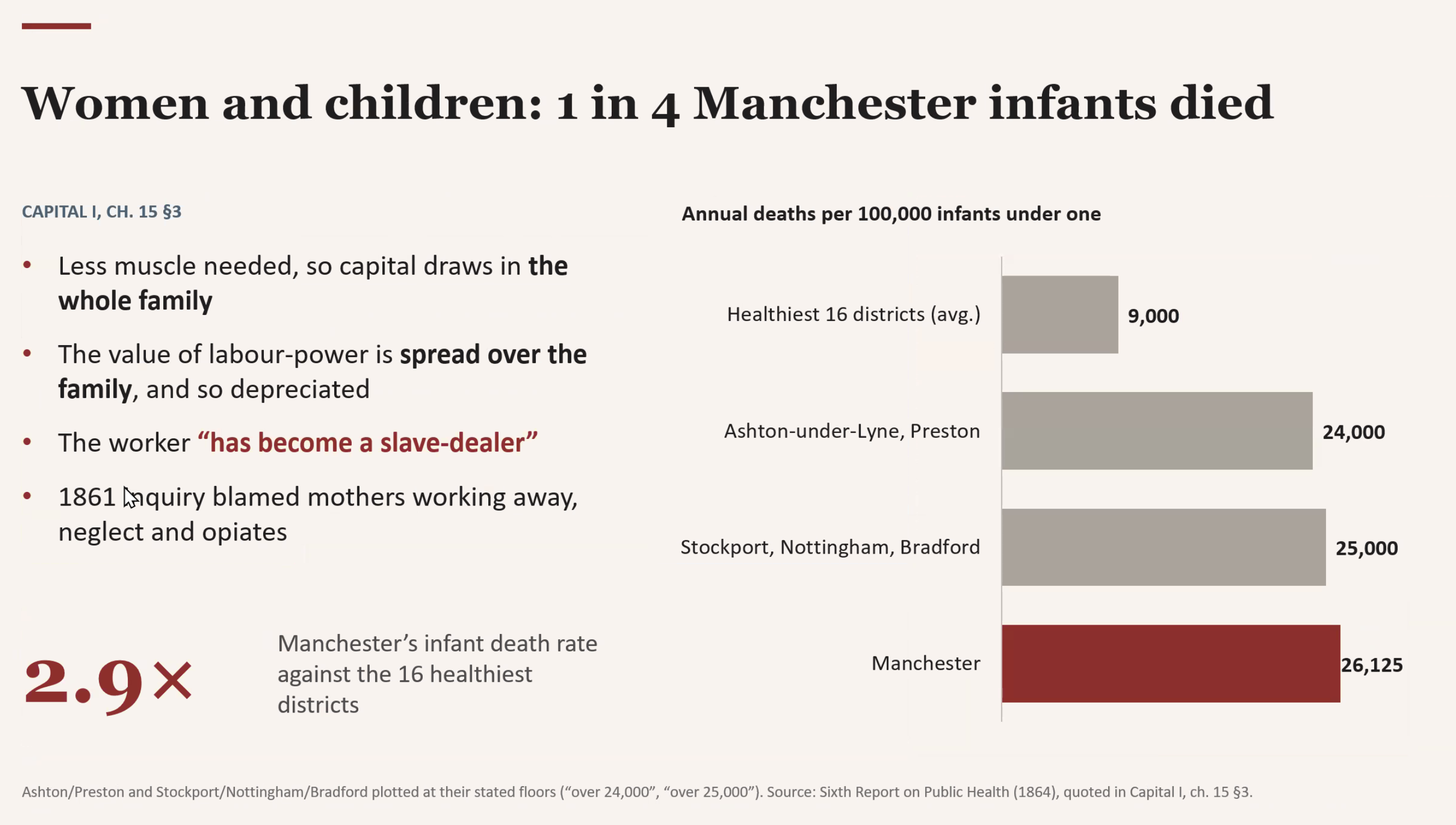
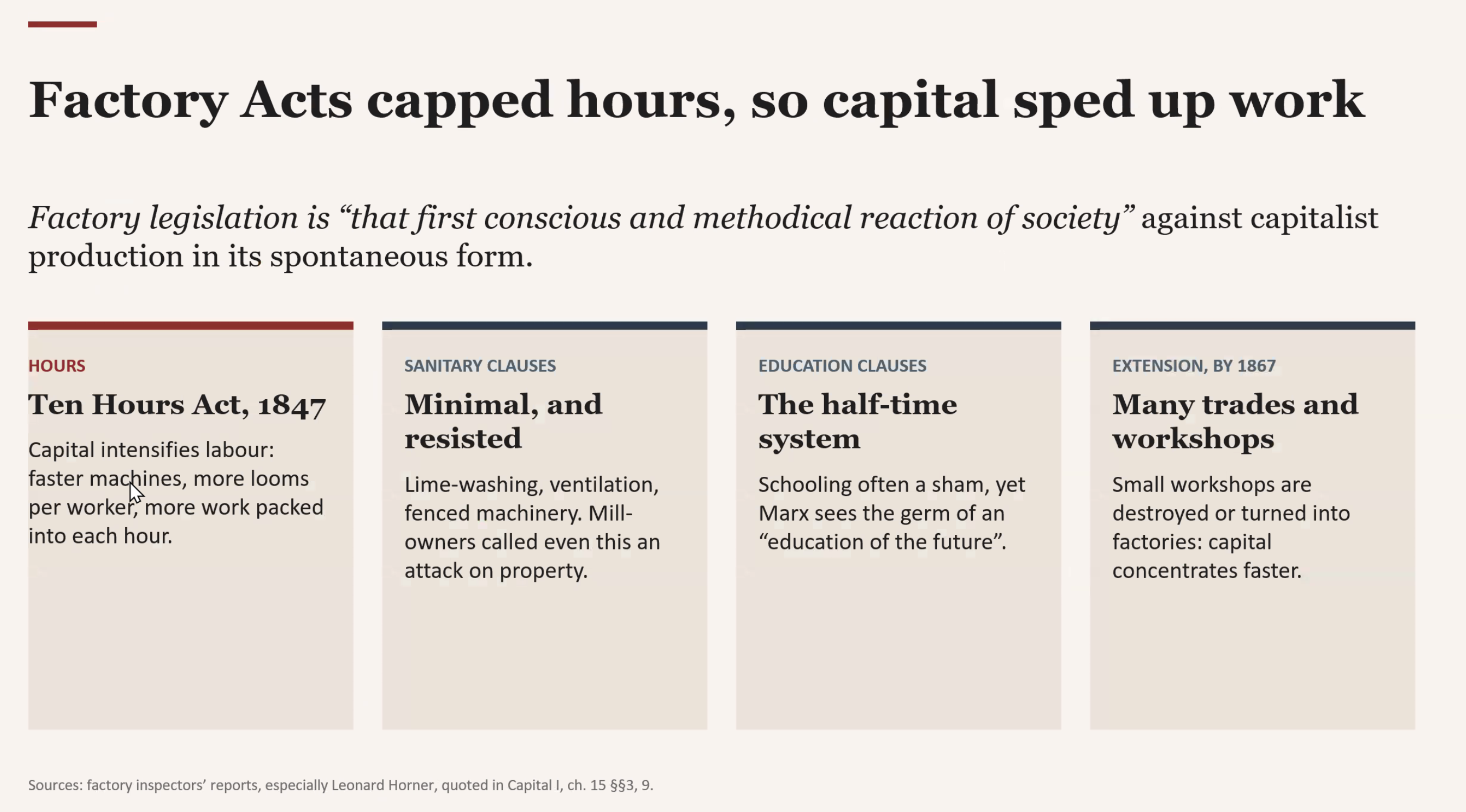
big upsurge of protest, capitalists so intent on profit that they were destroying society (social reproduction)
we are in full laissez faire capitalism, but government had to step in
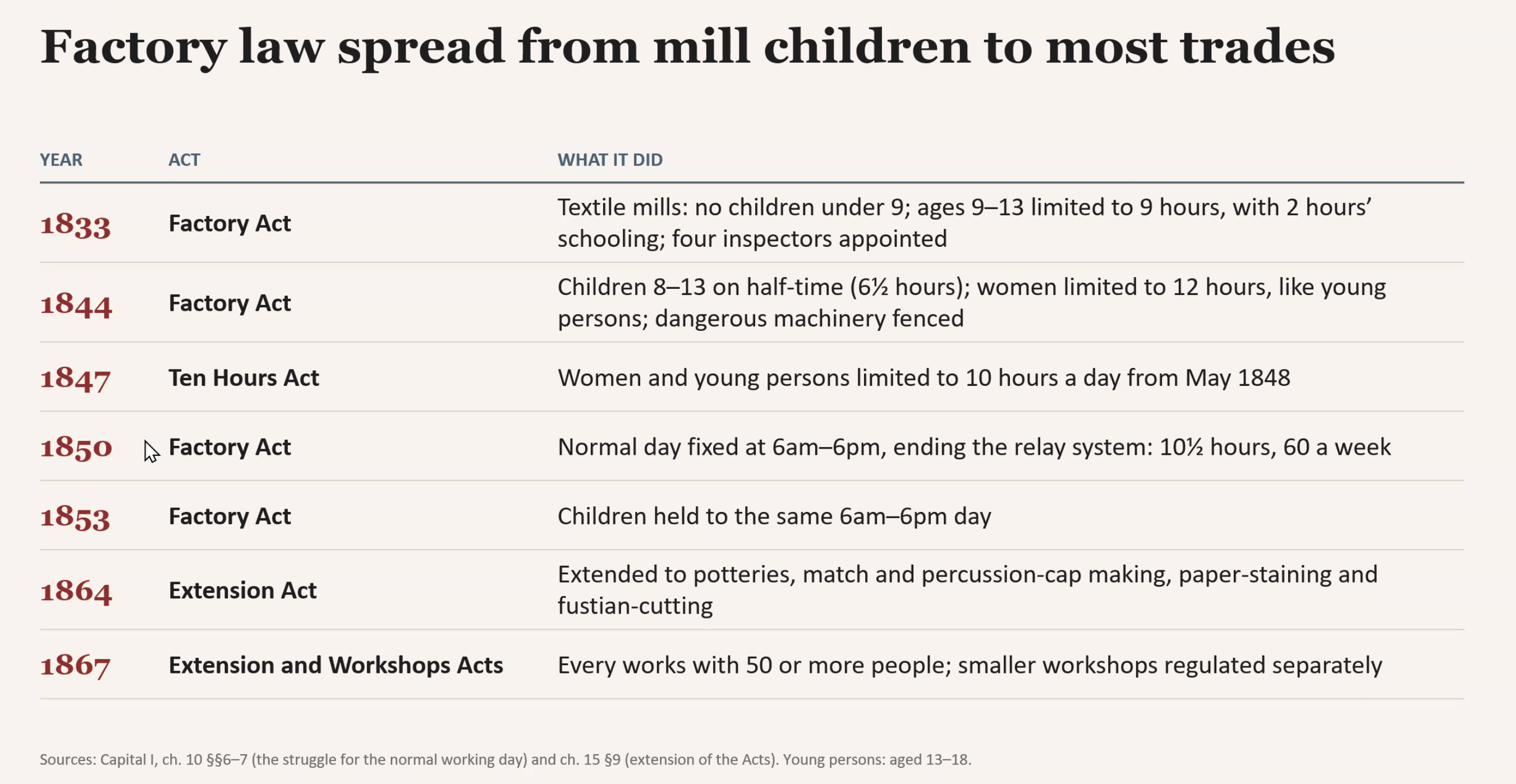
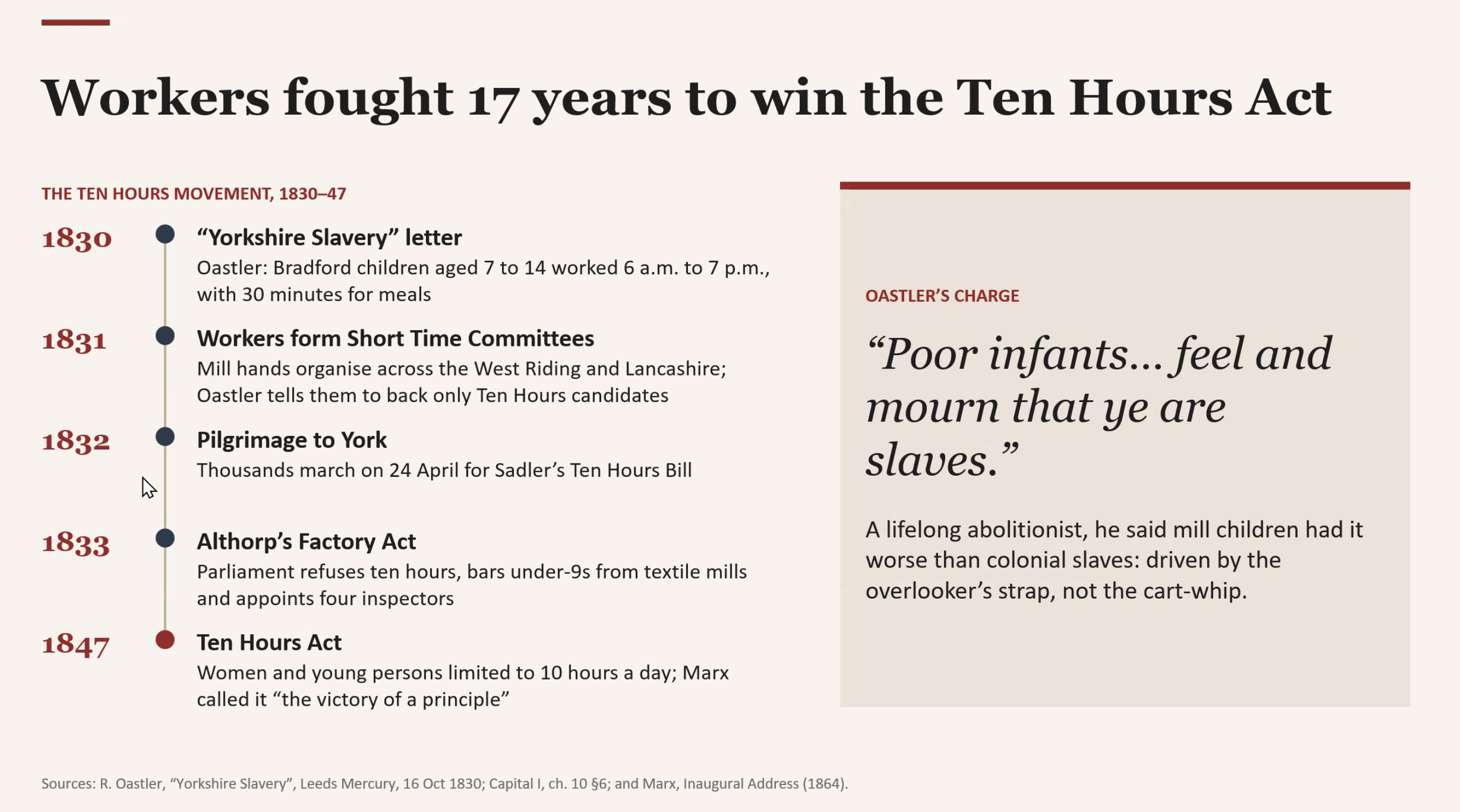
won by workers, not granted by “enlightened owners”
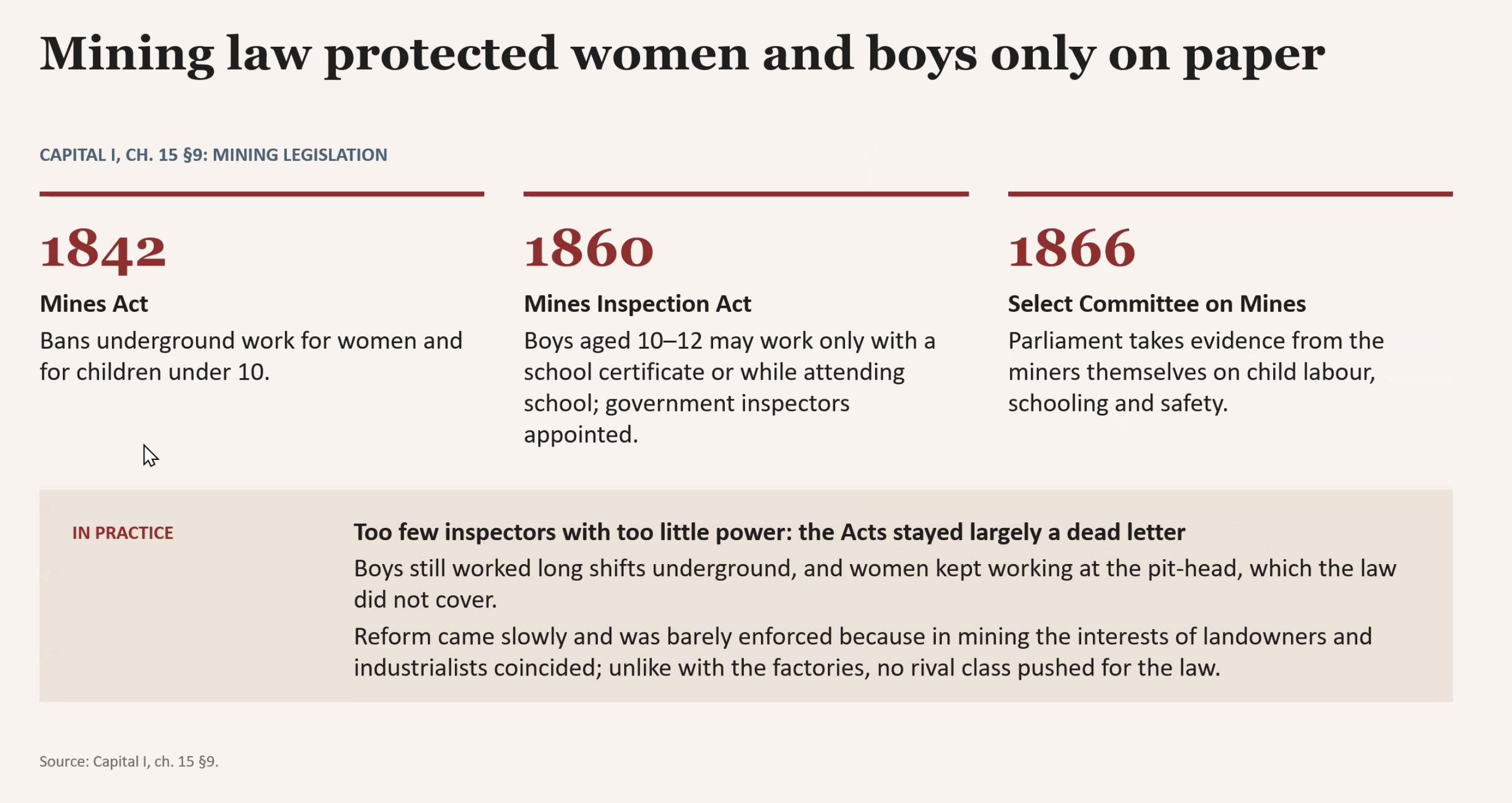
boom in servants
manchesters wealth based on slavery
1842 general strike, plug riots - empties the steam boilers