Capital Vol. 1, Ch. 15, part 1 — mind map
Text version — the same content in reading order
Economic Manuscripts: Capital Vol. I — Chapter Fifteen — marxists.org
Capital Vol. I : Chapter Fifteen (Machinery and Modern Industry)
Ch. 15 — Machinery and Large-Scale Industry
Part 1 · sections 1–5
The third form of relative surplus-value and the longest chapter in the book. Co-operation changed the scale, manufacture changed the process; machinery changes the instrument, and with it who holds the tool. Sections 1–5: what a machine is, what it is worth, what it does to the worker, what the factory is, and how the worker fights back.
1. The development of machinery — the question, and the definition
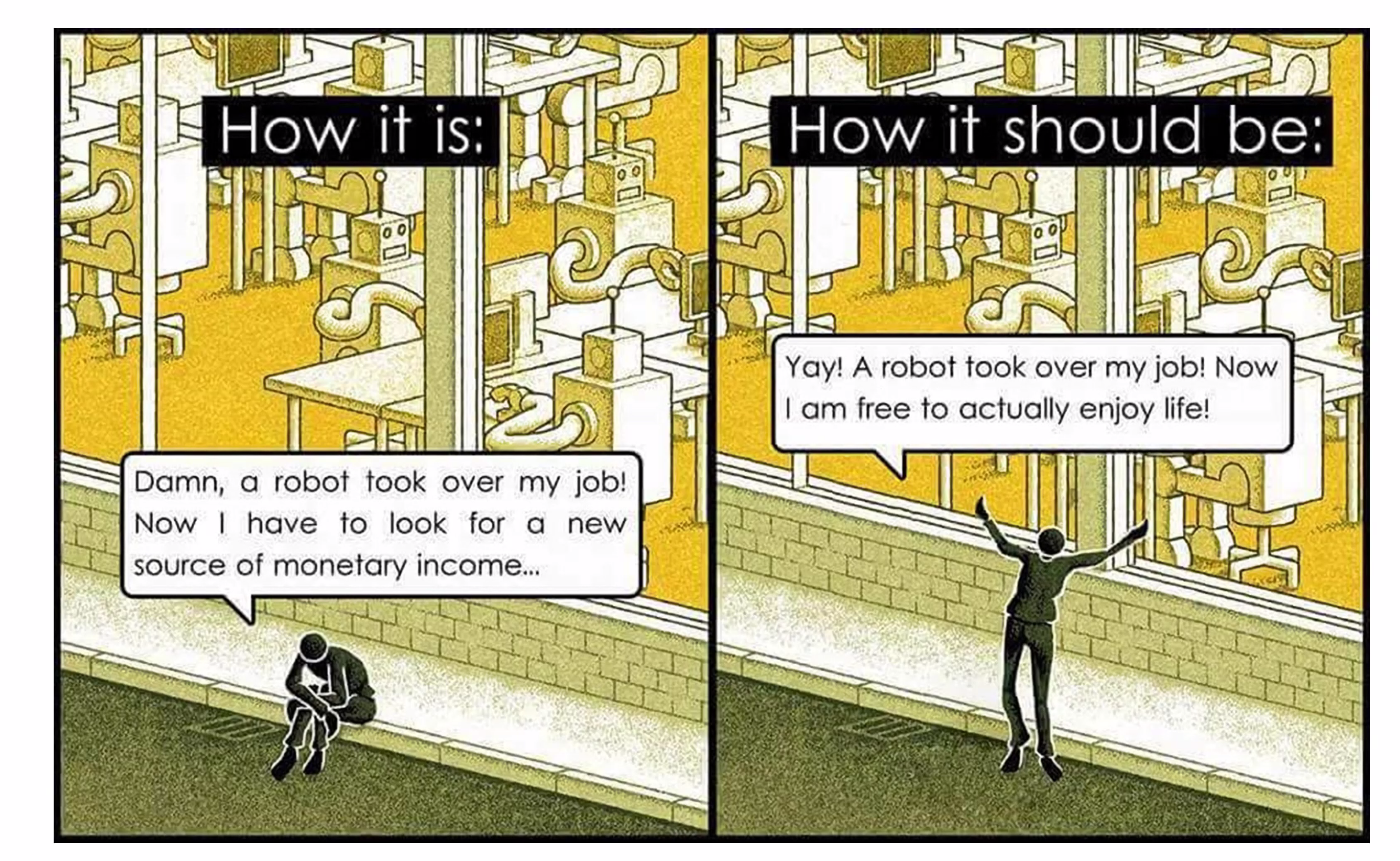
John Stuart Mill wondered whether all the mechanical inventions yet made had lightened the day’s toil of any human being. Marx: that was never the aim. Like every other instrument for increasing the productivity of labour, machinery is intended to cheapen commodities and, by shortening the part of the working day in which the worker works for himself, to lengthen the other part. It is a means for producing surplus-value.
What distinguishes a machine from a tool? Not the mathematicians’ answer (a tool is a simple machine, a machine a complex tool) — that misses the economic point. Nor that a machine is driven by non-human power — the ox-drawn plough is not a machine, and Claussen’s circular loom, turned by hand, is. The difference lies in what has happened to the tool.
Three parts, and the one that started it
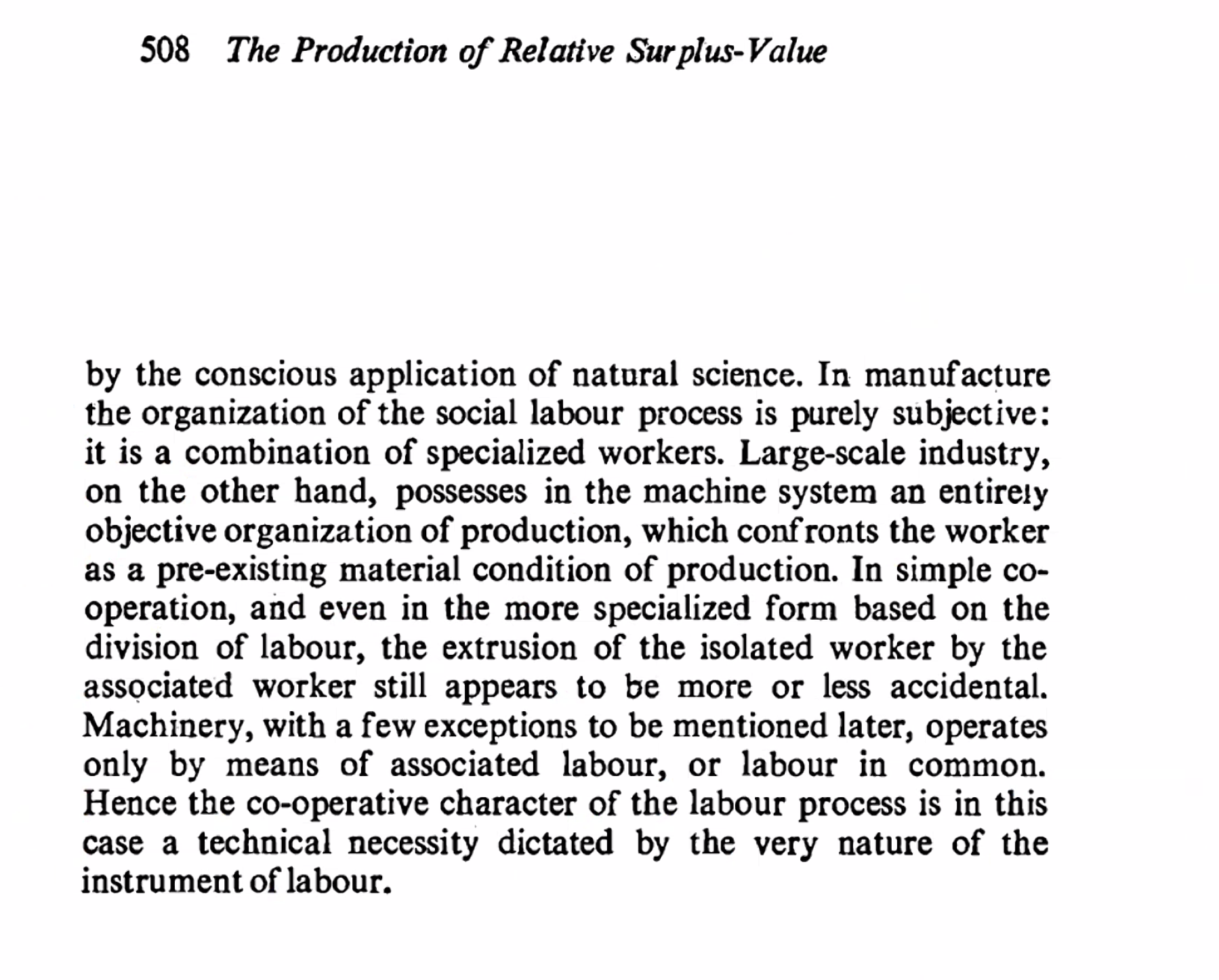
All fully developed machinery has three parts: the motor mechanism, the transmitting mechanism, and the tool or working machine. The industrial revolution began from the last.
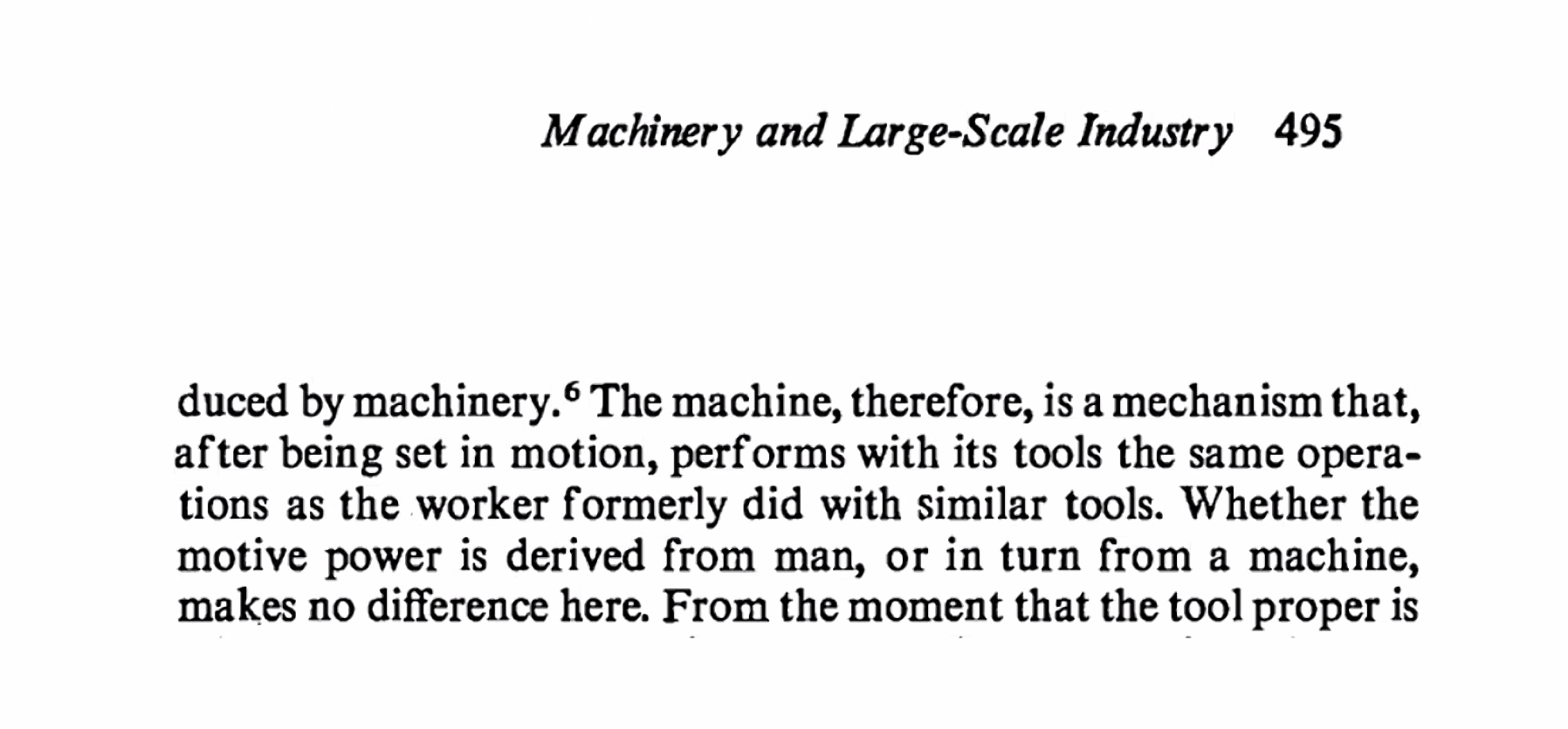
The working machine is a mechanism that, once set in motion, performs with its tools the operations the worker used to perform with similar tools. The jenny span with twelve or eighteen spindles at once where the spinner could manage one. The number of tools that a machine can bring into play simultaneously is from the outset emancipated from the organic limitations that confine the tools of the handicraftsman. The tool has been taken out of the hand.
Only then does the human being become the bottleneck — as a motor, he is weak, irregular and tired.
The motor, the system, the monster
So the working machine demanded a new motive power, and Watt’s double-acting engine of 1784 supplied it: a prime mover that makes its own power from coal and water, of any strength, movable, urban. The steam engine did not cause the industrial revolution; the working machine called for the steam engine.
Then machines co-operate. Where the product passes through a connected series of working machines, each feeding the next, there is a system of machinery — the organic manufacture of Ch.14 rebuilt in iron — and when the whole is driven from one motor it becomes an automaton. An organized system of machines to which motion is communicated by the transmitting mechanism from an automatic centre is the most developed form of production by machinery. The workshop becomes a mechanical monster whose body fills whole factories, and whose demonic power … breaks out into the fast and furious whirl of its countless working organs.
Machines made by machines
As long as machines were built by hand, they bore the stamp of the handicraft — limited in size, precision and number. Large-scale industry had to seize its own instrument: to produce machines by means of machines. Only then could it create for itself an adequate technical foundation, and stand on its own feet. The slide-rest on the lathe, the steam-hammer, the planing machine: cyclopean tools no hand could wield, making parts no hand could make.
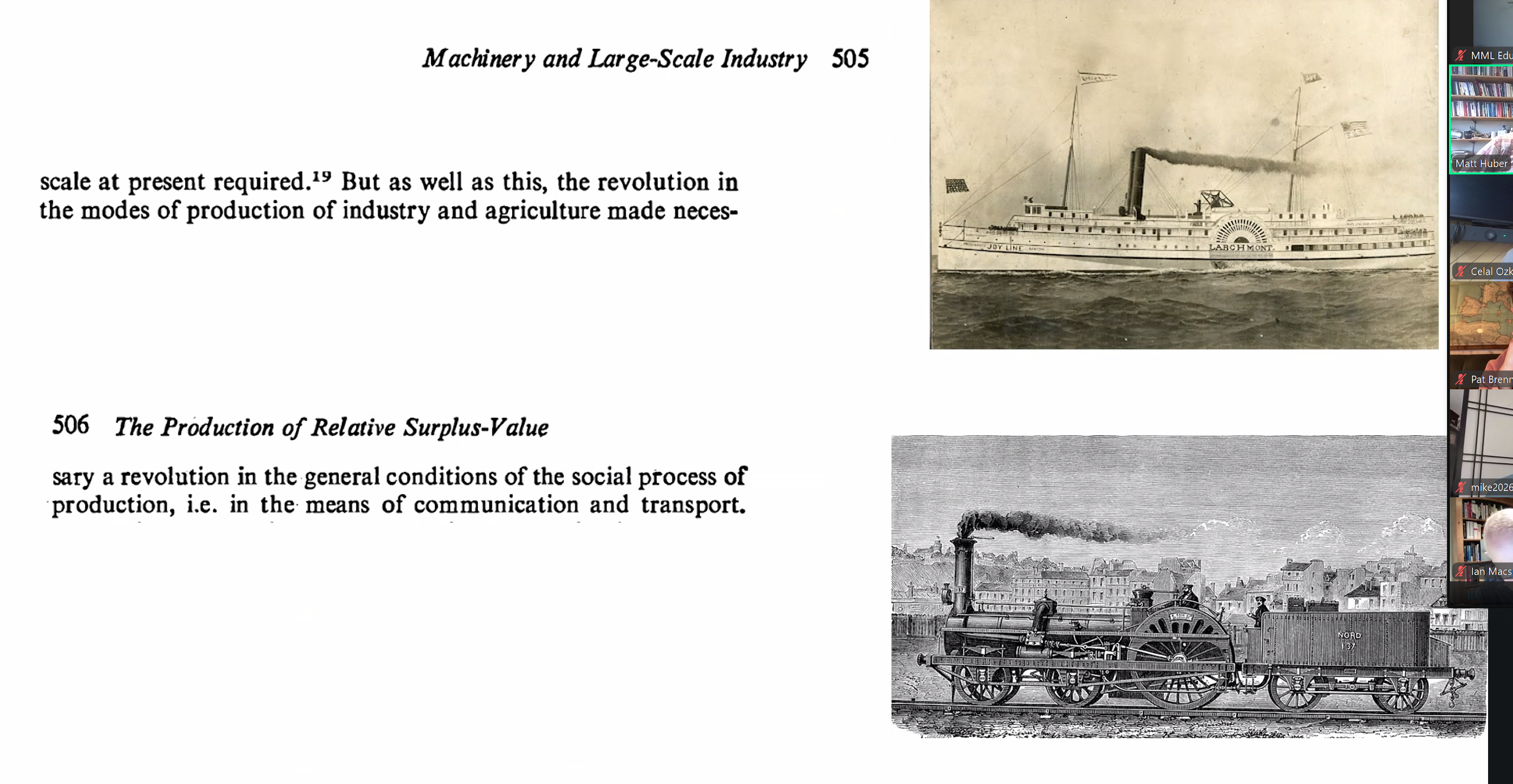
And a revolution in one sphere compels revolution in the next. Machine spinning demanded machine weaving, which demanded chemical bleaching and dyeing; cotton on this scale demanded the cotton gin; and the whole demanded a revolution in transport and communication — steamship, railway, telegraph — to move the mass of commodities and the mass of orders.
2. The value transferred by machinery to the product
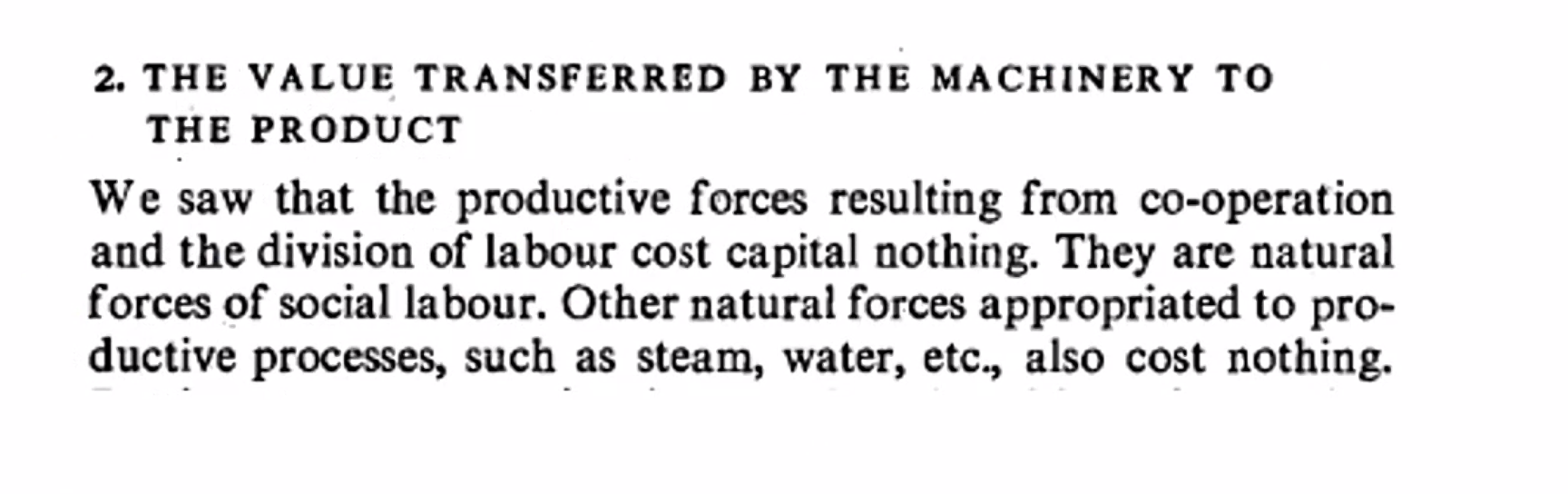
Machinery is constant capital. It creates no value; it transfers its own value, piecemeal, over everything it helps to produce. Its productivity is measured by the human labour-power it replaces, and the natural forces and science it harnesses cost nothing.
So there is a limit to its use for cheapening the product: less labour must go into making the machine than the machine displaces. But the capitalist’s limit is narrower still. He does not pay for the labour displaced; he pays for the wages displaced. So a machine is adopted only if it costs less than the paid part of the labour it replaces. Where wages are very low, it is not. England invented the stone-breaking machine; America used it. English canals were towed by women, because women were cheaper than horses or engines. Hence the invention nowadays of machines in England that are employed only in North America.
3(a). Women and children
Machinery dispenses with muscular strength, so it can be worked by those with little — and the labour of women and children was therefore the first result of the capitalist application of machinery. Where the man once sold his own labour-power, the whole family is now thrown on the market. The value of labour-power that maintained the family is spread across four pairs of hands; each is cheaper; the family earns more in total and far less per head.
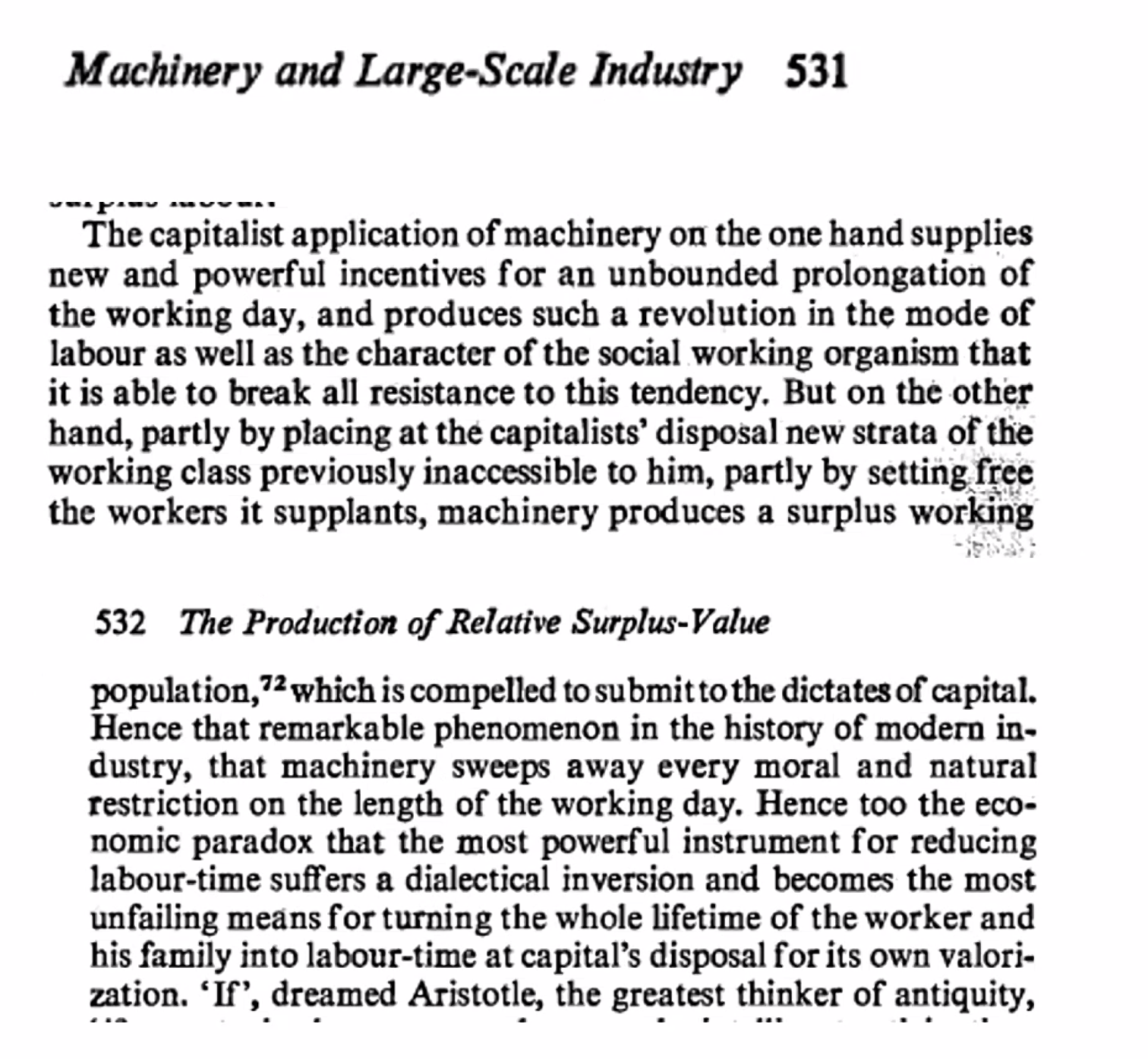
The father becomes a dealer in his own wife and children. Infant mortality rises in the factory districts; the Children’s Employment Commission records children of six in the brickfields and nine in the mills. Machinery, in itself the most powerful means of shortening labour, becomes the most unfailing means of turning the whole life of the worker’s family into labour-time for capital.
3(b). The prolongation of the working day
Machinery is the most powerful means of lengthening the working day beyond all natural limits — a paradox, since it is also the greatest means of shortening labour. Five reasons.
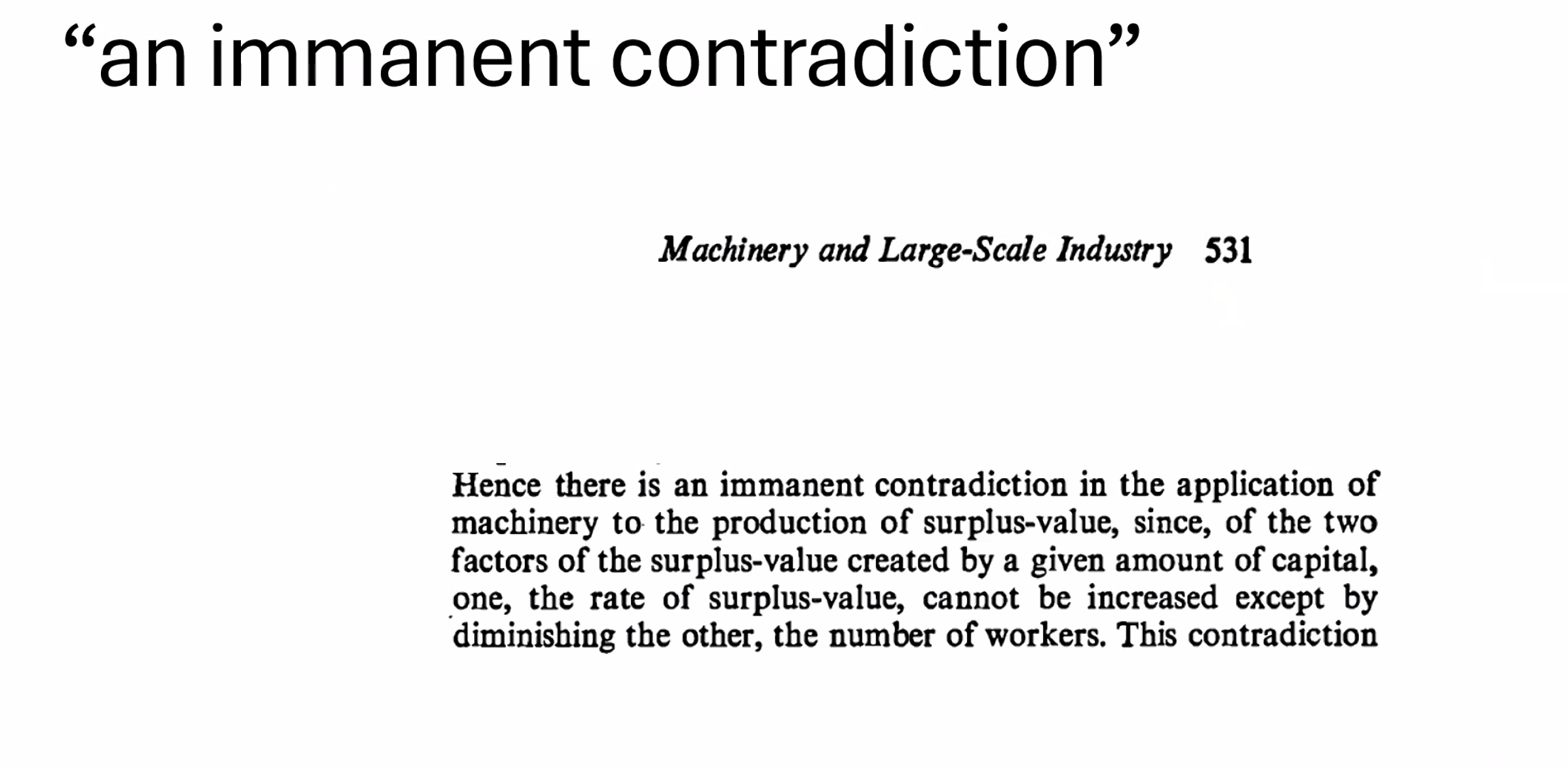
The machine does not tire. It represents a large block of constant capital that earns nothing while idle. It suffers moral depreciation — a newer machine devalues it before it wears out — so capital wants it used up fast. In its first period it yields the extra surplus-value of Ch.12, which fades as competitors catch up, so capital grabs what it can while it can. And it throws workers out, creating a working population that is superfluous and thus compelled to submit to the dictation of capital. Hence the eighteen-hour days of the early mills. The Ten Hours Act of Ch.10 was the answer; machinery is the reason the question arose.
3(c). Intensification of labour
Once the day is capped by law, capital turns to density. The same hour is made to contain more labour: machines run faster, each worker tends more of them, pauses are eliminated. The shortening of the working day creates the subjective condition for the condensation of labour — a rested worker can be driven harder.
The inspectors’ reports show it. Hours fell to twelve in 1844 and ten in 1847; output rose. Intensified labour counts as more labour — an hour of it produces more value than an ordinary hour — and so the capped day yields more surplus than the long one did. But intensity has a limit of its own, in the breakdown of the worker’s body, and when that limit is reached the only road left is once more to shorten the day.
4. The factory
Dr Ure, the Pindar of the automatic factory, gives two definitions. In one the factory is the combined co-operation of many orders of workers tending a system of machines. In the other it is a vast automaton, composed of various mechanical and intellectual organs, acting in uninterrupted concert … all of them being subordinated to a self-regulated moving force. The first makes the workers the subject; the second makes the automaton the subject and the workers its organs. The second is the capitalist factory.
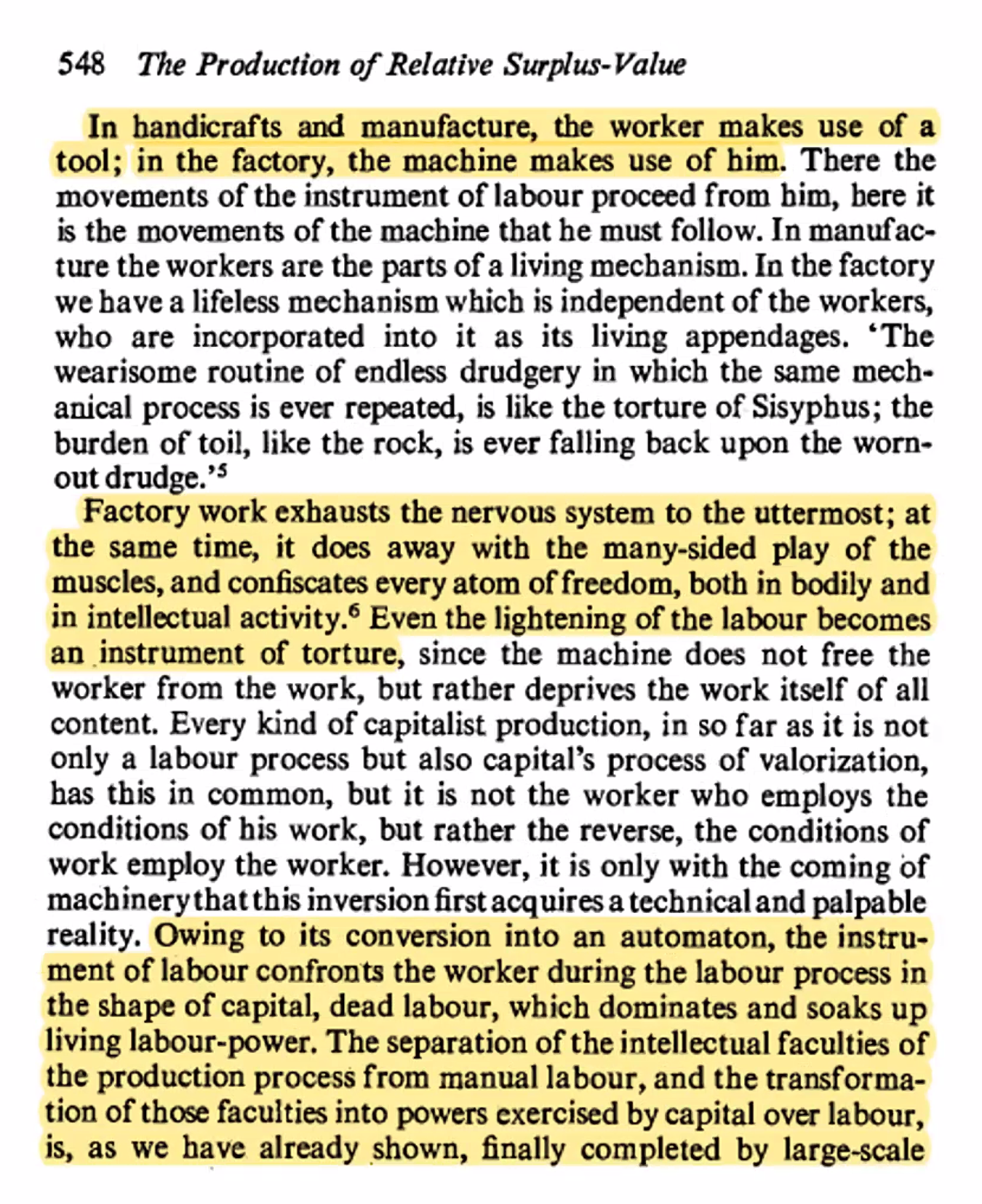
In handicrafts and manufacture, the worker makes use of a tool; in the factory, the machine makes use of him. The lifelong speciality of handling one tool becomes the lifelong speciality of serving one machine. The content of the work is gone; the worker is a living appendage of the machine. Dead labour dominates living labour — it is not the worker who employs the conditions of his work, but the reverse.
Discipline, and the body in the factory
Subordination to the pace of the automaton requires a discipline unknown to the handicraft: the factory code, the capitalist’s private legislation, with its fines and deductions, its barrack-like discipline, its overseers — the foremen of Ch.13 now enforcing the rhythm of a machine. Ure is cited on the refractory hand of labour once more.
And the conditions: heat, dust, noise, the crowding of machines, the danger to life and limb — every organ of sense is injured. Economy of the means of production, which under capital always means economy at the worker’s expense: no space, no ventilation, no guard on the shaft. Fourier called the factories mitigated jails. He was not wrong, Marx says, except in the mitigation.
5. The struggle between worker and machine
The struggle between capital and labour is as old as capital — the guilds fought the ribbon-loom in Danzig in 1579, the Dutch wind-sawmill in the 1630s, Everet’s shearing machine in 1758. But only with machinery does the worker fight the instrument of labour itself: the Luddite risings of the first fifteen years of the nineteenth century, the frames smashed, the Act of 1812 making it a hanging matter.
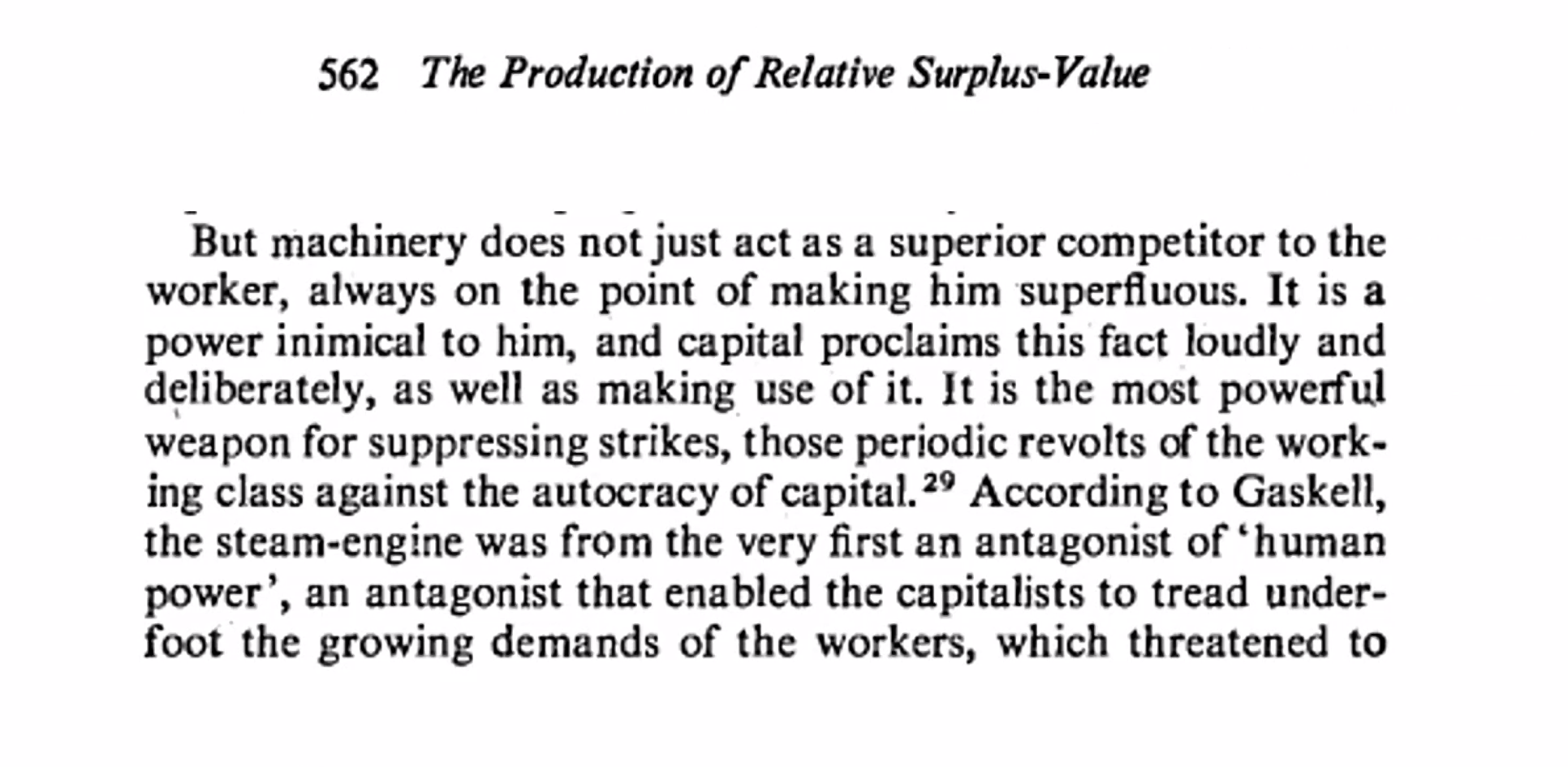
It took both time and experience before the workers learnt to distinguish between machinery and its employment by capital, and therefore to transfer their attacks from the material instruments of production to the form of society which utilizes those instruments.
The machine as competitor, and as weapon
The instrument of labour, when it takes the form of a machine, immediately becomes a competitor of the worker himself. The English hand-loom weavers died slowly over decades; in India the competition was swifter — the bones of the cotton-weavers are bleaching the plains of India.
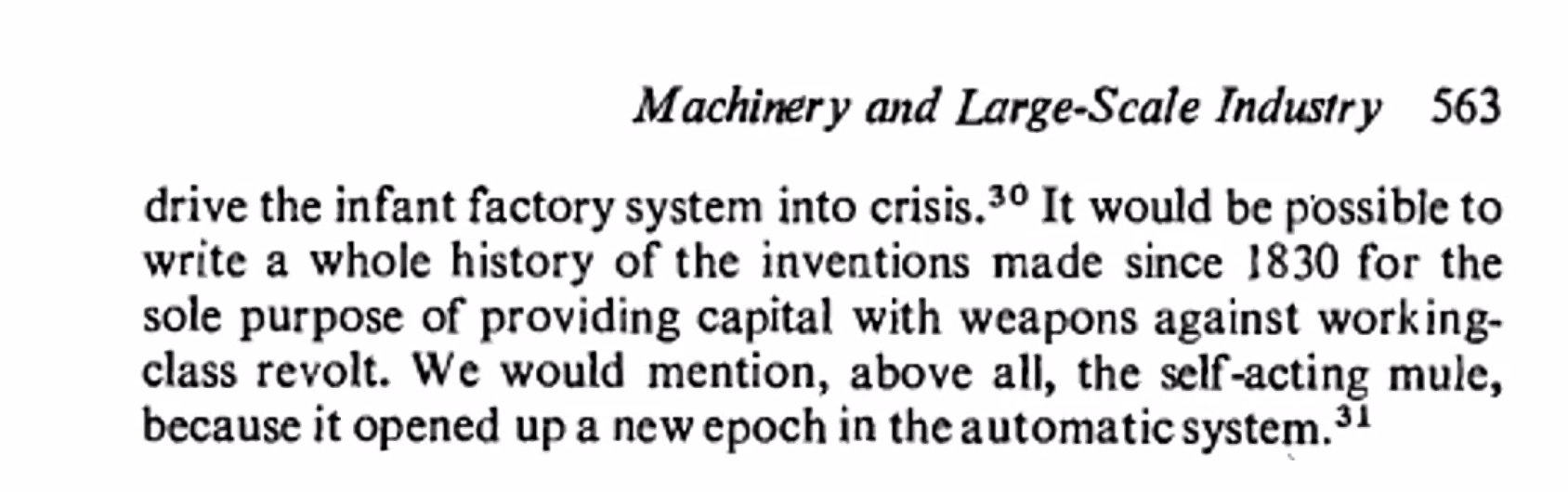
And capital uses the machine deliberately against the worker. The self-acting mule was built to break the spinners’ strikes; Nasmyth answered the engineers’ strike of 1851 with the steam-hammer; Ure boasts that when capital enlists science in her service, the refractory hand of labour will always be taught docility. It would be possible to write a whole history of the inventions made since 1830 for the sole purpose of providing capital with weapons against working-class revolt.
Ure’s two factories
Definition one the combined co-operation of many orders of work-people tending a system of productive machines → the workers are the subject; the machines their instruments
Definition two a vast automaton composed of mechanical and intellectual organs, acting in uninterrupted concert, subordinated to a self-regulated moving force → the automaton is the subject; the workers its organs
Ure thought them equivalent. Marx: the first describes any use of machinery; the second describes its capitalist use — and is the true one.
Three immediate effects — §3
| mechanism | what it does to labour-power | the Acts’ reply | |
|---|---|---|---|
| (a) women & children | no muscle needed | value spread over the family; each hand cheaper | education clauses; age limits |
| (b) longer day | tireless motor; moral depreciation; surplus population | the whole life becomes labour-time | the Ten Hours Act |
| (c) denser hour | speed; more machines per hand | more labour in the same hour | — the next frontier |
Each is machinery turning its own promise inside out.
When is a machine worth using?
| standpoint | the machine is adopted if its cost is less than… |
|---|---|
| society | the labour it displaces |
| capital | the wages it displaces |
The gap between the two is unpaid labour — which the capitalist never had to pay for, and so never saves by replacing.
Consequences
- stone-breaker: invented in England, used in America
- canal towing: women, not horses — cheaper
- low-wage trades stay on the hand-tool
- machines invented in England that are employed only in North America
Anatomy of a machine
motor mechanism — the source of power human · animal · wind · water · steam, 1784
transmitting mechanism — shafts, belts, gears, pulleys regulates, changes form and direction, distributes
working machine — the tool, mechanised this is where the revolution began spinning jenny: 12–18 spindles at once
↓ one motor, many working machines, in series
the automaton — the system of machinery a mechanical monster whose body fills whole factories
↓ machines that make machines slide-rest · steam-hammer · planing machine
Mill’s question answered in a sentence: machinery was never meant to lighten toil. And Marx’s definition of the machine is functional, not physical — the question is not what drives it but who holds the tool. Once the tool is in the mechanism’s hand, the worker’s skill is no longer the regulating principle. That is the whole of real subsumption.
Order of causation matters. The popular story is steam engine → factory. Marx reverses it: working machine first, which removed the limit of the human hand and so exposed the limit of the human motor; the steam engine was the answer to a demand the working machine created. Newcomen’s engine had existed for sixty years without revolutionising anything.
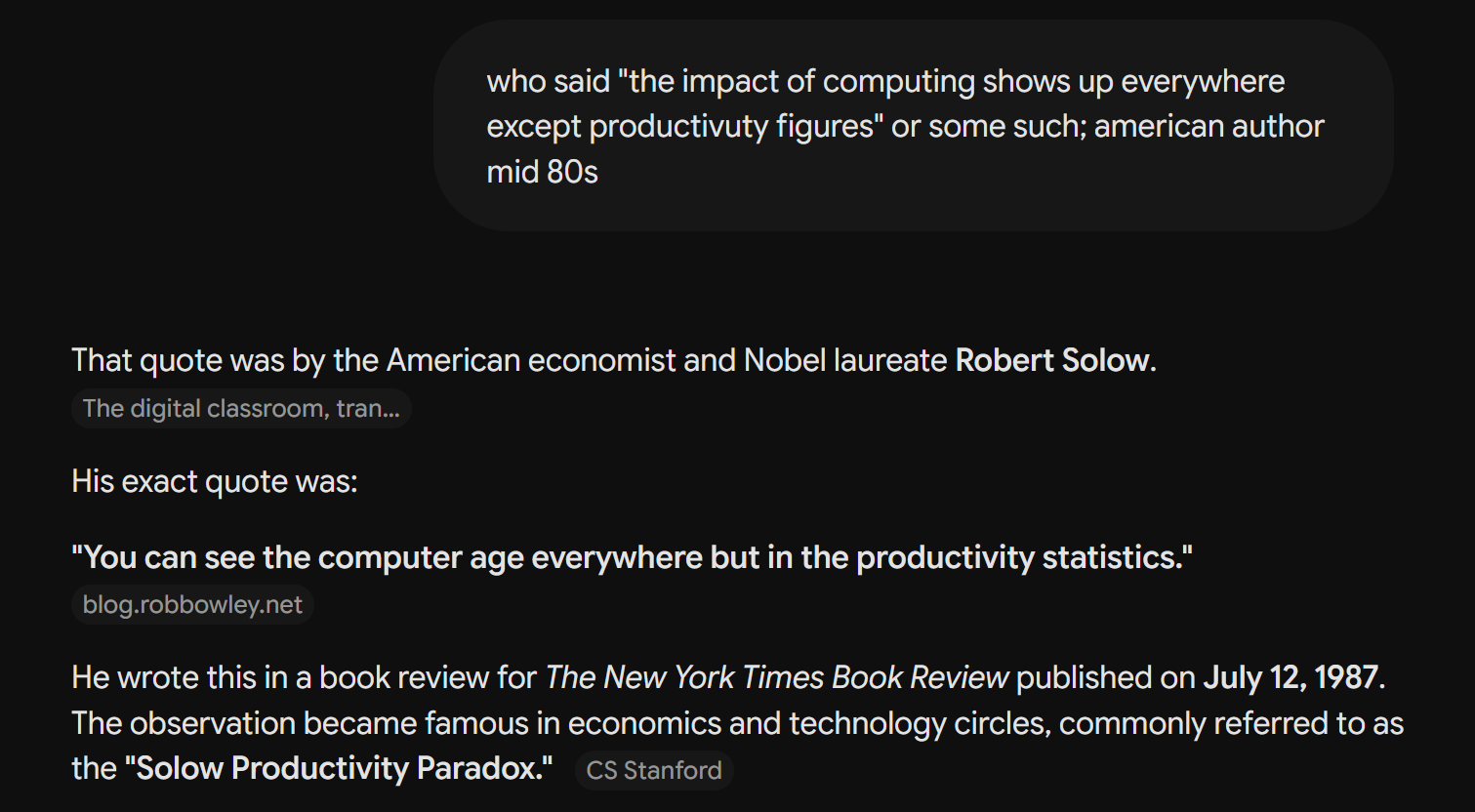
Two things in §2 to hold onto. First, machinery creates no value — the whole of Ch.8 stands, and machines make profit remains an illusion. Second, the capitalist limit on mechanisation is wages saved, not labour saved. So cheap labour retards machinery, and abundant cheap labour can keep a whole economy on the hand-tool. Still the rule: compare any low-wage sector today.
The paradox of machinery, in three movements. It could shorten the day; under capital it first lengthens it (3b); when law stops that, it intensifies it (3c). The hour ceases to be a fixed measure — the denser hour — and the Ch.10 limit, once reached, simply moves the struggle inside the hour. Absolute and relative surplus-value are now the same fight.
The inversion completed. In manufacture the collective worker was still a body of people, however crippled; in the factory the subject is the automaton and the people are its organs. The machine makes use of him — Ch.7’s labour process now literally run by dead labour. Real subsumption is finished; nothing in the labour process belongs to the worker any longer.
Luddism re-read: not fear of technology but a stage of learning what the enemy is — the machine, or the relation that wields it. That distinction (machinery vs. its capitalist employment) is the spine of the whole chapter, and the economists’ refusal of it is the target of §6.
And the strike-breaking machine: innovation driven by class struggle rather than efficiency. A sharp question for any room — which inventions since 1830, or since 2000?
capital takes controlover workforce with machinery
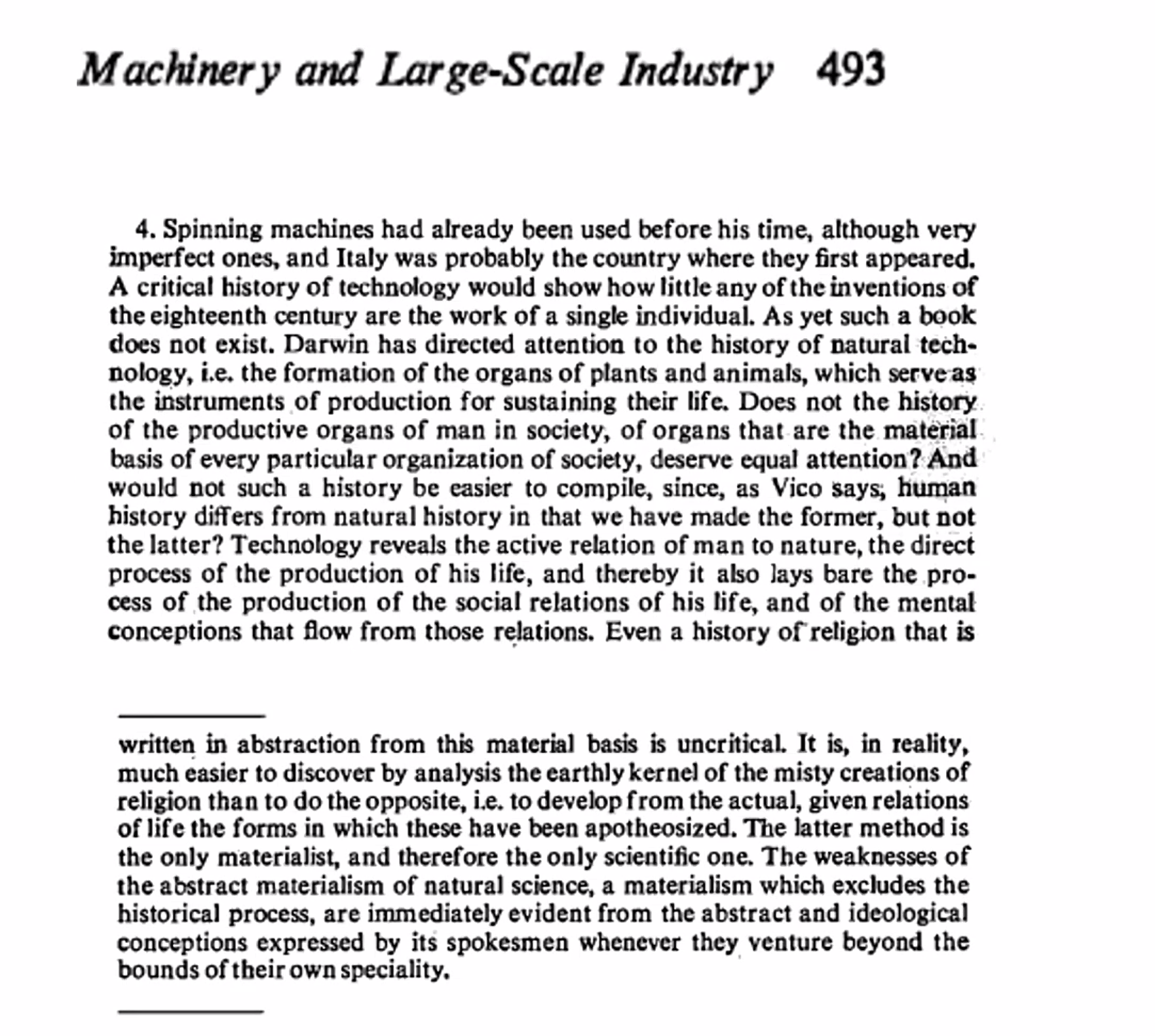
what a history of mechanisation wuld look like - one of the great footnotes
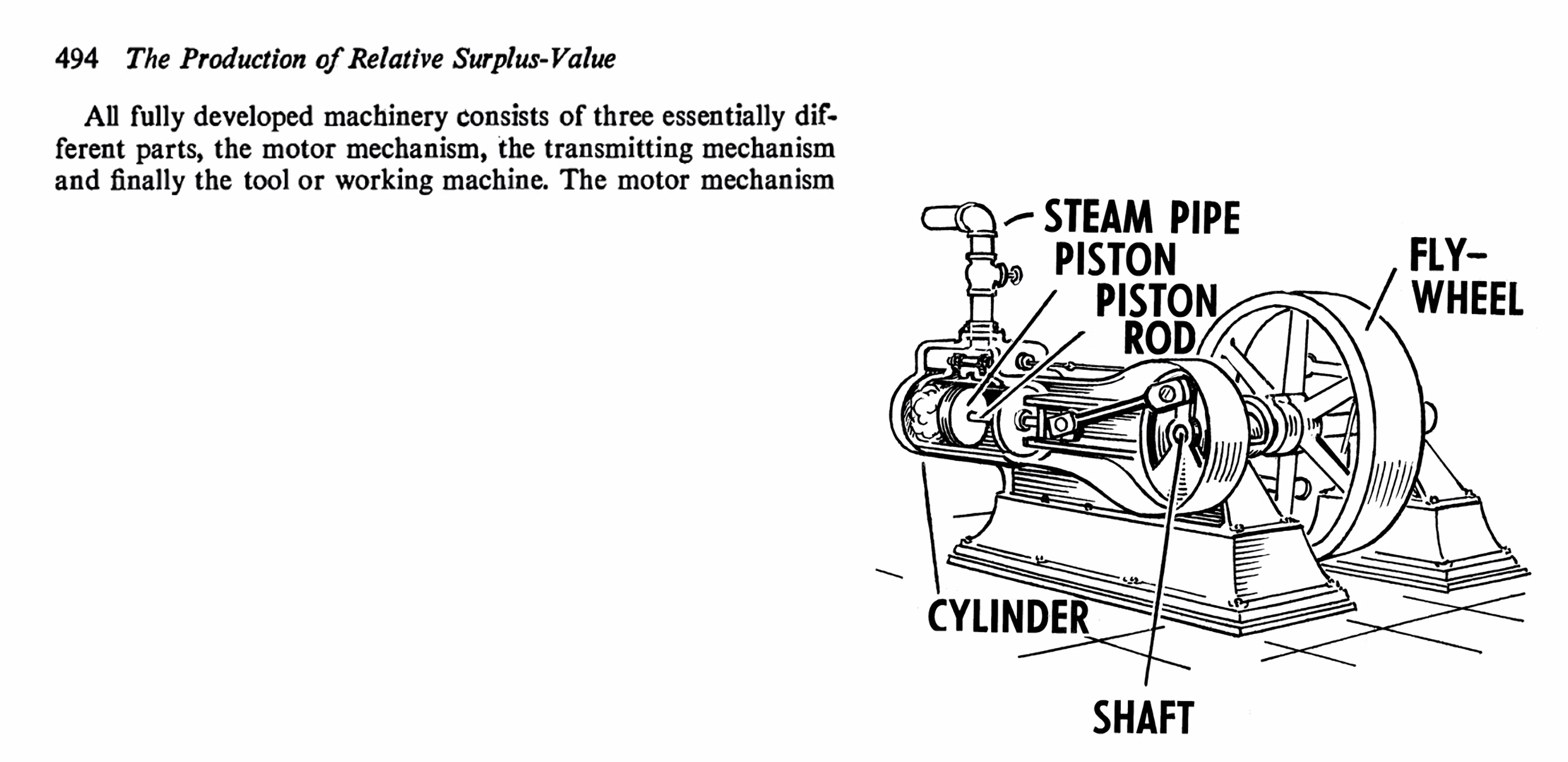
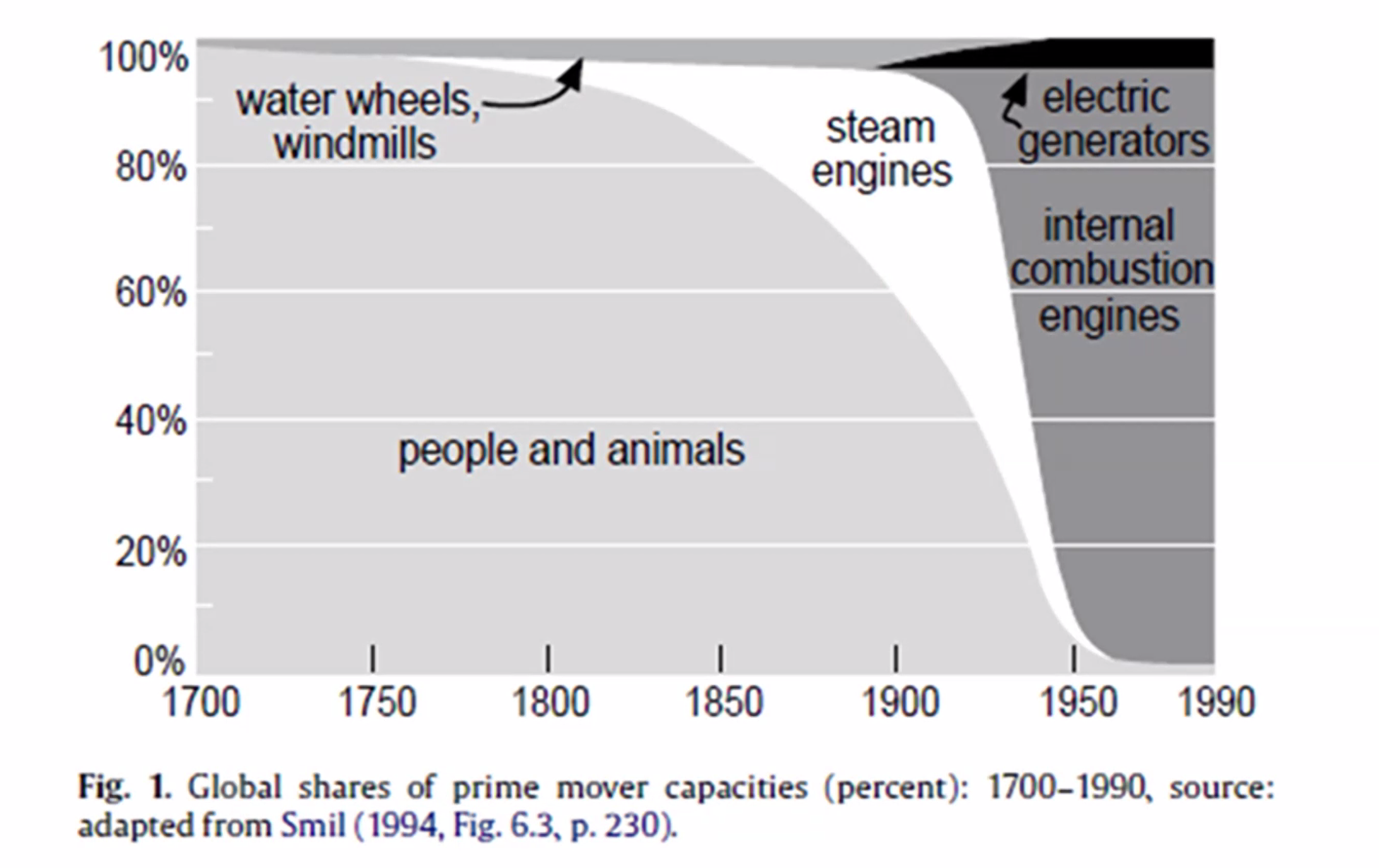
doesn’t matter what the power source is, its about the tool part replacing human labour
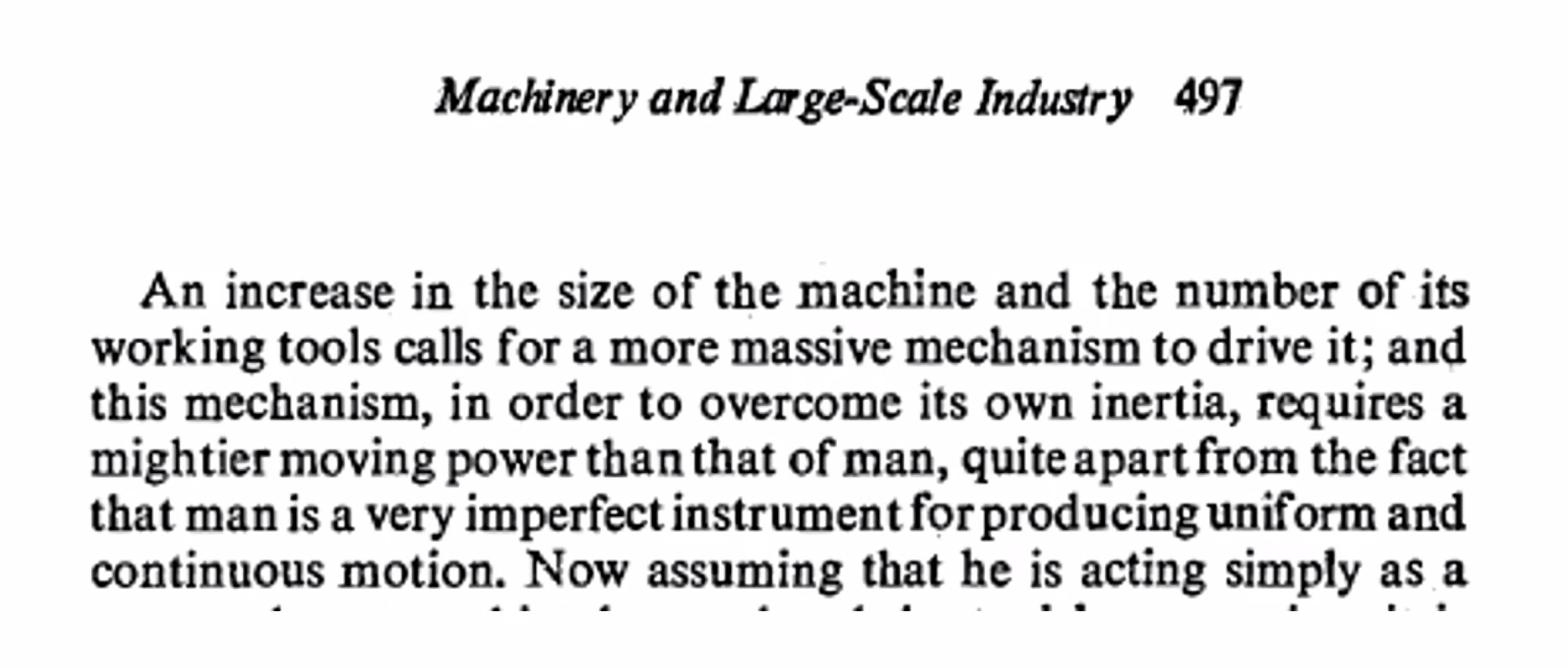
above a certain scale, human / animal power is impossible
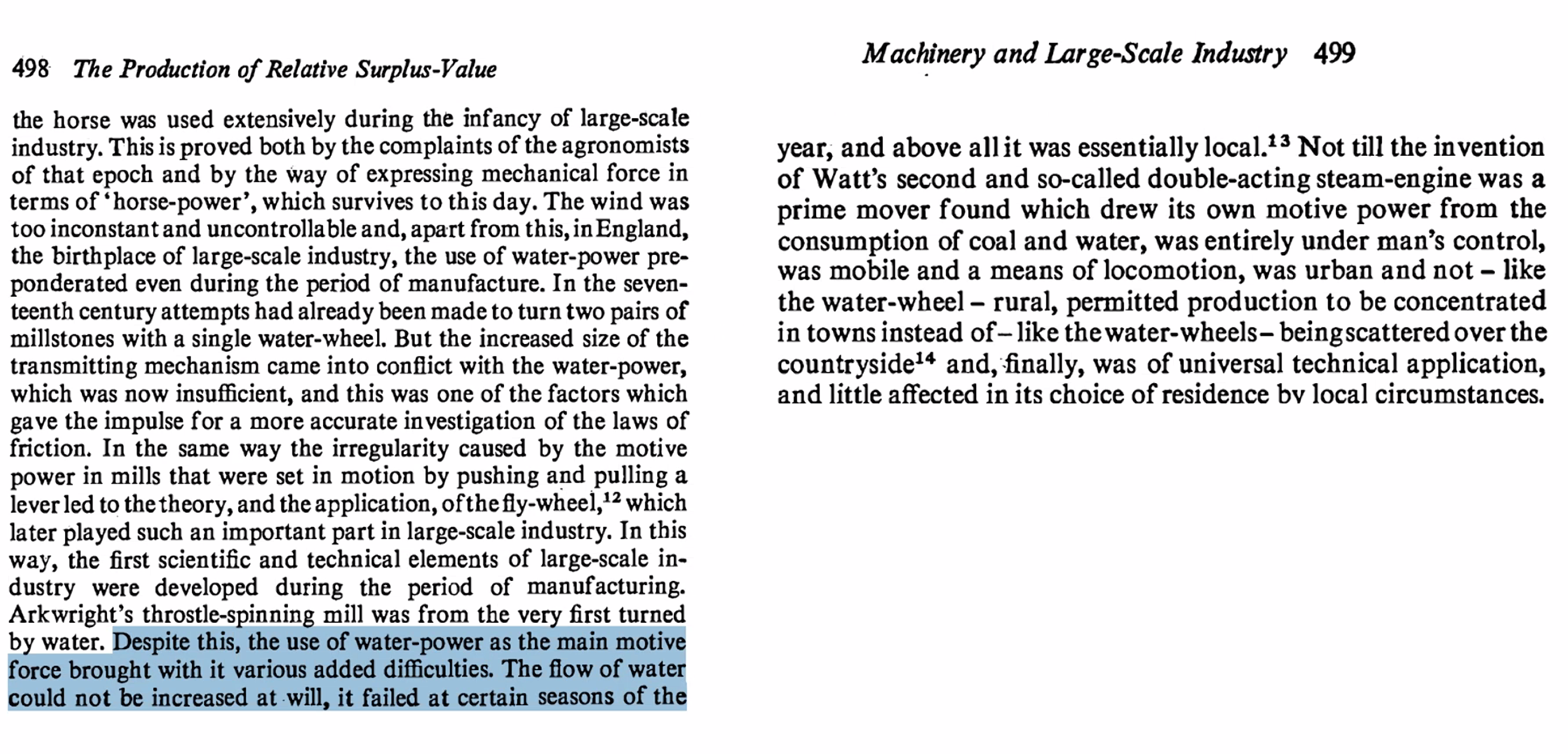

for most of human history work done by muscle power
Breaking Things at Work — versobooks.com
In the Nineteenth-century, English textile workers responded to the introduction of new technologies on the factory floor by smashing them to bits. For years the Luddites roamed the English countryside, practicing drills and manoeuvres that they would later deploy on unsuspecting machines. The movement has been derided
the means of comms and transport, due to need to expand arket
socilises form of production -> creates oportunity for “socialism”
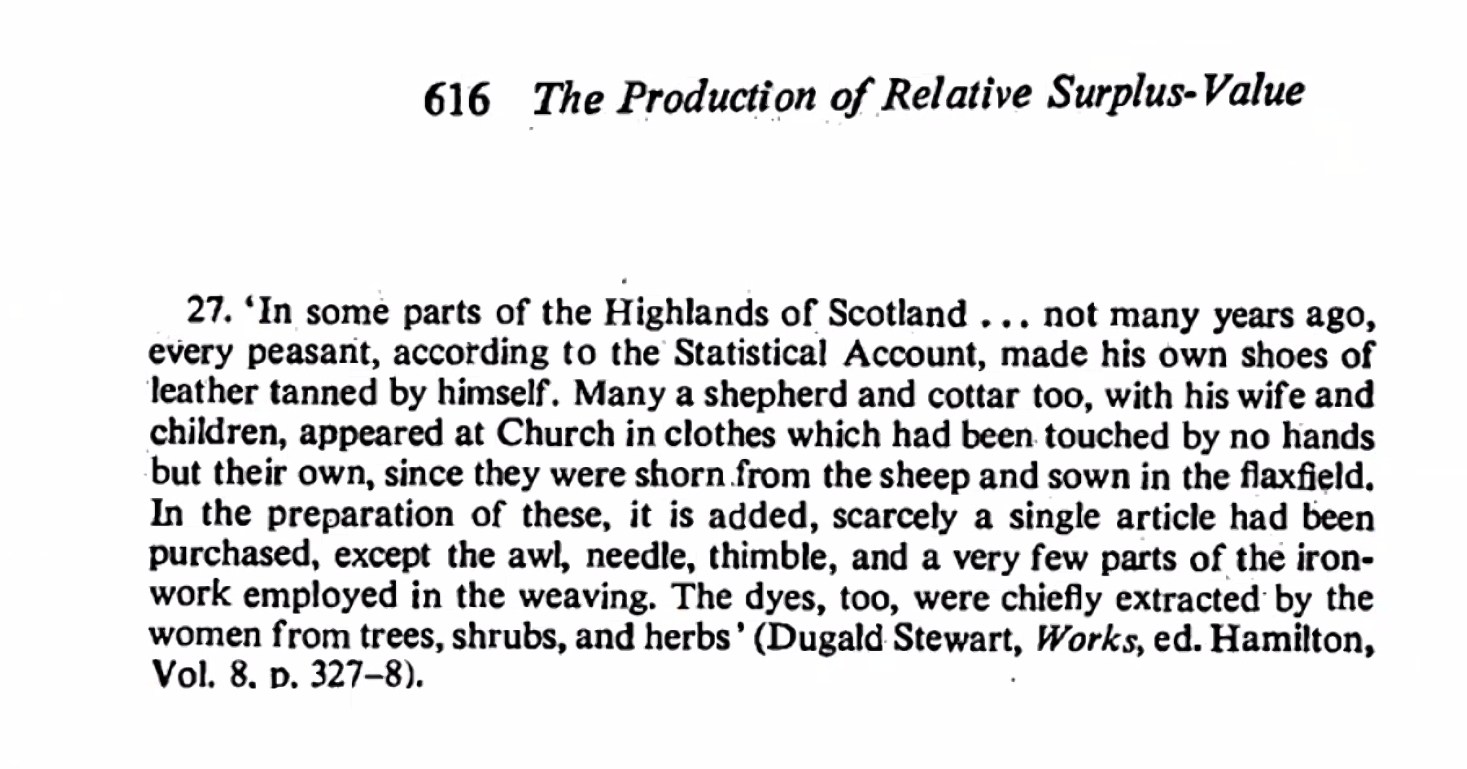
pre capitalist production looks like

harry braverman