Capital Vol. 1, Ch. 10 — mind map
Text version — the same content in reading order
Economic Manuscripts: Capital Vol. I - Chapter Ten — marxists.org
Capital Vol. I : Chapter Ten (The Working-Day)
Ch. 10 — The Working Day
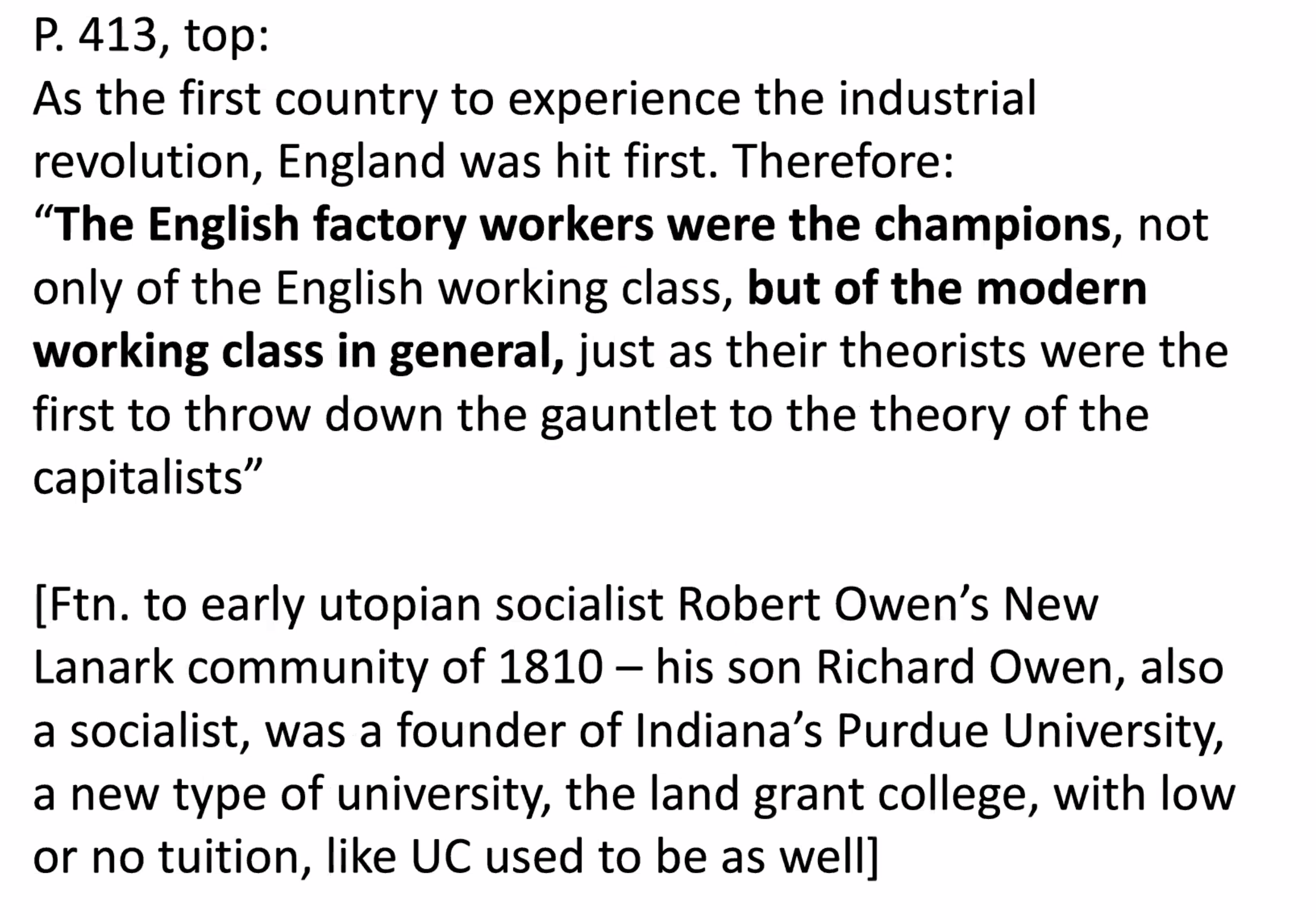
Ch.9 left everything hanging on one quantity: the length of the day. Ch.10 shows that quantity is not given by economics at all. It is fought over — and the chapter turns from arithmetic to history: the factory inspectors, the Blue Books, five centuries of statute, and a class that had to learn to act as a class.
1. The Limits of the Working Day
The day = necessary labour + surplus labour. The first part is fixed (given the value of labour-power); the second is variable — so the day itself is not a constant but a variable quantity.
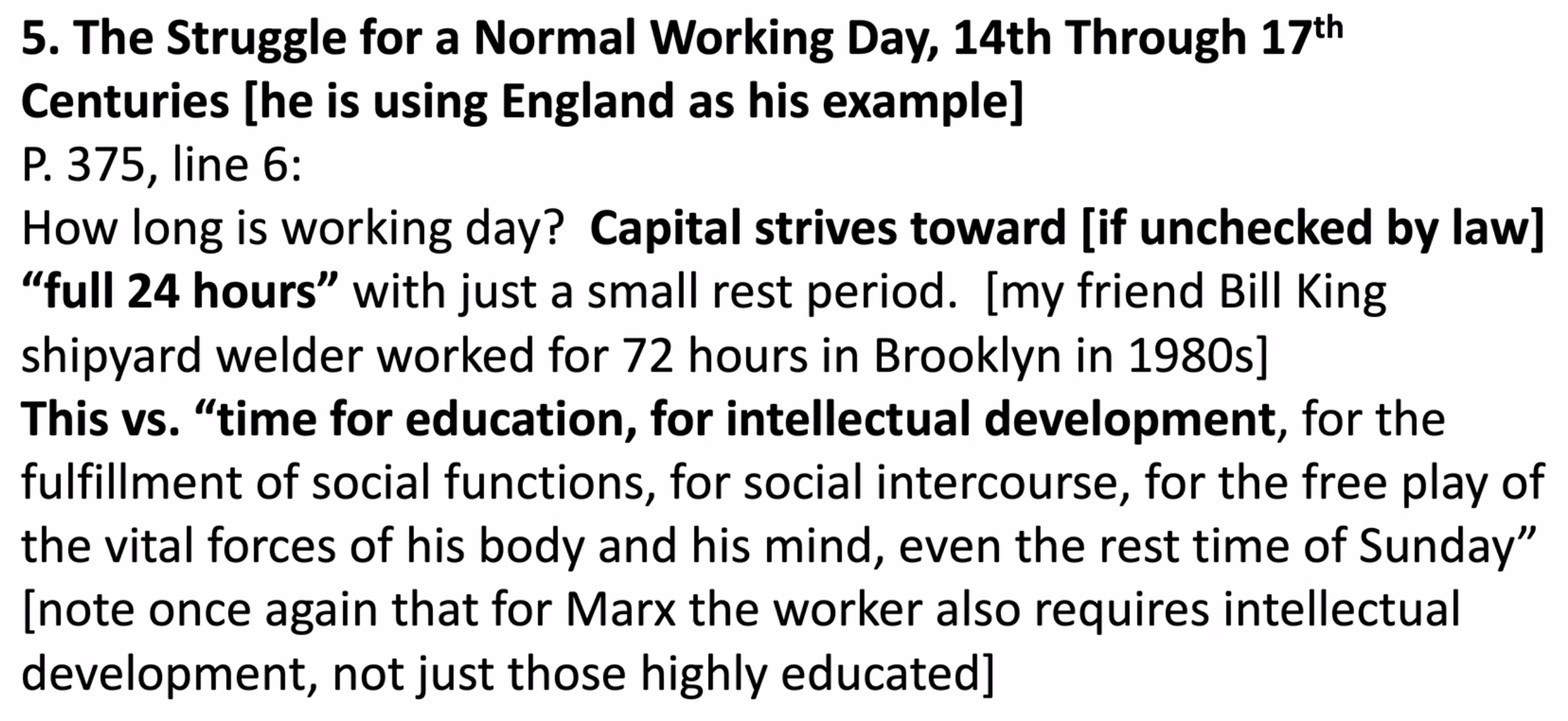
It has a floor and a ceiling. The minimum cannot be reached under capital: a day of necessary labour alone would leave no surplus. The maximum is set by two things — the physical limit (the body must sleep, eat, rest) and the moral limit (the worker needs time for intellectual and social needs, whose extent is set by the general level of civilisation). Both are highly elastic. A working day of 8, 10, 12, 14, 16, 18 hours — all have existed.
The capitalist’s case. He bought labour-power at its daily value. Its use-value for the day belongs to him — he has the right to make the worker work the whole day, just as a man who hires a horse for a day rides it all day. Every unused minute is a theft from him. Capital has one drive: to valorize itself, to absorb the greatest possible quantity of surplus labour.
Capital is dead labour which, vampire-like, lives only by sucking living labour, and lives the more, the more labour it sucks.
The worker’s case. The worker sold his labour-power at its value — the cost of maintaining it for its normal duration. A commodity used up beyond its normal life is being consumed faster than paid for. If the day is 12 hours and you use up in that time what would sustain me for 36, you pay me for one day’s labour-power while using up three days’ worth. What looks like normal use is robbery. The worker demands the value of his commodity like any other seller: the normal length of a working day of normal intensity.
Both are right — by the same law. There is here therefore an antinomy, of right against right, both equally bearing the seal of the law of exchange. Between equal rights, force decides.
Hence, in the history of capitalist production, the establishment of a norm for the working day presents itself as a struggle over the limits of that day — a struggle between collective capital, i.e. the class of capitalists, and collective labour, i.e. the working class.
2. The Voracious Appetite for Surplus Labour. Manufacturer and Boyar
Capital did not invent surplus labour. Wherever one part of society holds a monopoly over the means of production, the worker must add surplus labour for the owner — Athenian aristocrat, Etruscan theocrat, Roman citizen, Norman baron, American slave-owner, Wallachian boyar, modern landlord or capitalist. But where the aim of production is use-value, the surplus is bounded by the master’s needs. Where it is exchange-value, it has no bound. Ancient forms turn monstrous once grafted onto the world market: the American South once cotton became an export; the Danubian principalities once grain did.
The corvée of the Wallachian boyar is a lesson in surplus labour made visible: nominally 12 days a year, by the arithmetic of the Règlement organique of 1831 in fact 56 — and the boyars and the Russian governor who wrote the code called it a great relief.
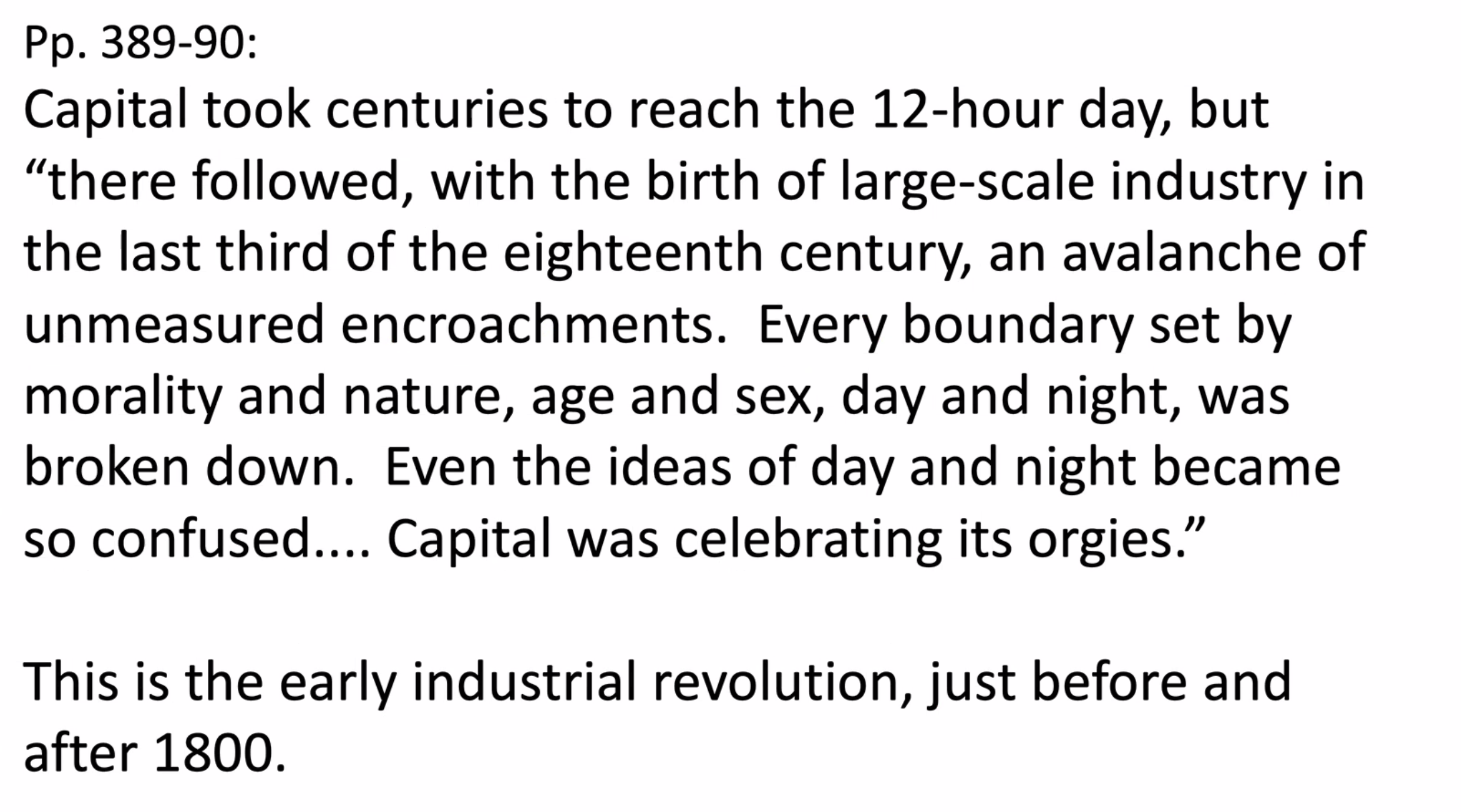
The English Factory Acts express the same appetite, only negatively — as the state having to hold it back. The inspectors’ reports: manufacturers nibbling and cribbling at meal-times, starting five minutes early, running on after the bell, petty pilferings of minutes, snatching a few minutes. Five minutes stolen ten times a day is an hour; an hour a day is more than a working week a year.
Moments are the elements of profit. The inspectors found the manufacturers had a keener eye for the arithmetic than the Professor.
3. Branches of English Industry without Legal Limits to Exploitation
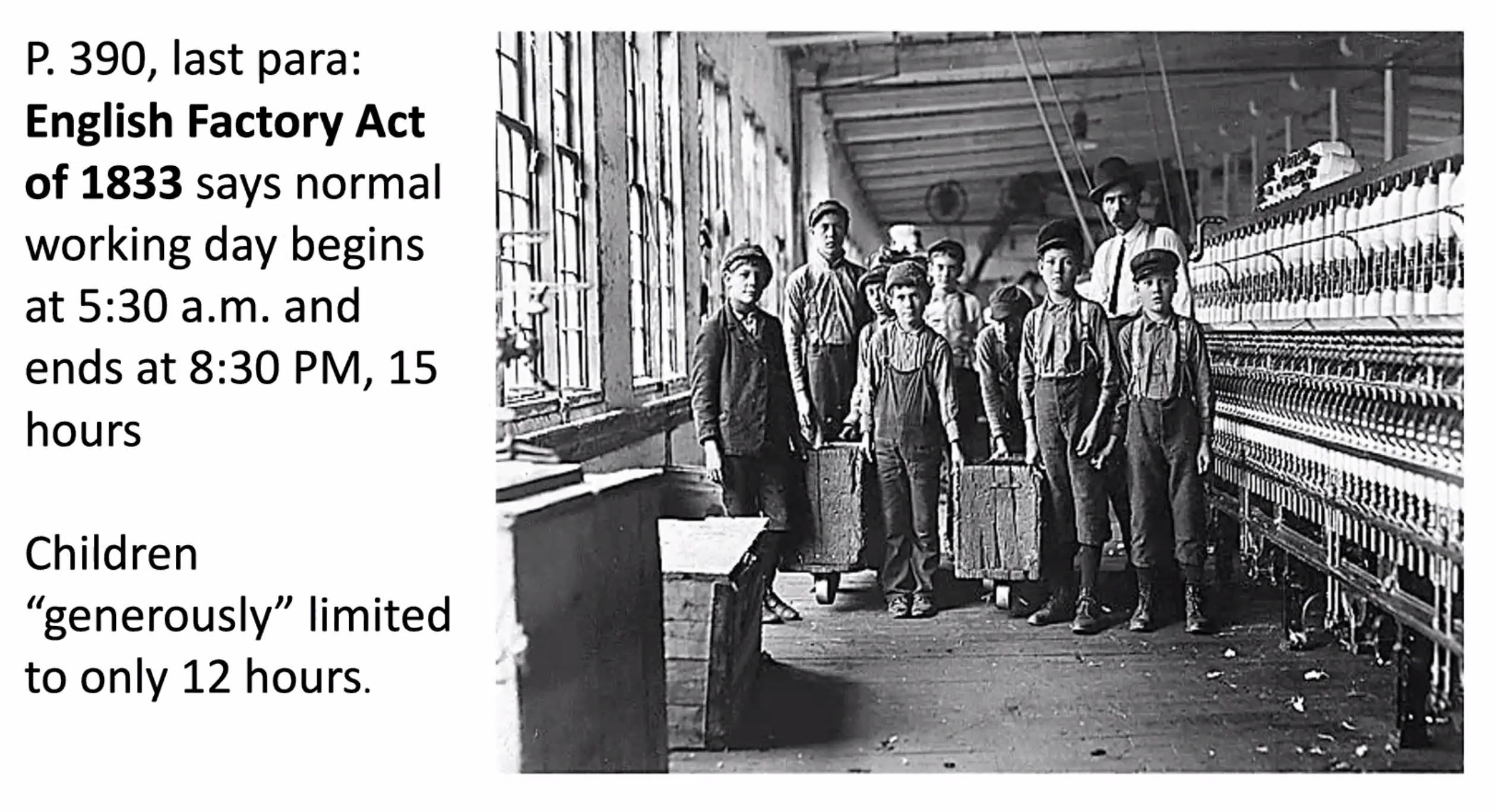
What the appetite does when nothing restrains it. Marx assembles the evidence from the Children’s Employment Commission, the Public Health reports and the press. Lace-making: children of nine and ten worked from two in the morning until ten or midnight. The Staffordshire potteries: Dr Greenhow’s finding that the potters were a degenerated population, stunted and short-lived. Lucifer matches: phosphorus necrosis, half the hands under thirteen. The London bakehouses: night work, adulterated bread, journeymen working twenty hours. Railwaymen: accidents born of overwork. And the milliner Mary Anne Walkley, twenty, who died in June 1863 after twenty-six and a half hours without a break in a room with sixty others — Death from simple over-work, as the coroner and the press put it.
4. Day Work and Night Work. The Relay System
Constant capital idle is capital not valorizing. So the day is stretched around the clock by shifts — relays of workers, day and night, in blast-furnaces, forges, rolling mills, glass-works, potteries. Boys of nine testifying that they worked the night turn, slept in the works, ate when they could.
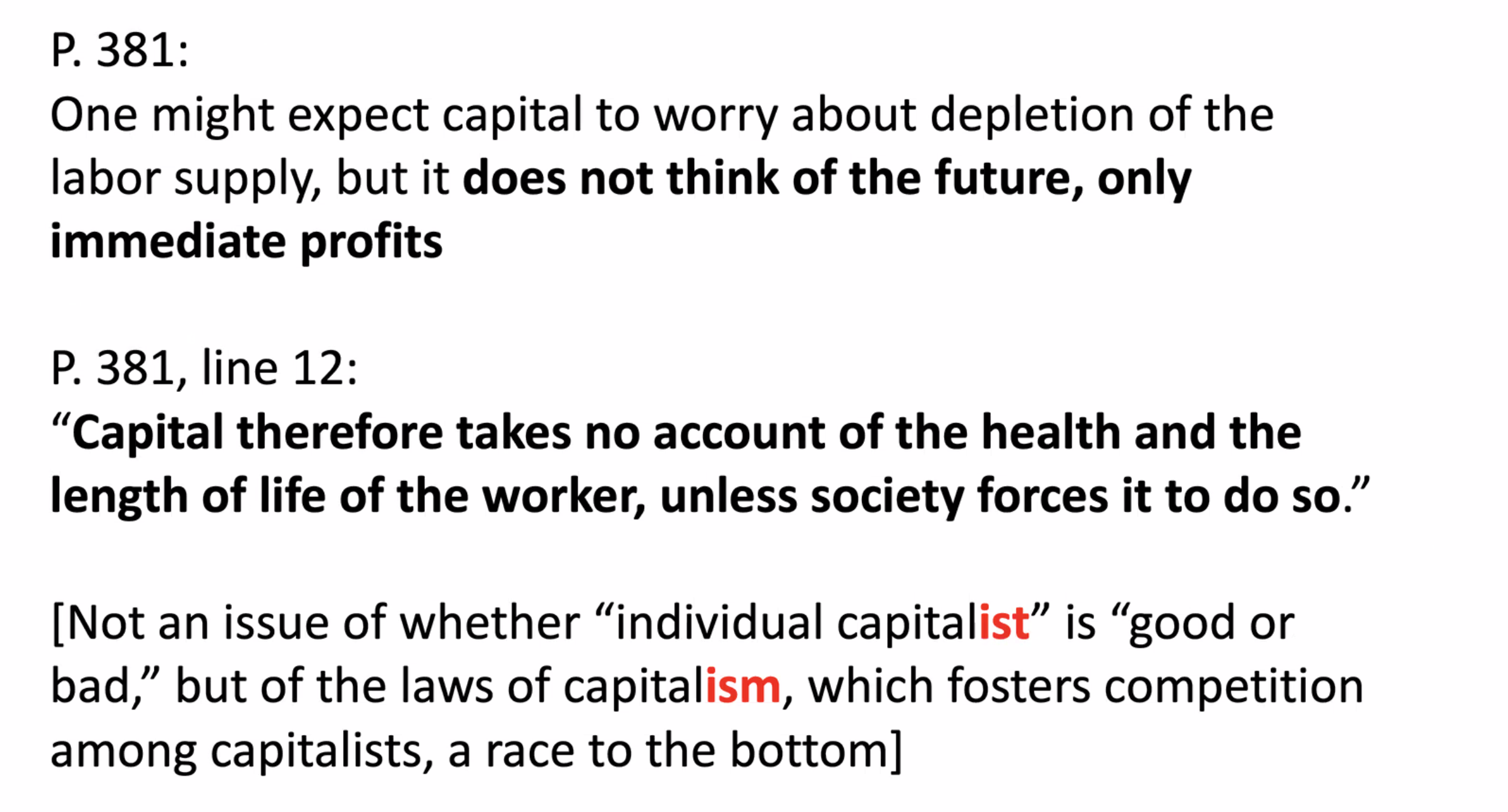
Capital, Marx says, does not ask about the length of life of labour-power. What interests it is the maximum that can be set in motion in a day, and it shortens the worker’s life the way a greedy farmer exhausts a soil. Après moi le déluge! is the watchword of every capitalist and every capitalist nation. It takes no account of the health and length of life of the worker unless society forces it to. And this is not the good or ill will of the individual capitalist — under free competition, the immanent laws of capital confront him as external coercive laws.
5. The Struggle for a Normal Working Day — laws for the compulsory extension of the day, 14th to 17th centuries
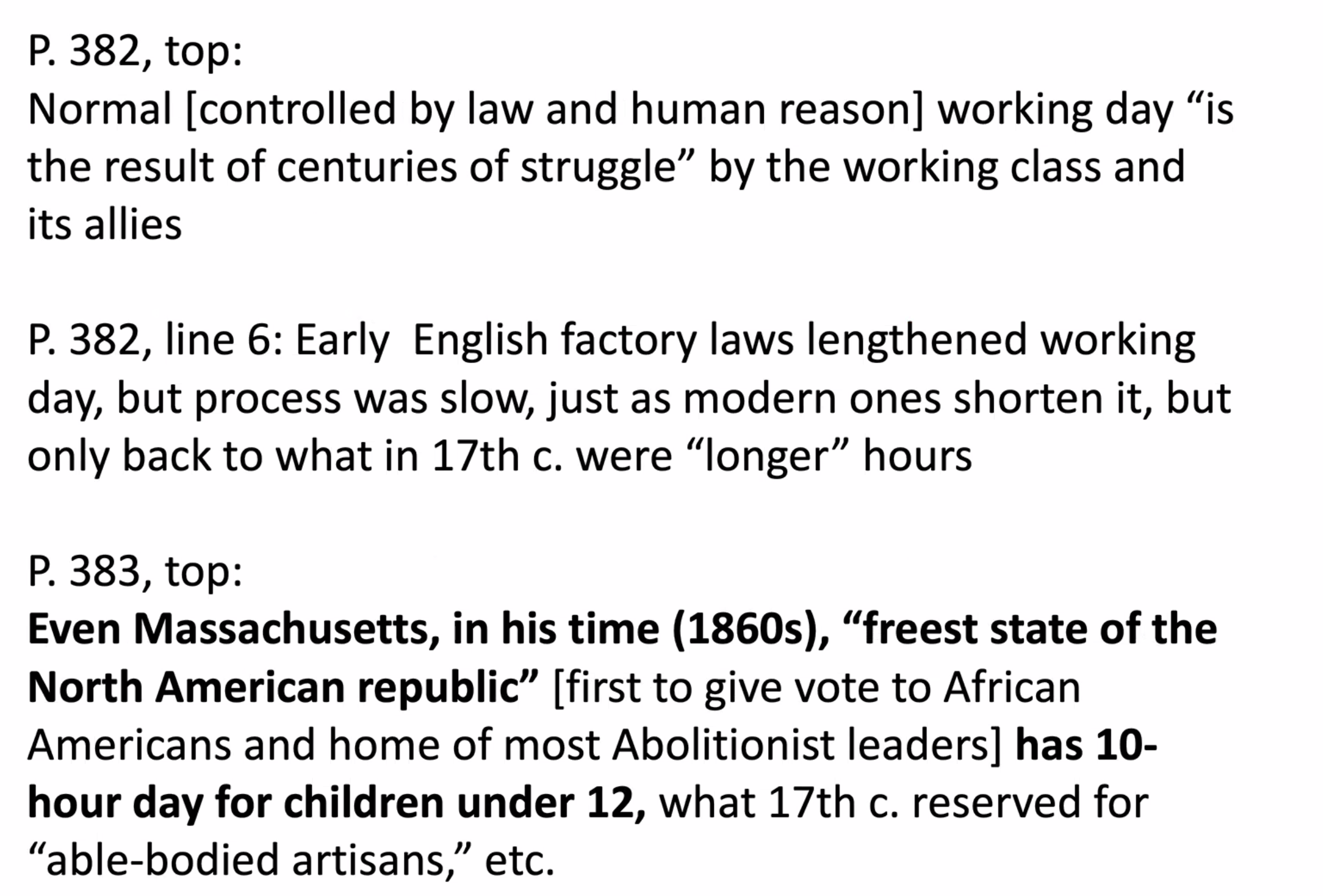
A reversal. Capital took centuries to force the worker to sell the whole of his active life. The Statute of Labourers of 1349, the statutes of 1496 and 1562, fixed maximum wages and minimum hours — the state compelling longer days on a workforce that still had land, custom and holidays. Even in the eighteenth century the manufacturers complained the English workers would not work a full week.
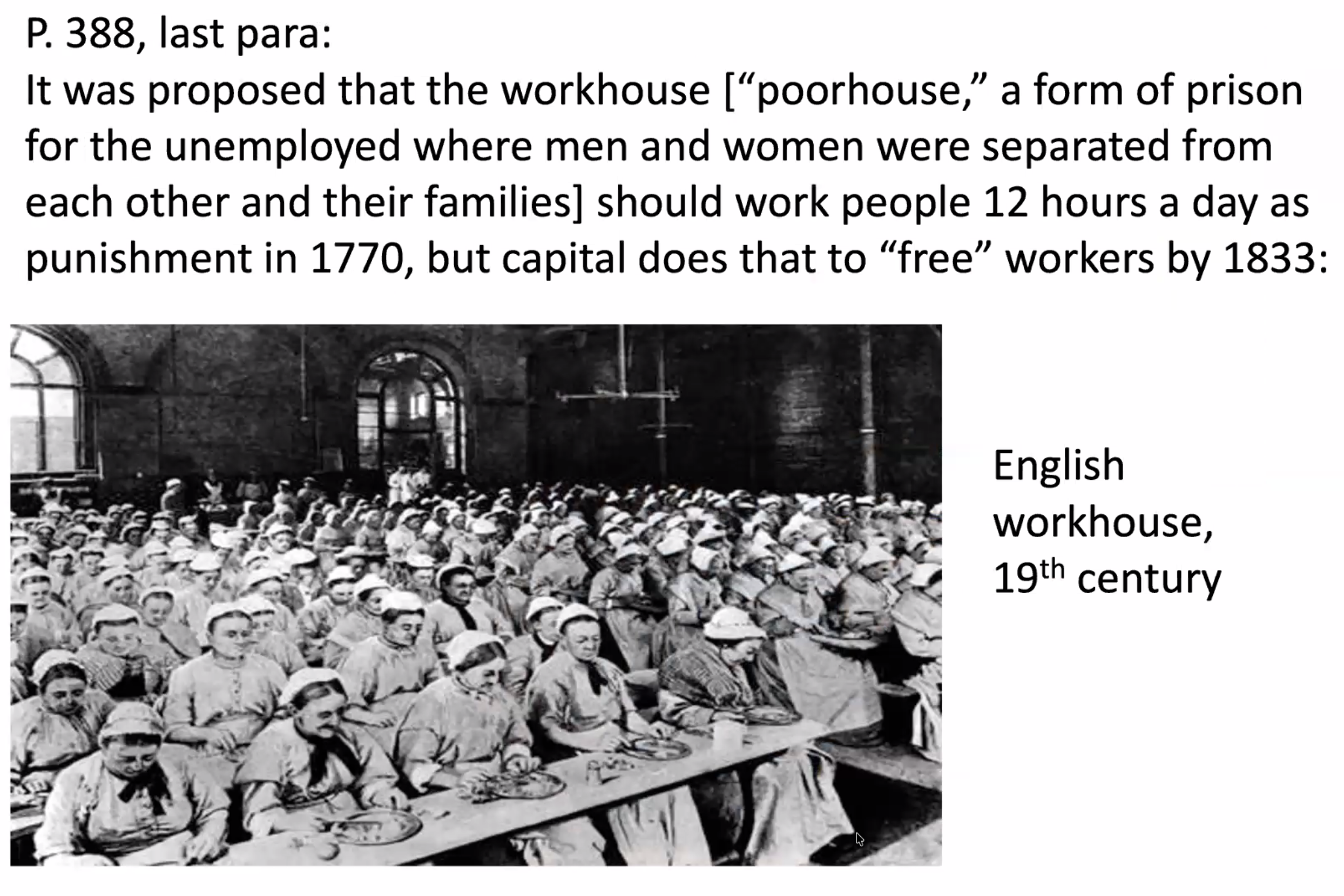
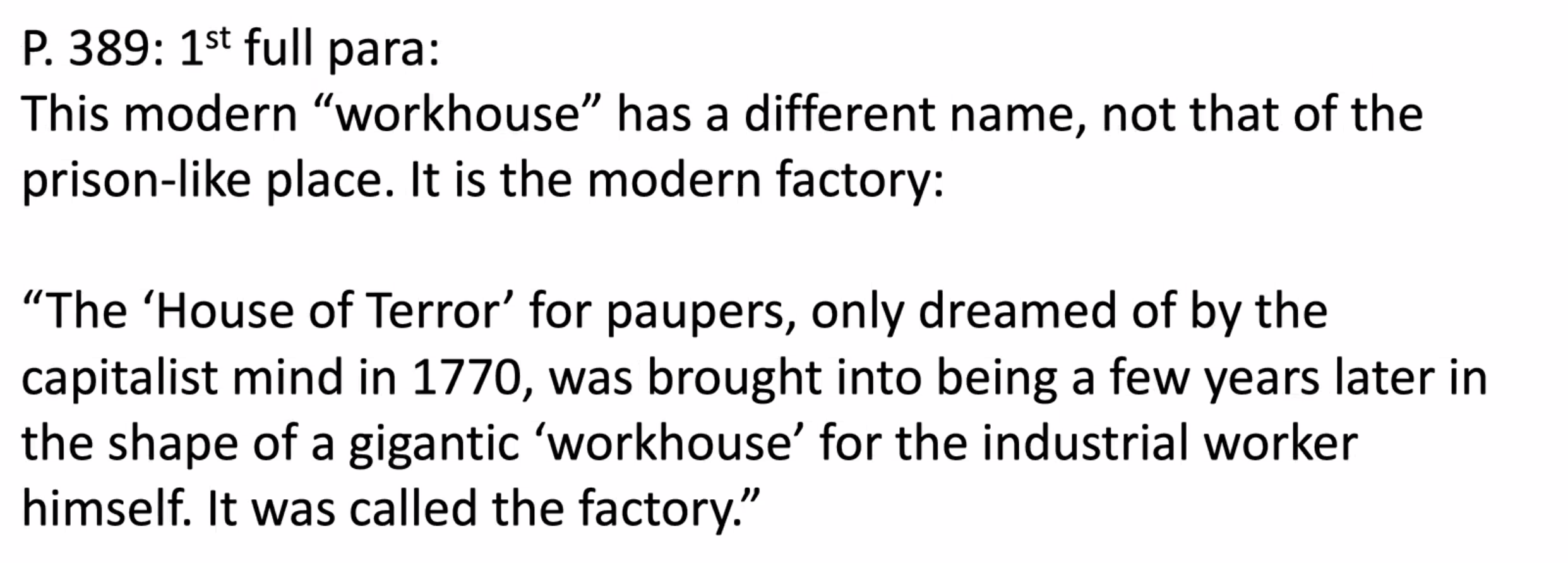
A pamphlet of 1770 proposed a House of Terror for paupers — twelve hours’ labour a day. What in 1770 was only a dream became reality a few years later as the gigantic workhouse for the industrial worker himself — the factory. And the ideal of the House of Terror paled before the reality.
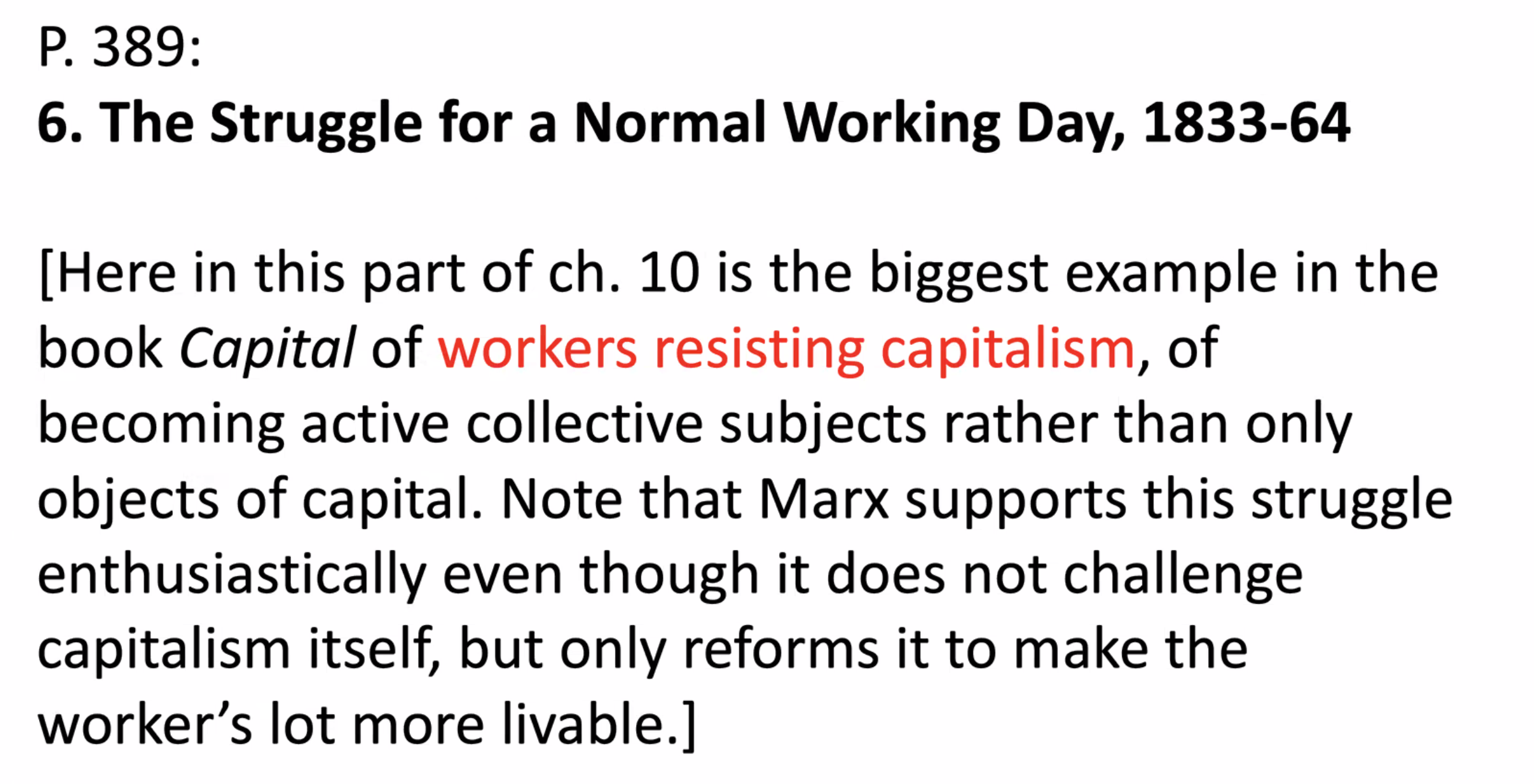
6. The Struggle for a Normal Working Day — compulsory limitation by law, 1833–64
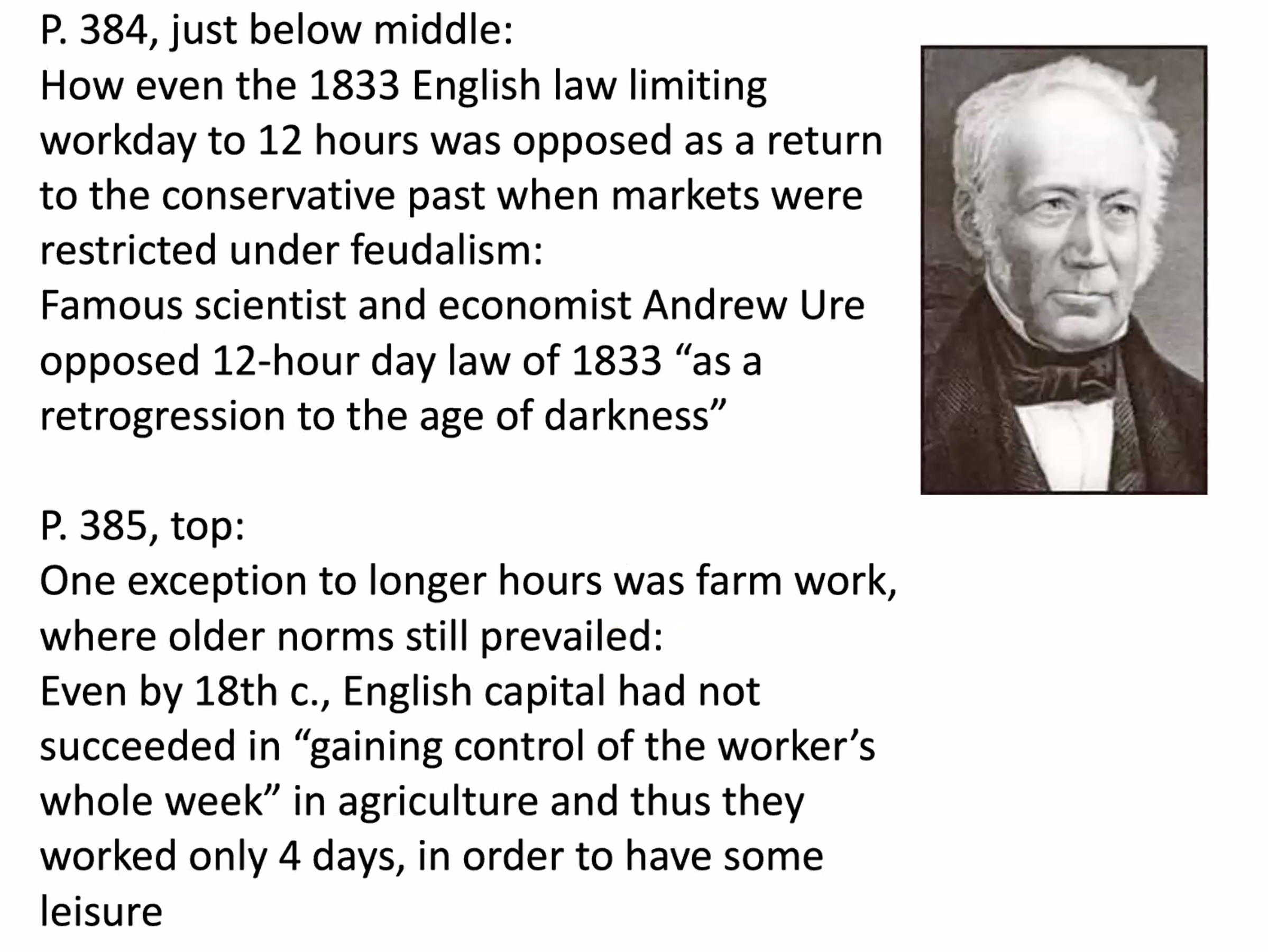
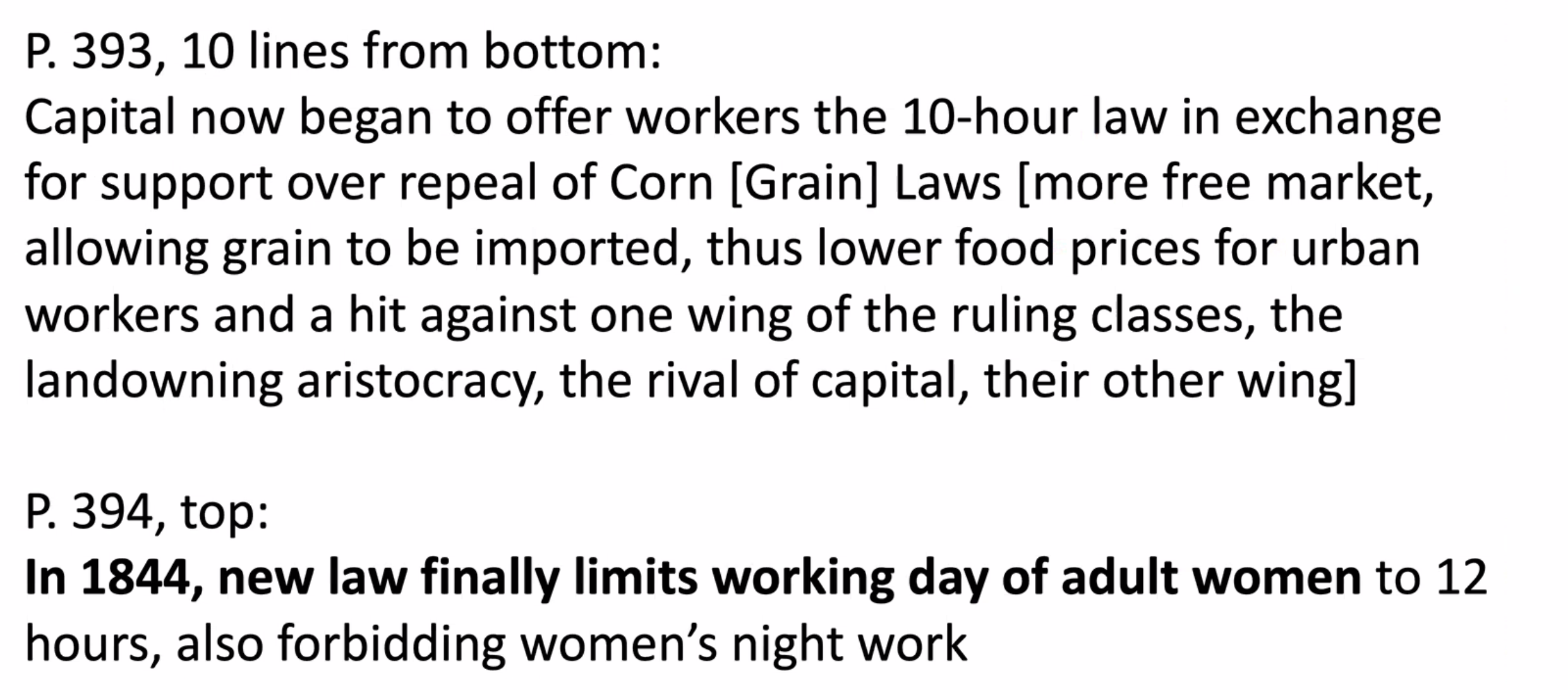
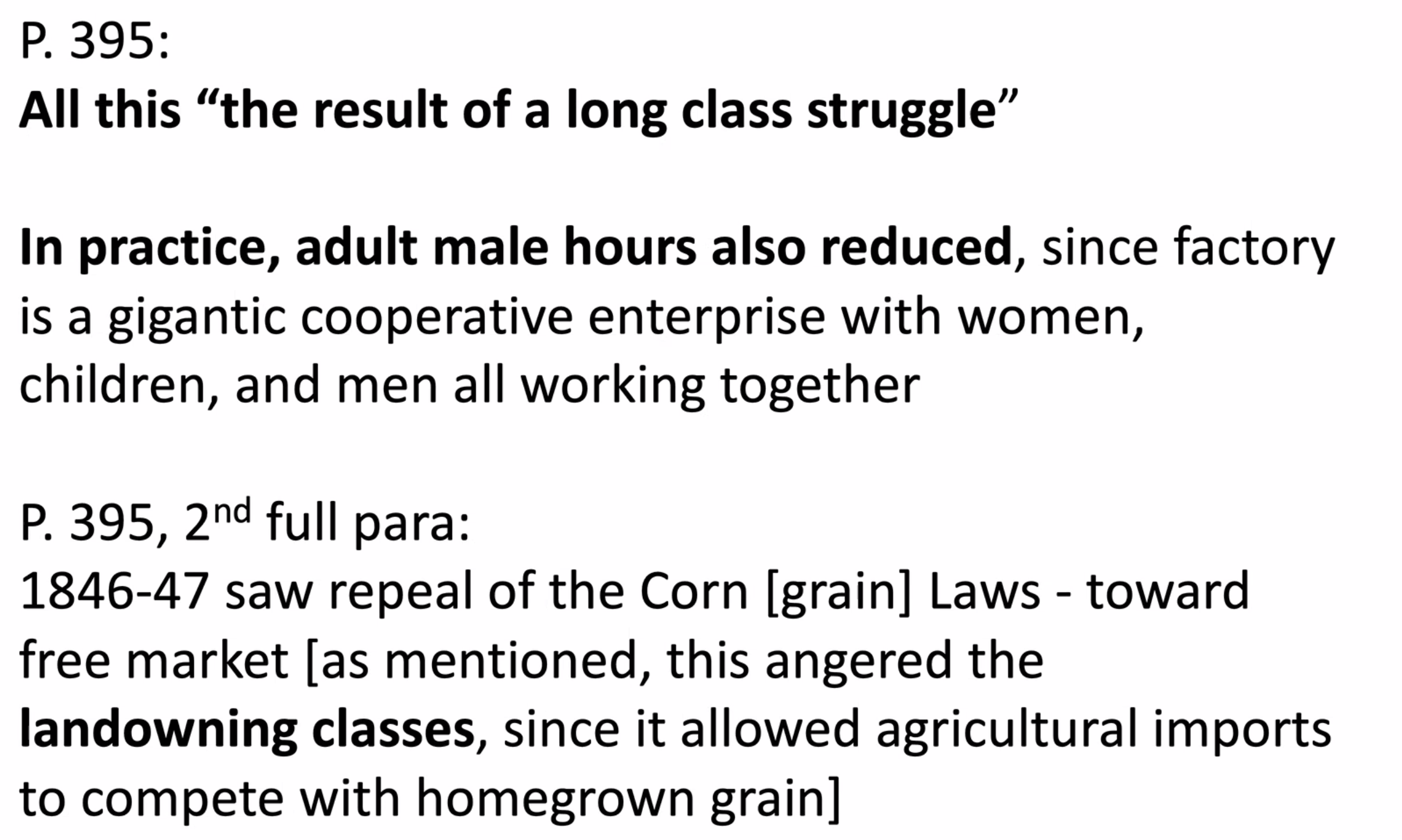
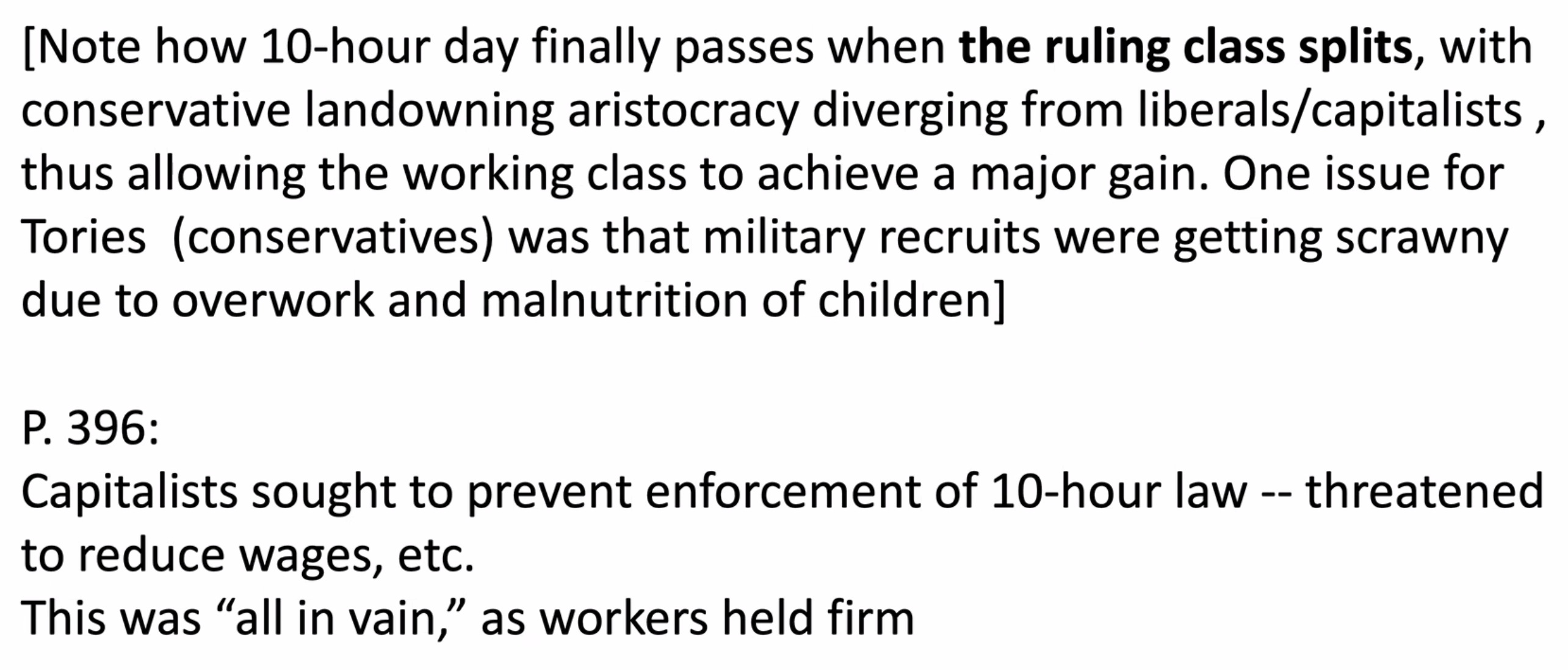
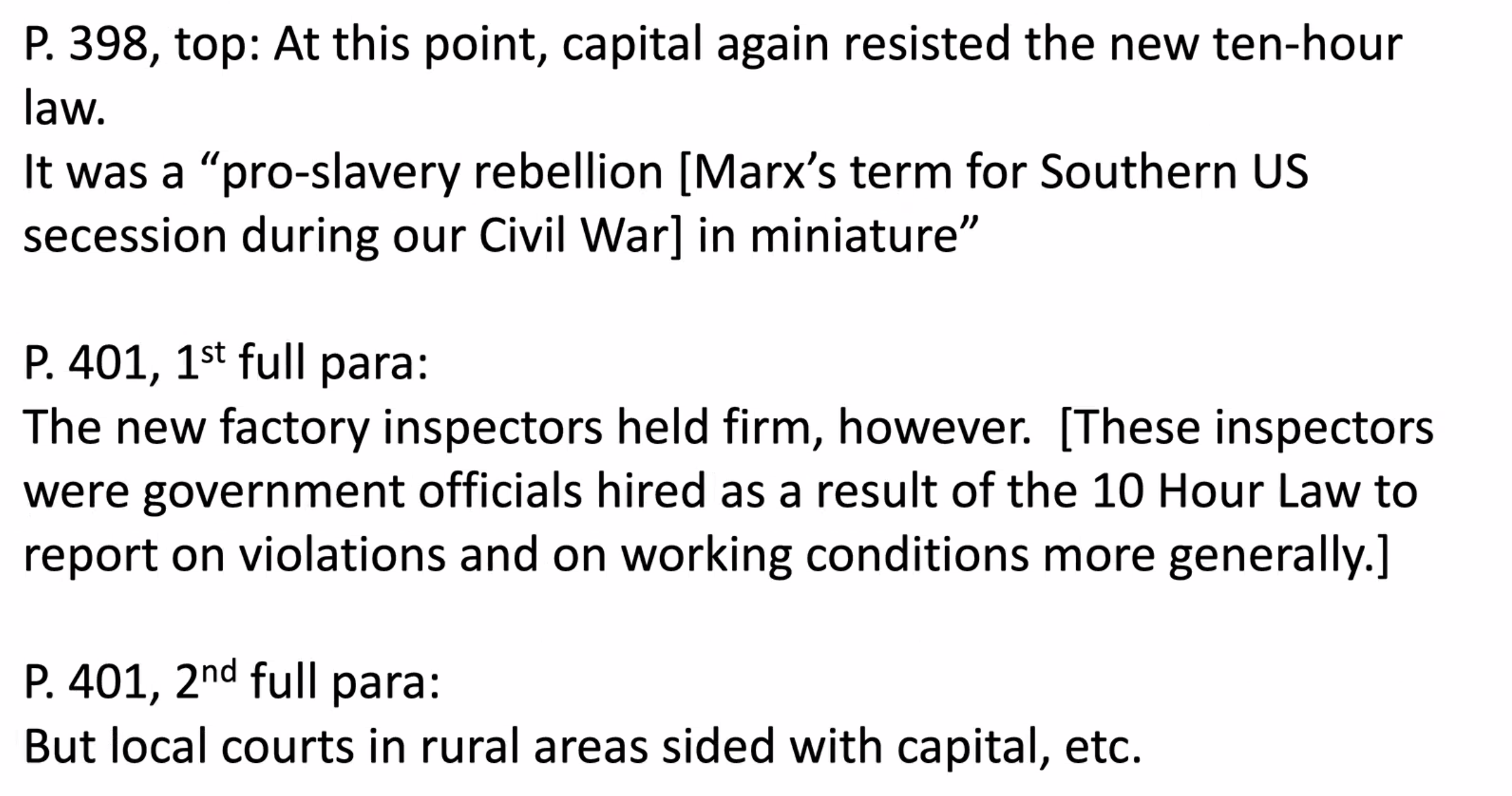
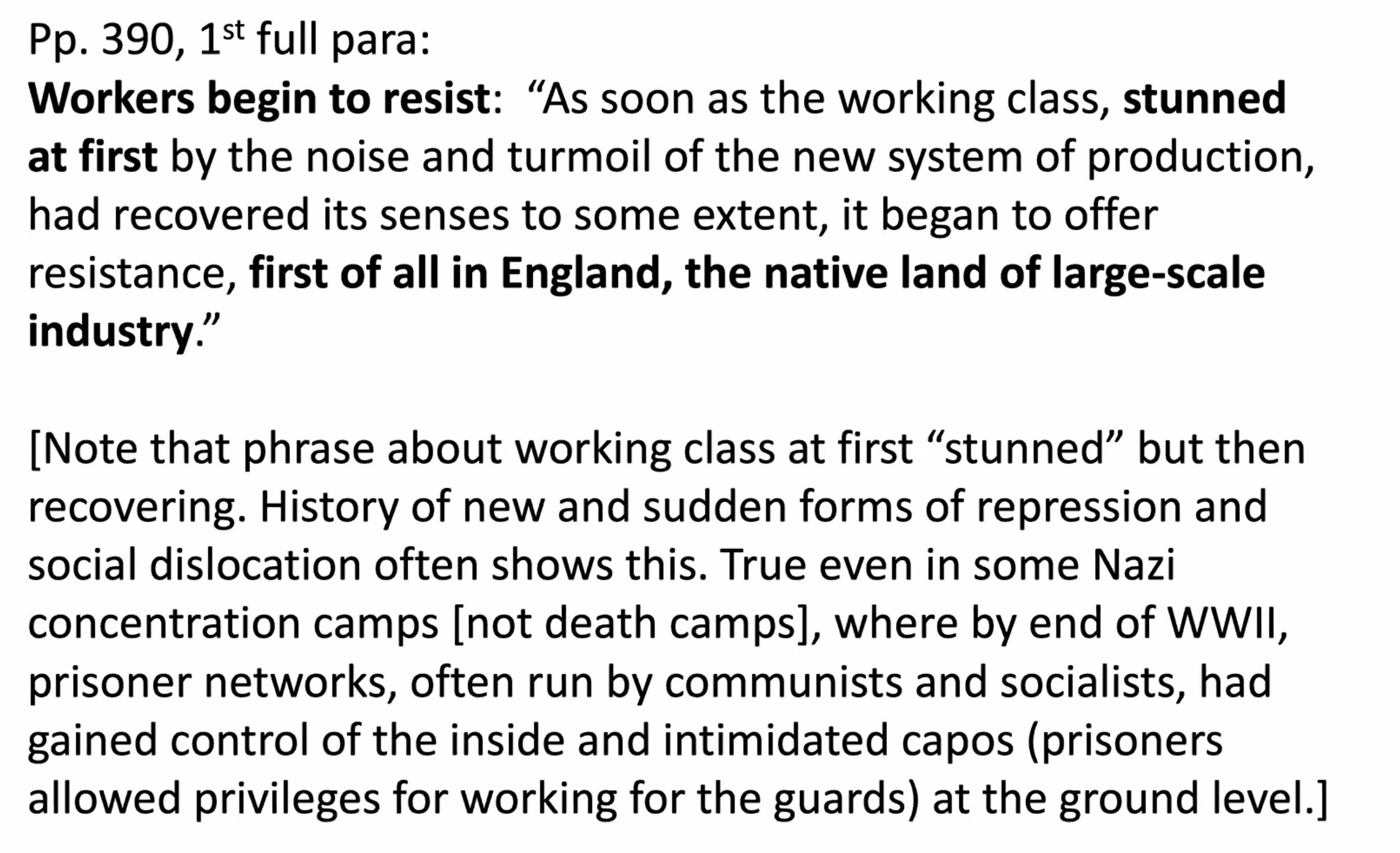
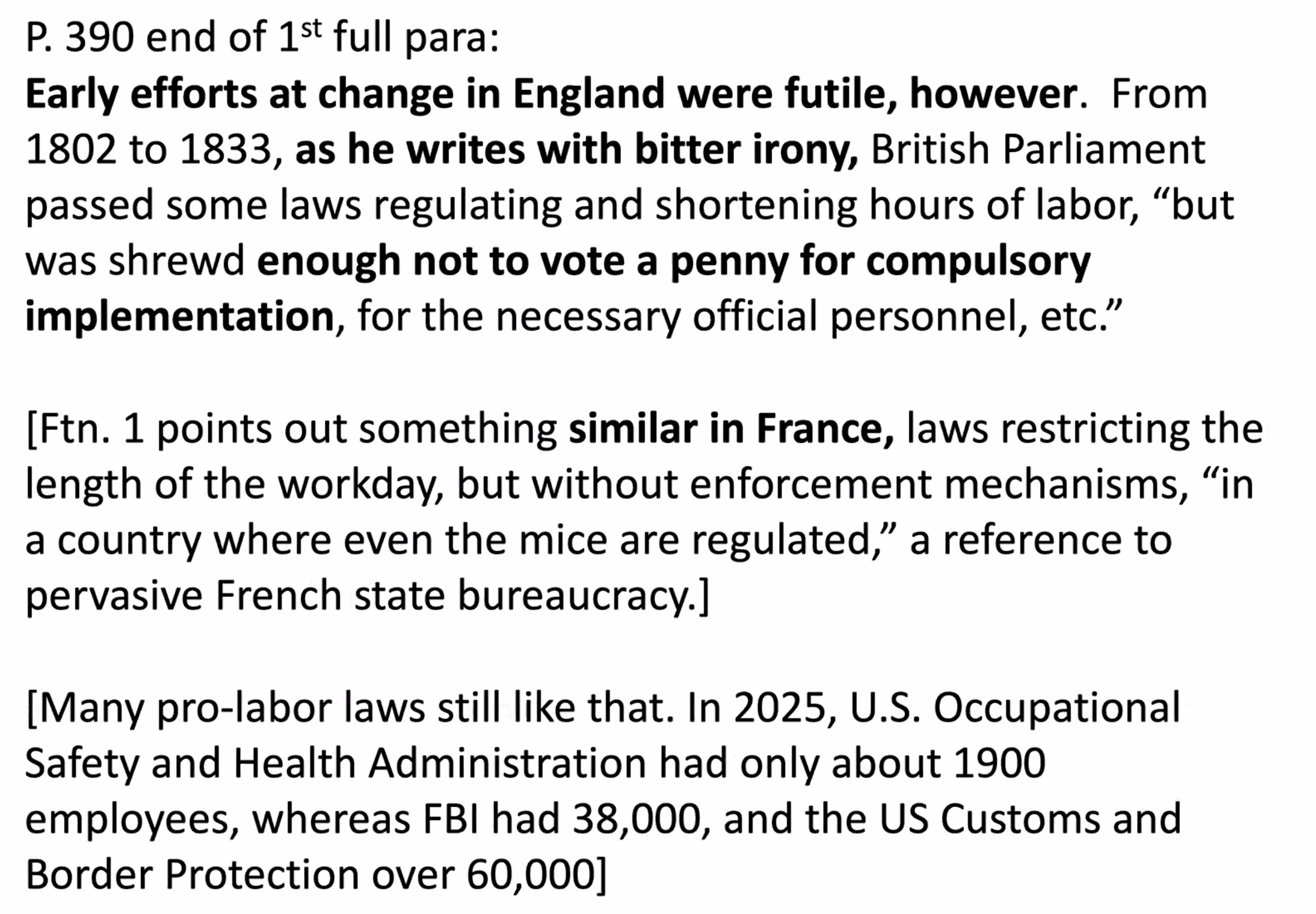
Once large-scale industry existed, the state had to restrain what it had spent centuries compelling. The Act of 1833: children 9–13 limited to eight hours, young persons 13–18 to twelve, night work banned under eighteen, and — the decisive novelty — factory inspectors to enforce it. The manufacturers answered with the relay system, shuffling children between mills so that no inspector could tell whose hours were whose. The Act of 1844 brought women under protection. Then the Ten Hours Act of 1847 — carried in part because the landed interest, smarting from the repeal of the Corn Laws, was glad to punish the manufacturers.
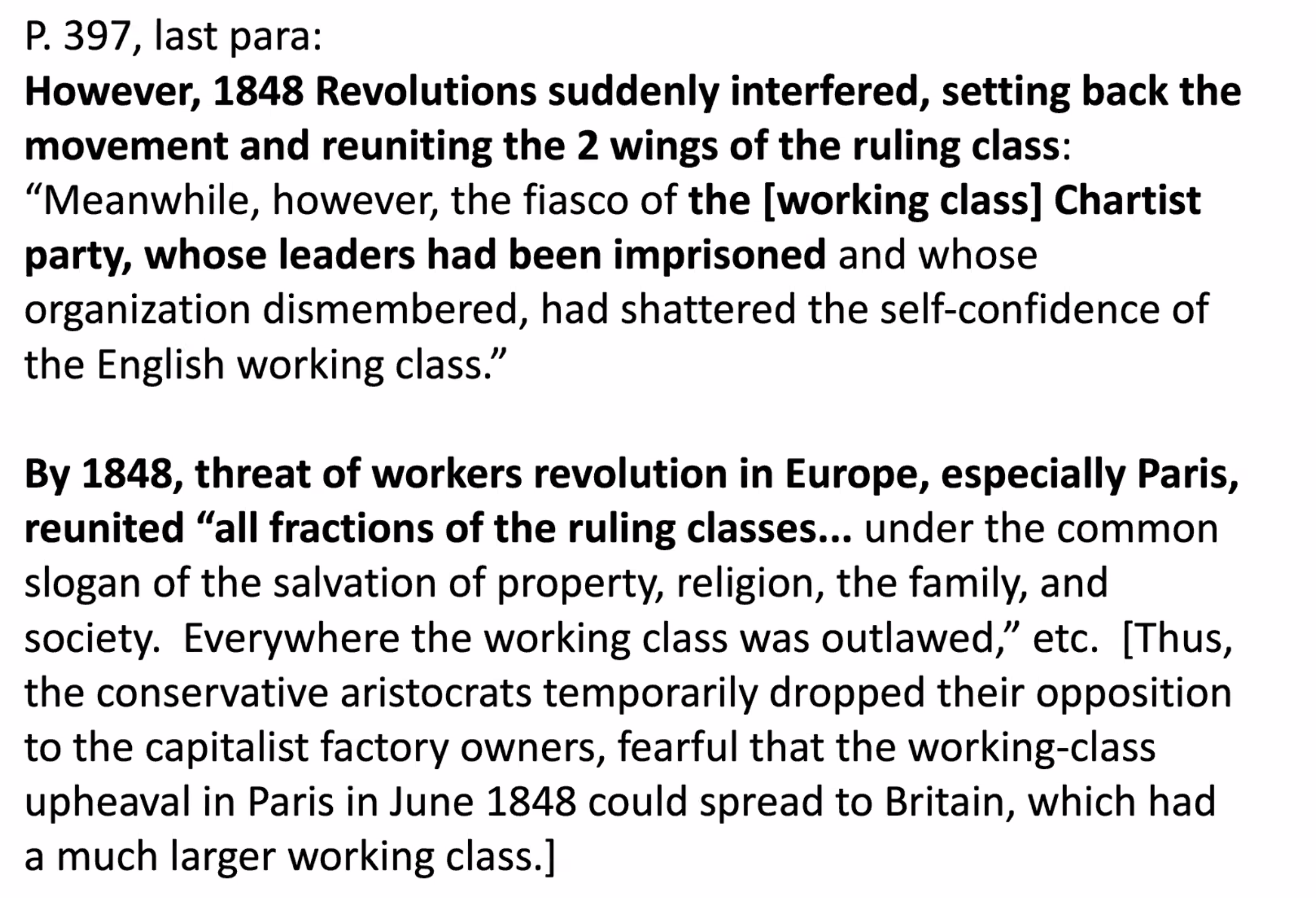
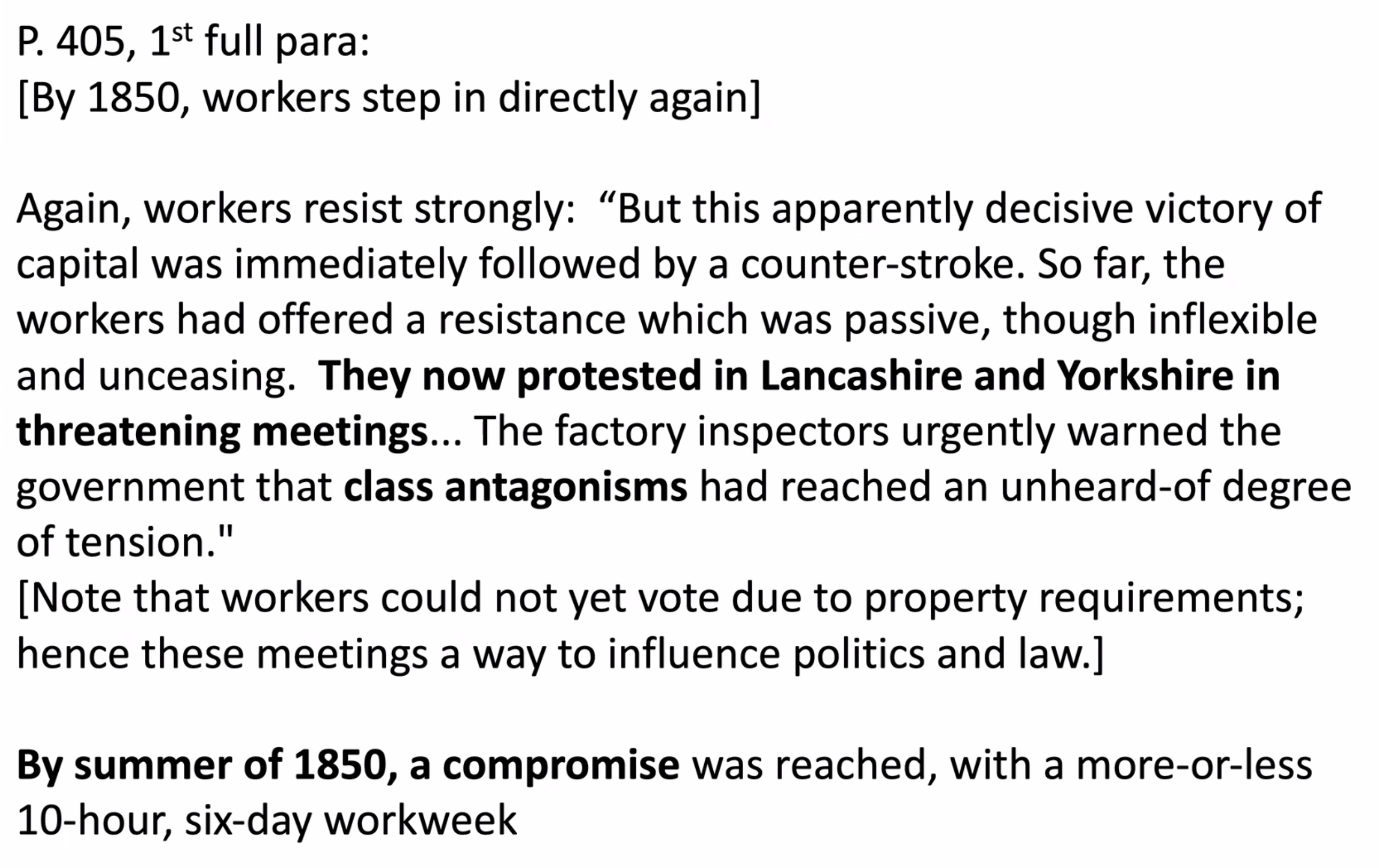
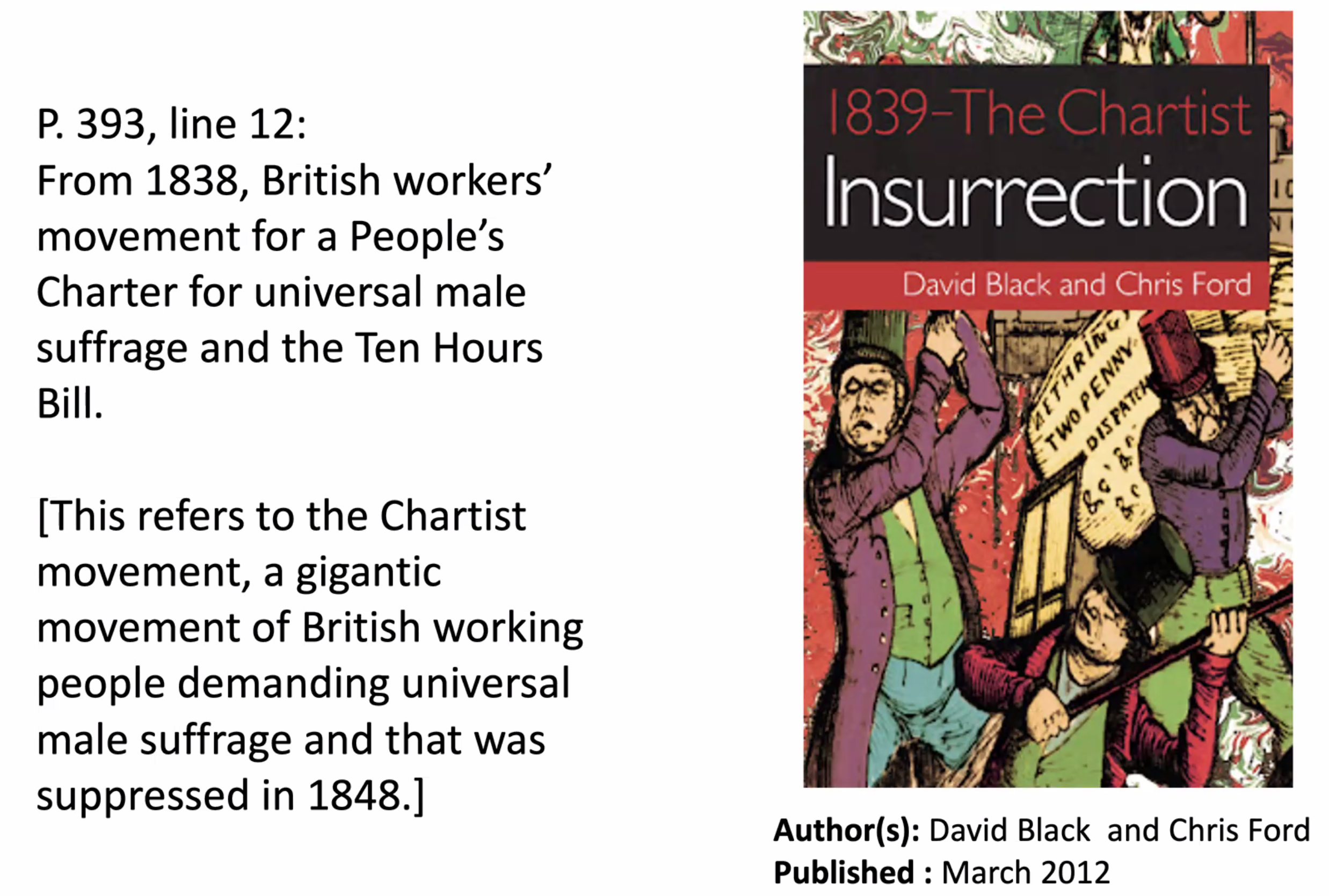
The revolt of capital, 1848–50. Wages cut by a quarter under cover of the crisis; workers coerced into petitioning against the Act they had fought for; the relay system revived in its most chaotic form to make the law unworkable; and in 1850 the Court of Exchequer ruled the Act meant nothing. The manufacturers rebelled openly, and their justices of the peace refused to enforce the law. The workers answered with Chartism and with mass meetings; the compromise of 1850 fixed the day at 10½ hours within fixed clock-limits — 6 a.m. to 6 p.m., 2 p.m. on Saturday — and finally closed the relay loophole. Extension followed: children in 1853; print-works, bleaching, dyeing, lace and bakeries in the early 1860s; potteries, matches, wallpaper in 1864.
The creation of a normal working day is therefore the product of a protracted and more or less concealed civil war between the capitalist class and the working class.
7. Impact on other countries
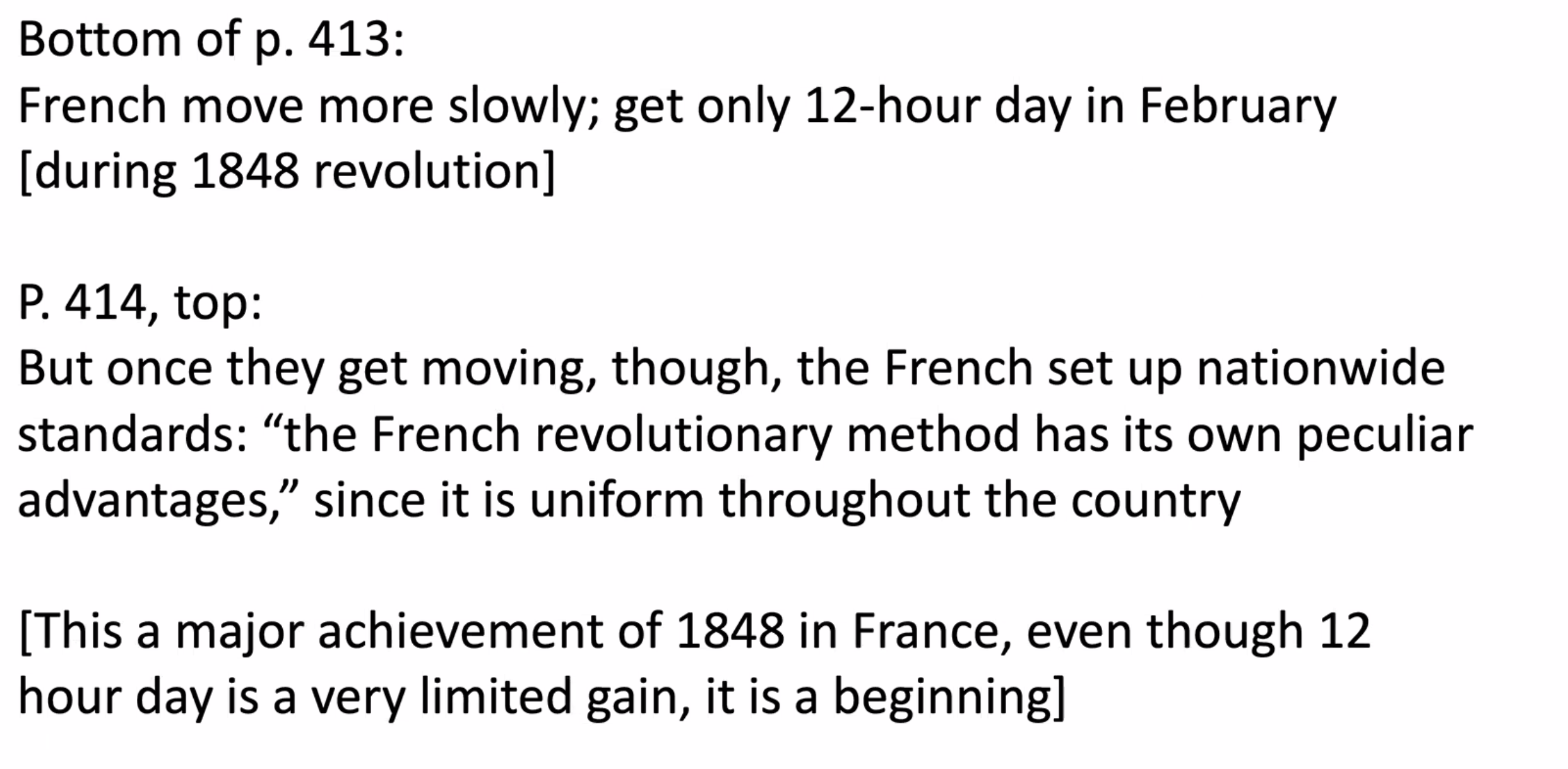
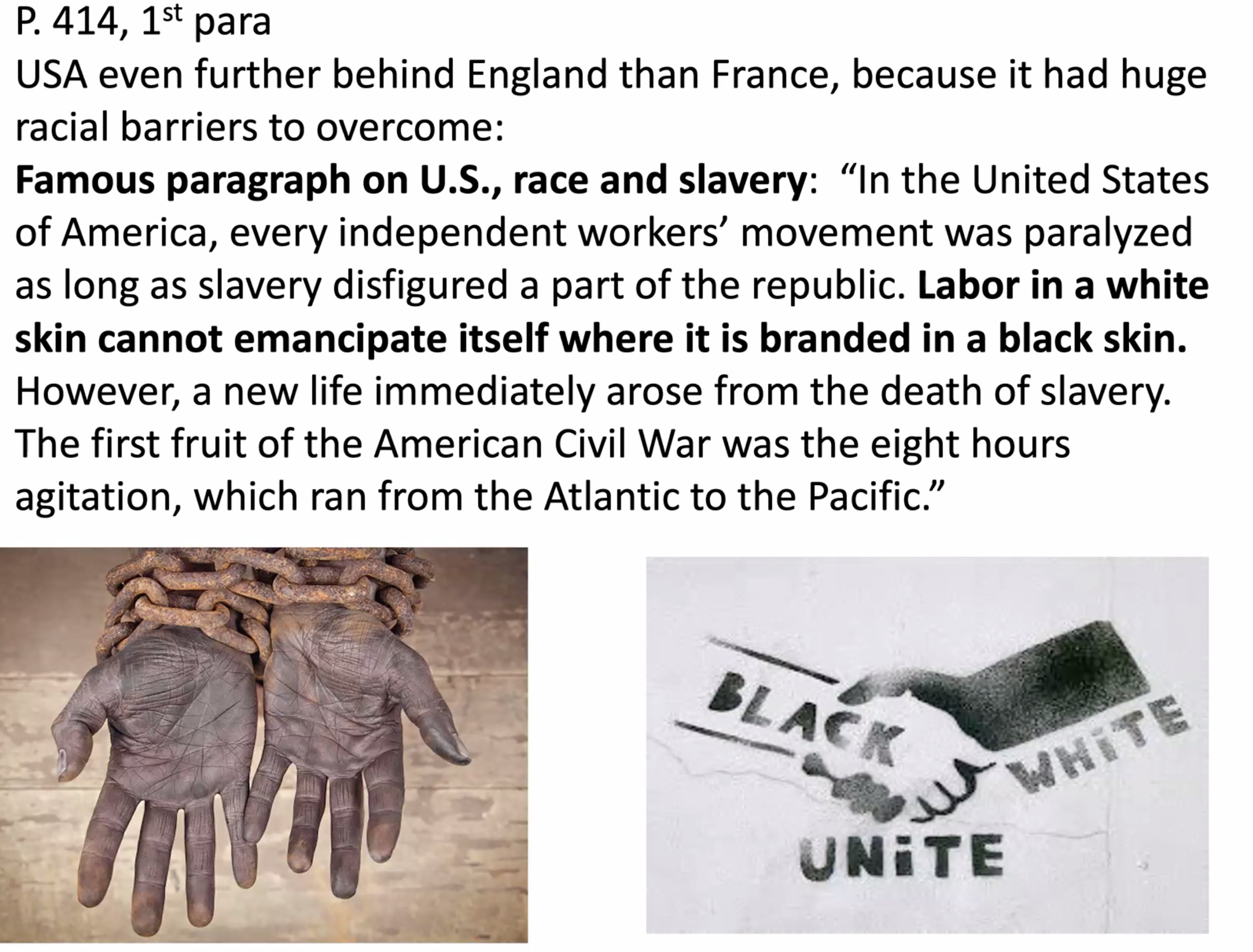
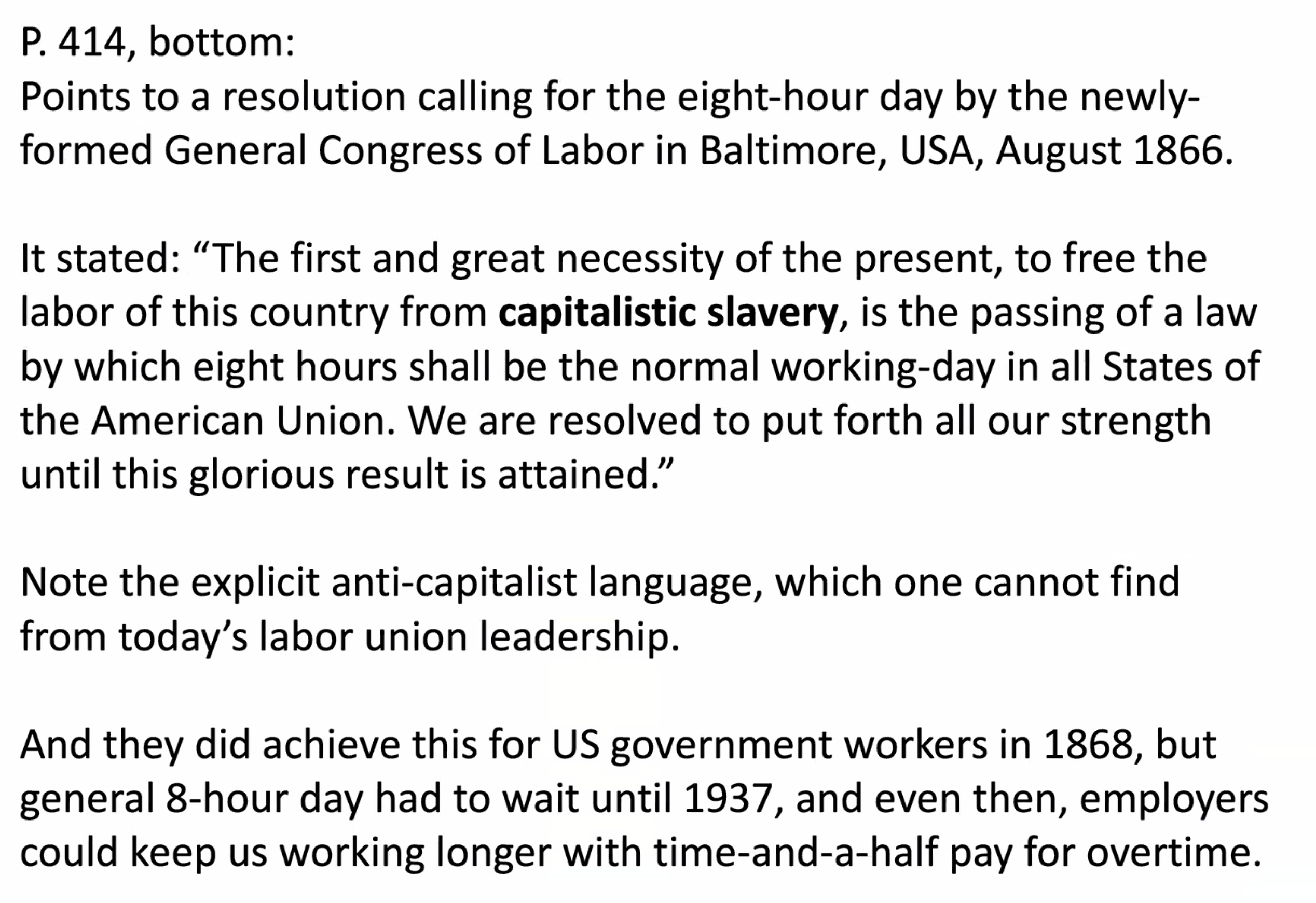
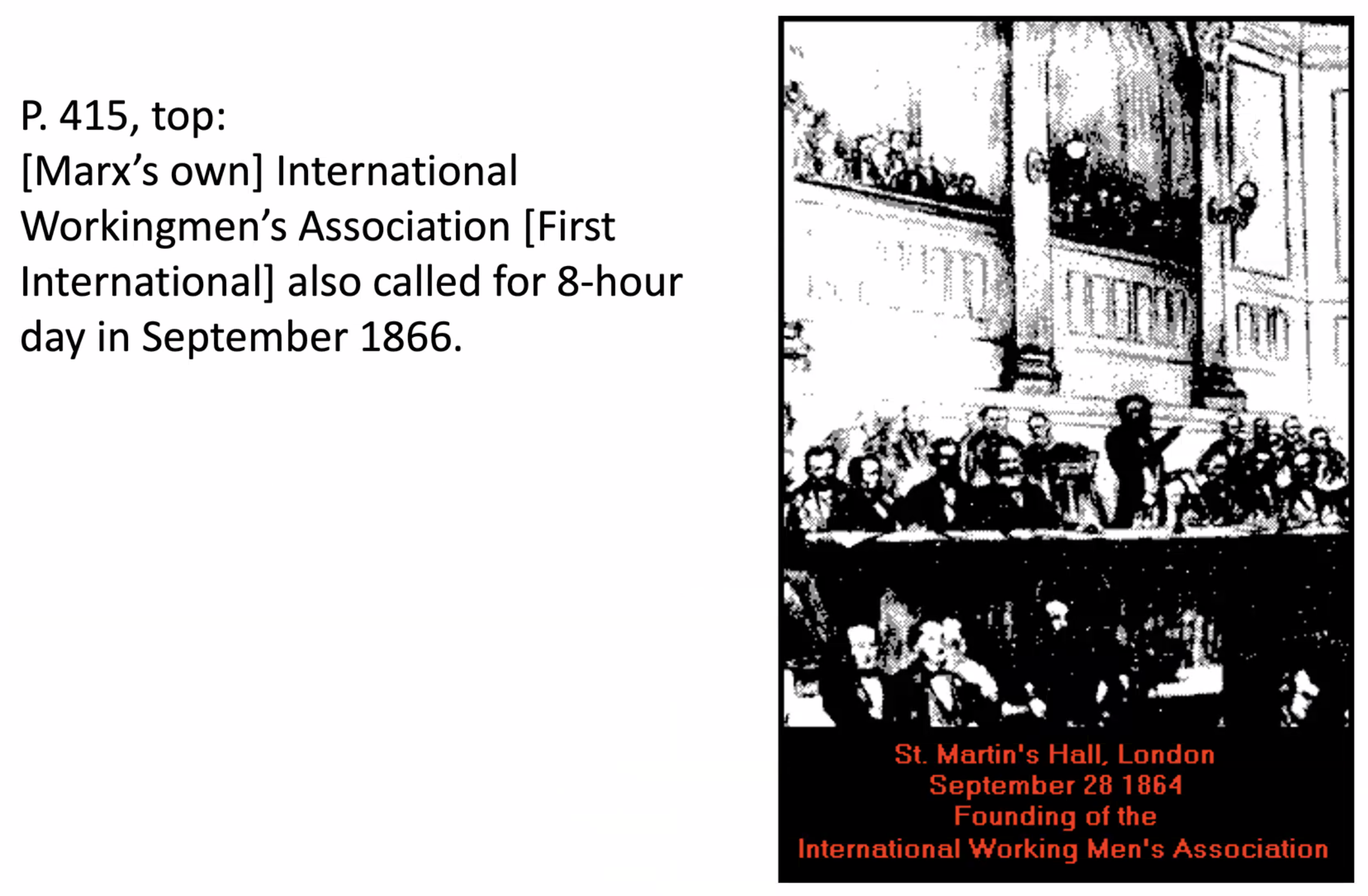
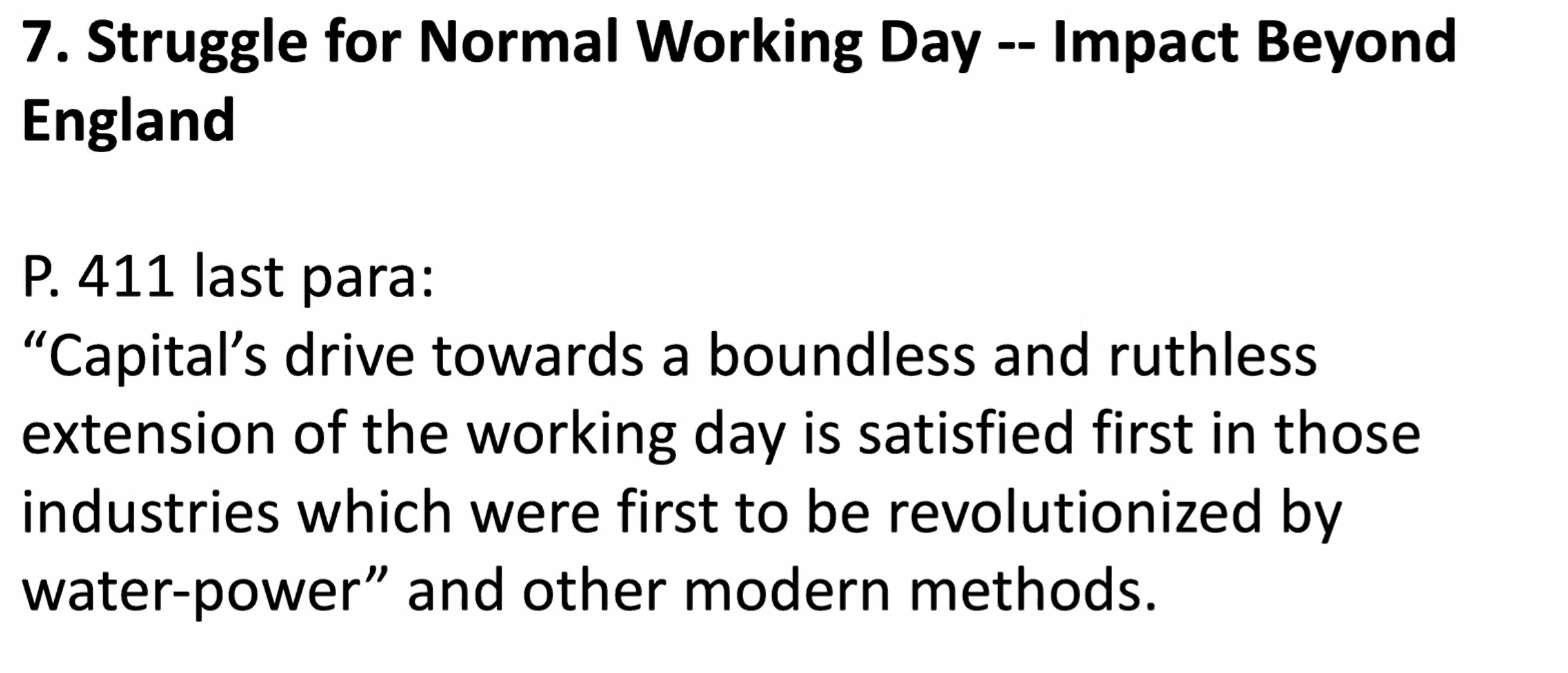
France limped behind, but the revolution of 1848 produced the French revolutionary method — a twelve-hour limit proclaimed for all workshops at once, where England had crept from industry to industry. In the United States every independent workers’ movement was paralysed while slavery stood: Labour in a white skin cannot emancipate itself where it is branded in a black skin. Out of the Civil War came the eight-hour movement — the Baltimore Congress of August 1866, and, the same month, the International’s Congress at Geneva, which made the eight-hour day the first demand of the working class of the world.
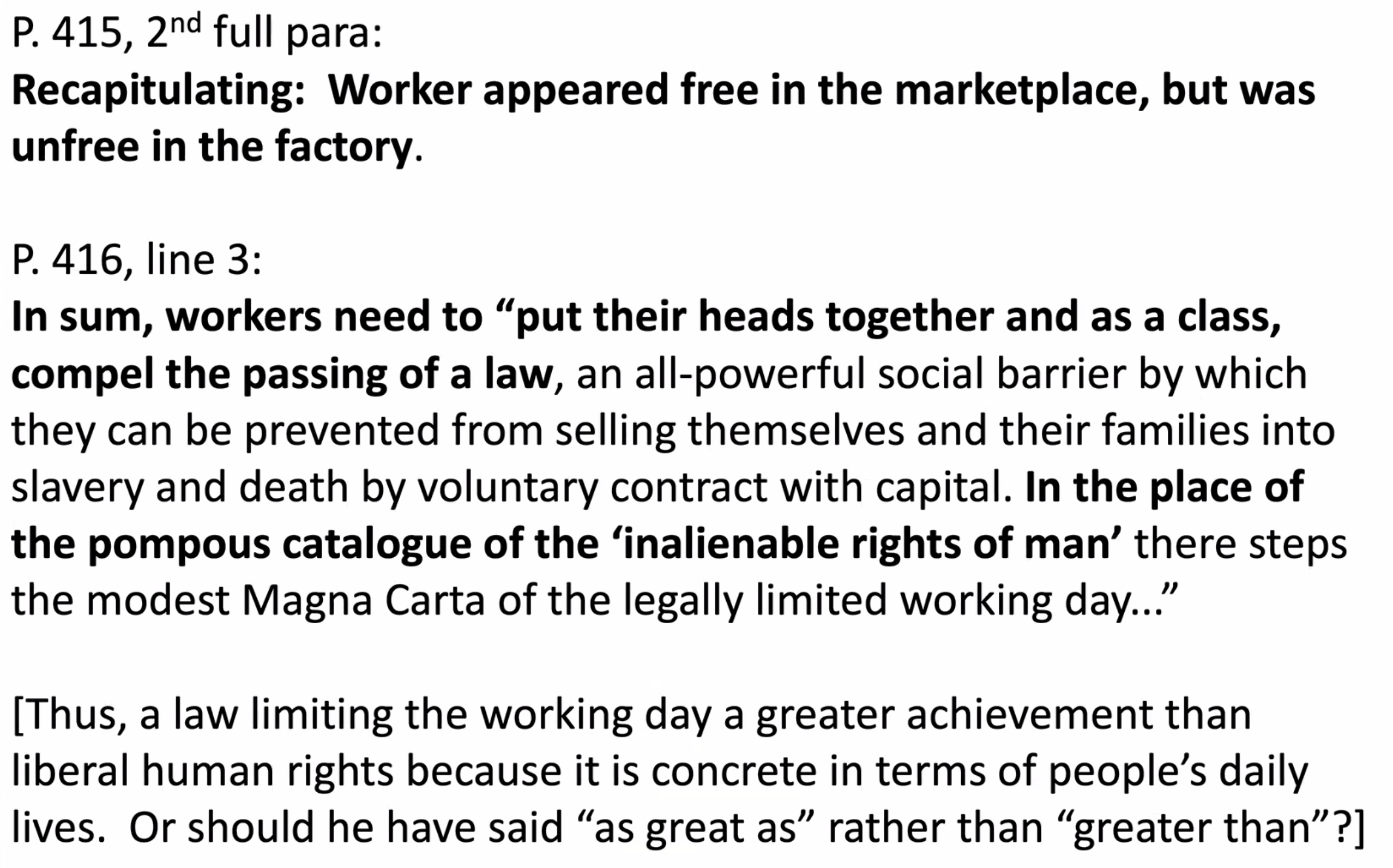
In place of the pompous catalogue of the inalienable rights of man there steps the modest Magna Carta of a legally limited working day, which at last makes clear when the time which the worker sells is ended, and when his own begins. The workers must put their heads together and, as a class, compel the passing of a law — a social barrier that prevents them from selling themselves and their families into slavery and death by voluntary contract with capital.
Timeline of the working day
1349 Statute of Labourers — max wages, min hours 1496 · 1562 statutes renewed; day fixed 5 a.m.–8 p.m. 1770 the House of Terror proposed 1802 first Factory Act (apprentices; a dead letter) 1833 children 8 h, young persons 12 h; inspectors 1844 women protected; children half-time 1847 Ten Hours Act 1848–50 revolt of capital; Court of Exchequer 1850 10½ h within 6 a.m.–6 p.m.; relays ended 1853 children’s hours aligned 1860–64 print-works, bleach, lace, bakeries, potteries, matches 1866 Baltimore Congress · Geneva Congress — eight hours 1867 Capital, vol. I
The case-file, §3
lace — children of nine, 2 a.m. to midnight potteries — a degenerated population (Dr Greenhow) matches — phosphorus necrosis of the jaw; half the hands under thirteen bakehouses — night work, twenty-hour shifts, adulterated bread railways — overwork and accidents millinery — Mary Anne Walkley, d. June 1863, 26½ hours without rest blacksmiths — dying at 31 per 1,000 against 11
All from official reports and the press, 1860–64.
Boyar and manufacturer
Wallachian corvée (Règlement organique, 1831) nominal: 12 days a year for the lord by the code’s own arithmetic of tasks: 56 days
necessary labour → peasant’s own plot surplus labour → lord’s land separate places, separate days: visible
Lancashire mill necessary labour → hours 1 to ~4 surplus labour → hours ~4 to 12 same place, same day, one wage: invisible
The bounds of the working day
0 ──── necessary ──── │ ──── surplus ──── 24
minimum — necessary labour only: impossible under capital, no surplus
physical maximum — 24 h minus sleep, meals, recovery
moral maximum — minus time for intellectual and social life; set by the level of civilisation
actual length — nothing in the theory of value fixes it. It lies between the limits, wherever force has put it.
Here absolute surplus-value stops being a ratio and becomes politics. The magnitude of s depends on the length of the day; the length of the day has no economic determination — only limits. Note the moral limit is not a moral judgement: it is a historically set standard of what a worker can be expected to give up.
Right against right. Marx refuses the moral argument. Both parties are correct under the law of exchange; nothing in the theory of value settles the day. So class struggle is not a moral complaint about bad capitalists — it is structural, built into the commodity labour-power itself. Force decides where right cannot.
The boyar’s corvée and the manufacturer’s day are the same ratio with different visibility. Under the corvée, necessary and surplus labour are separated in space and time — the peasant’s field, the lord’s field. Under the wage, they are fused in one day and hidden inside the hourly rate. Capital’s innovation is not more surplus labour but invisible surplus labour.
Method: the state’s own evidence turned against its ruling class. Marx’s sources are official — factory inspectors, the Children’s Employment Commission, Simon’s Public Health reports, coroners. The Preface: the English reports are Perseus’s magic cap turned inside out. This is what gives the chapter its force; nothing here is Marx’s opinion.
Capital’s indifference to the worker’s life is not personal cruelty. Under competition the individual capitalist cannot behave otherwise — a mill that spares its hands is undersold by one that does not. Hence the limit must come from outside every individual capital: from society, i.e. the state. Which is why the chapter is about law.
The great reversal. For four centuries the state compelled longer days on workers who had other means of living. Only once the working class was fully separated from the land and capital had matured did the state have to restrain it. The free worker of Ch.6 had to be manufactured — the theme of Part Eight.
The Factory Acts are the first conscious, systematic reaction of society against its own production process. Won by the working class — but also in the collective interest of capital, protecting the labour force from the individual capitals that would consume it. And they push capital toward Part Four: when the day can no longer be lengthened, it must be intensified and mechanised.
Marx is inside this history. He drafted the International’s 1866 Geneva resolution on the eight-hour day himself. The chapter that began with a ratio ends not with a theorem but with a demand — the only chapter in Vol. I that does.
this part is the first bit where hte working class are the subjec (an actor) rather than just the object
manchester wokrders supported the nothi in the civil war usa solidairty with slaves ? work opportunities
marx does not make an equivalence between slavery and factory conditions

Engels - not sure how much his conditions were ununsal but he donated his profits

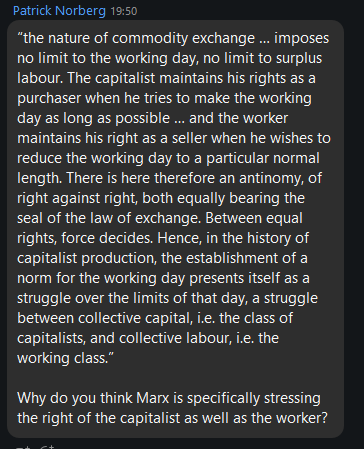

there must be some basis of exchange
to demonstrate the hypocrisy of the situation
equal situation, power imbalance negates the rights of the worker
structural problem